
Hotels in Turkey 2026: Prices by Star Rating, Best Areas and Tax
Hotels in Turkey 2026: nightly prices by star rating, what 3 to 5 stars legally require, all-inclusive resorts, cave hotels, the best areas and the 1% tax.

Hotels in Turkey numbered 8,843 licensed facilities with 1,268,237 beds in October 2026, plus 12,164 simple accommodation properties outside star classification. A mid-range room usually costs about $65 to $125 a night, from about $66 to $90 at three stars to $250 to $490 or more at five stars. The accommodation tax is 1% until 31 December 2026.
| Item | Value |
|---|---|
| Licensed hotels, October 2026 | 8,843 facilities with 1,268,237 beds |
| Simple accommodation | 12,164 facilities, outside star classification |
| Three-star room per night | About $66 to $90 |
| Four-star room per night | About $95 to $160 |
| Five-star room per night | About $250 to $490 or more |
| Accommodation tax | 1% until 31 December 2026, before VAT |
| Largest province by beds | Antalya, 529,003 |
| Minimum rooms for five stars | 60 rooms |
Hotels in Turkey range from five-room guesthouses to resorts with thousands of beds, and the star on a listing does not always mean what you think. This guide puts three things side by side: what a night costs at each star class, what the law actually requires a hotel to provide at that class, and where the licensed beds are. Official figures come from the Turkish Ministry of Culture and Tourism, the Turkish Statistical Institute, the Central Bank and the Official Gazette. Prices are market ranges, labelled as such, and were last checked on 11 November 2026.
A star on a booking site is a label. A star on a Turkish tourism operation certificate is a legal checklist.
It is also the hub our city guides branch from — Istanbul hotels and Trabzon hotels — linked again in place below.
Hotels in Turkey by the official numbers
In October 2026, 8,843 hotels and resorts in Turkey held a tourism operation certificate, with 1,268,237 beds between them. The Turkish Ministry of Culture and Tourism publishes monthly counts of accommodation holding its certificates. This is the canonical table of this article, from the October 2026 file (provisional, read on 11 November 2026):
| Certificate type | Facilities | Rooms | Beds |
|---|---|---|---|
| Tourism operation certificate | 8,843 | 602,191 | 1,268,237 |
| Tourism investment certificate | 443 | 53,123 | 118,890 |
| Simple accommodation certificate | 12,164 | 272,915 | 551,929 |
The figure that should stop you is the third: simple-accommodation properties outnumber certified tourism operations by 3,321, despite holding under half the beds. A large share of what appears in your search results for hotels in Turkey therefore belongs to a different legal category from the star-classified hotel.
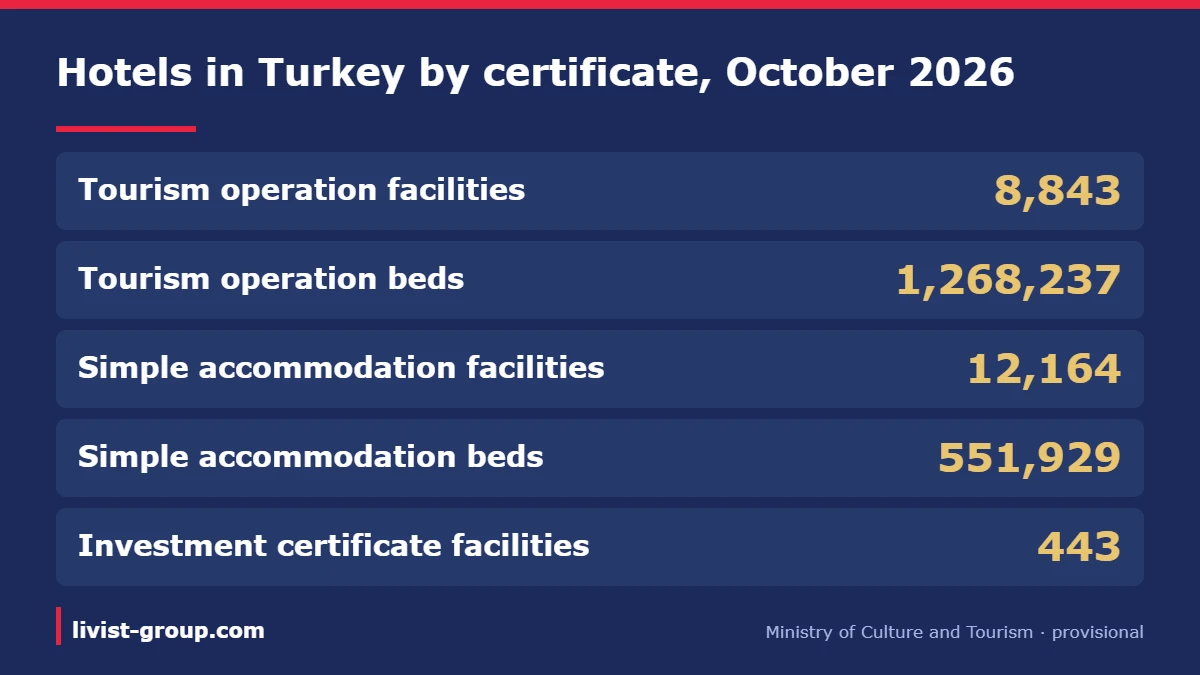
Accommodation in Türkiye by certificate type in October 2026, per the Ministry of Culture and Tourism, provisional data read on 11 November 2026.
Turkey hotel prices: how much is a night at each star class?
A hotel room in Turkey typically costs about $65 to $125 a night in the mid-range, with three-star rooms around $66 to $90, four-star around $95 to $160 and five-star from about $250 to $490 or more. These are the ranges Google's AI answer gave on 11 November 2026 for "How much does a hotel room cost in Turkey?", drawing on booking platforms and travel sites. No Turkish government body publishes room rates, so treat them as market ranges that move with city, season and the lira.
| Star class | Typical nightly range (USD) | In lira at the TCMB rate of 10 November 2026 |
|---|---|---|
| Budget beds and hostels | $10 to $30 | about ₺500 to ₺1,500 |
| Three stars | $66 to $90 | about ₺3,300 to ₺4,500 |
| Four stars | $95 to $160 | about ₺4,800 to ₺8,000 |
| Five stars | $250 to $490+ | about ₺12,500 to ₺24,600+ |
Market ranges from Google's AI answer on 11 November 2026, not an official tariff. Prices rise in July and August and vary sharply between Istanbul, the coast and inland cities. Lira figures use the US dollar buying rate of 50.1078 from the Central Bank bulletin of 10 November 2026.
The official statistics point the same way. The Turkish Statistical Institute's tourism bulletin for July to September 2026 puts the average spending of overnight visitors at $107 per night, covering everything, not only the room. It also shows accommodation spending up 19% on the same quarter a year earlier, and accommodation making up 12.5% of tourism income (TÜİK, published 30 October 2026).
Cheap hotels in Turkey: where and when prices drop
The cheapest stays in Turkey start at about £8 to £20 a night for basic rooms and hostels, and the cheapest months are January, February and November. Those were the ranges in Google's answers on 11 November 2026. Two practical rules follow. Inland and northern cities usually undercut Istanbul and the resort coast. And winter rates are low partly because many coastal resorts close for the season, so a cheap rate on the coast in January may come with fewer services open. Check the certificate type on a very cheap listing: it may be simple accommodation rather than a star-classified hotel.
Turkey hotel star ratings: what 3, 4 and 5 stars legally mean
Hotel classification in Türkiye is governed by the Regulation on the Certification and Qualities of Tourism Facilities (Presidential Decision 1134, Official Gazette of 1 June 2019, as amended). Its Article 19 sets a binding minimum for each class. This is not marketing copy; it is a condition of holding the certificate. Four- and five-star hotels must also pass the points threshold set for their class in the certification inspection.
| Class | Minimum rooms | Key additional legal requirements over the class below |
|---|---|---|
| One star | 5 rooms | Lobby with reception and waiting area · seating area serving hot and cold drinks |
| Two stars | 10 rooms | Management office · television and hairdryer in rooms · floor service office or cupboard on bedroom floors |
| Three stars | — | Breakfast room · air conditioning in public areas · at least one chair and a luggage rack in rooms · in-room safe · internet in public areas · laundry and ironing service with a bag and price list |
| Four stars | — | Restaurant(s) serving 30% of bed capacity simultaneously · baggage room with left-luggage and porter service · air conditioning in rooms and public areas, in-room internet · at least ten varieties of amenity items · dry cleaning with a price list · at least 15% of staff trained or certified · administrative staff trained or with at least five years' experience |
| Five stars | 60 rooms | Minibar · seating group in the room · television with international channels · in-room hot-drink equipment · full-length mirror · room service with a menu · bathroom telephone or cordless phone in the room · at least 30% of staff trained or certified · guest relations in a space separate from reception · staffed parking service for 10% of the room count · separate staff and goods entrance |
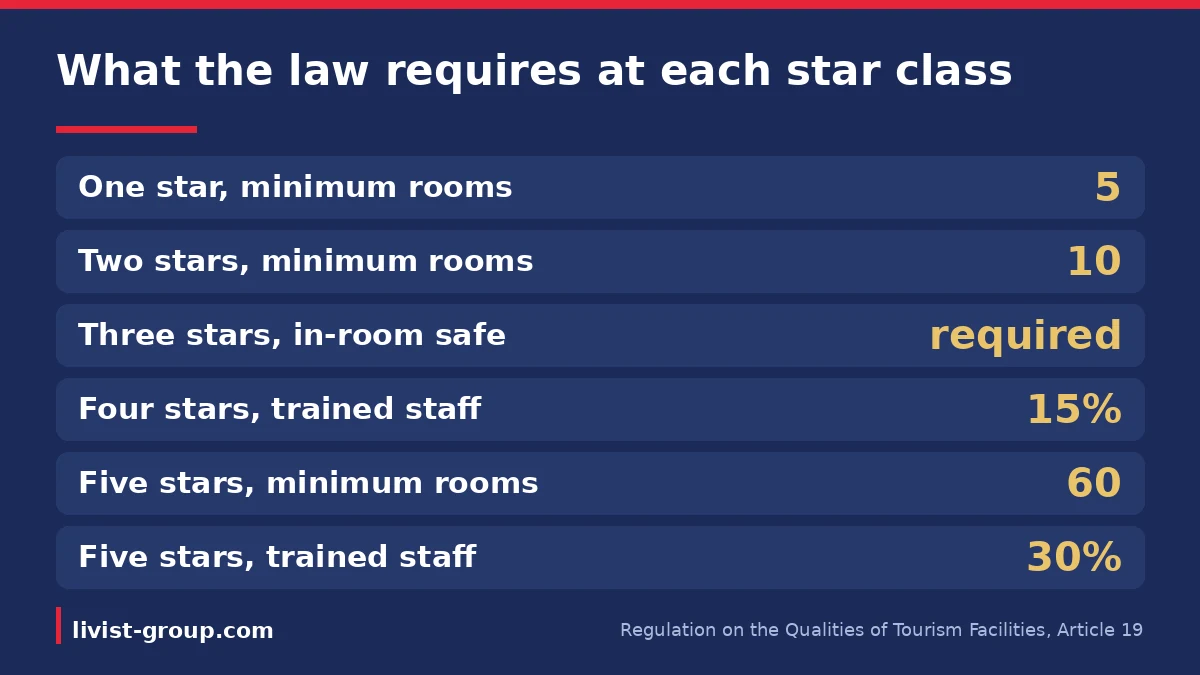
The binding minimum that Article 19 of the Regulation on the Certification and Qualities of Tourism Facilities imposes at each star class, checked against the official text on 11 November 2026.
5 star hotels in Turkey: the real difference from 4 stars
Not luxury, but specific clauses. Three matter most: size — five-star requires at least sixty rooms while the regulation sets no room minimum for four-star; trained staff ratio — it doubles from 15% to 30%; and services that simply do not exist at four-star — room service with a menu, guest relations physically separate from reception, and staffed parking.
The restaurant, by contrast, is a four-star obligation rather than a five-star one: the regulation requires a four-star hotel to have a restaurant serving 30% of bed capacity at once, and that obligation carries upward automatically because each class inherits the one below it.
What one and two stars actually mean for hotels in Turkey
Less than most people assume. A one-star hotel needs five rooms, a lobby and a seating area. A two-star hotel needs ten rooms plus a management office, a television and a hairdryer. Neither is required by law to have air conditioning in the rooms, an in-room safe, or in-room internet.
Three-star hotels: where the safe and the internet begin
Three stars is the first class at which the law requires an in-room safe for valuables, air conditioning in public areas, internet in public areas, a breakfast room and a laundry service with a published price list. In practice it is the floor you should not go below if you are carrying work equipment or travelling with children.
Operation certificate versus simple accommodation for hotels in Turkey
This is the single most important point in the guide. The Turkish state sorts accommodation into three boxes:
- Tourism operation certificate — governed by the regulation above and star-classified. 8,843 facilities in October 2026.
- Tourism investment certificate — under construction or fitting out, not yet operating. 443 facilities.
- Simple accommodation certificate — a separate lighter category outside star classification. 12,164 facilities.
Practically, a booking platform may show you a "hotel" in the third box, in which case the stars displayed beside it are a commercial descriptor rather than a state classification. The only way to be sure is to ask about the certificate type, not the star count.
Best hotels in Turkey: how to choose without a ranking
No Turkish government body publishes a "best hotels" list. The state publishes exactly one thing: classification — which star class a property belongs to, and what the law obliges it to provide at that class. Any other ranking you see is commercial, built on commissions or user ratings, not on a statutory standard.
So you will not find a list of hotel names here. You will find a method that works for any shortlist:
- Check the certificate. Tourism operation certificate, not simple accommodation, if stars matter to you.
- Match the class to what you need. A safe and internet start at three stars; a restaurant at four; room service and guest relations at five.
- Match the province to the trip. Resorts in Antalya and on the Muğla coast, city hotels in Istanbul, cave hotels in Cappadocia (see the map below).
- Read recent reviews for the season you are travelling in. A summer resort and the same resort in November are different products.
- Confirm what the price includes: board basis, accommodation tax and VAT.
Turkey all inclusive: resorts and what a week costs
All-inclusive is concentrated where the big resorts are: Antalya, with 529,003 licensed beds in 1,275 properties in October 2026, and the Muğla coast, with 130,423. Antalya averages about 415 beds per licensed property, against about 128 in Istanbul, which is the resort format in numbers. That is why most all-inclusive hotels in Turkey and most of the country's large resorts sit along the Antalya coast (Lara, Belek, Side, Alanya, Kemer) and in Bodrum, Marmaris and around Fethiye.
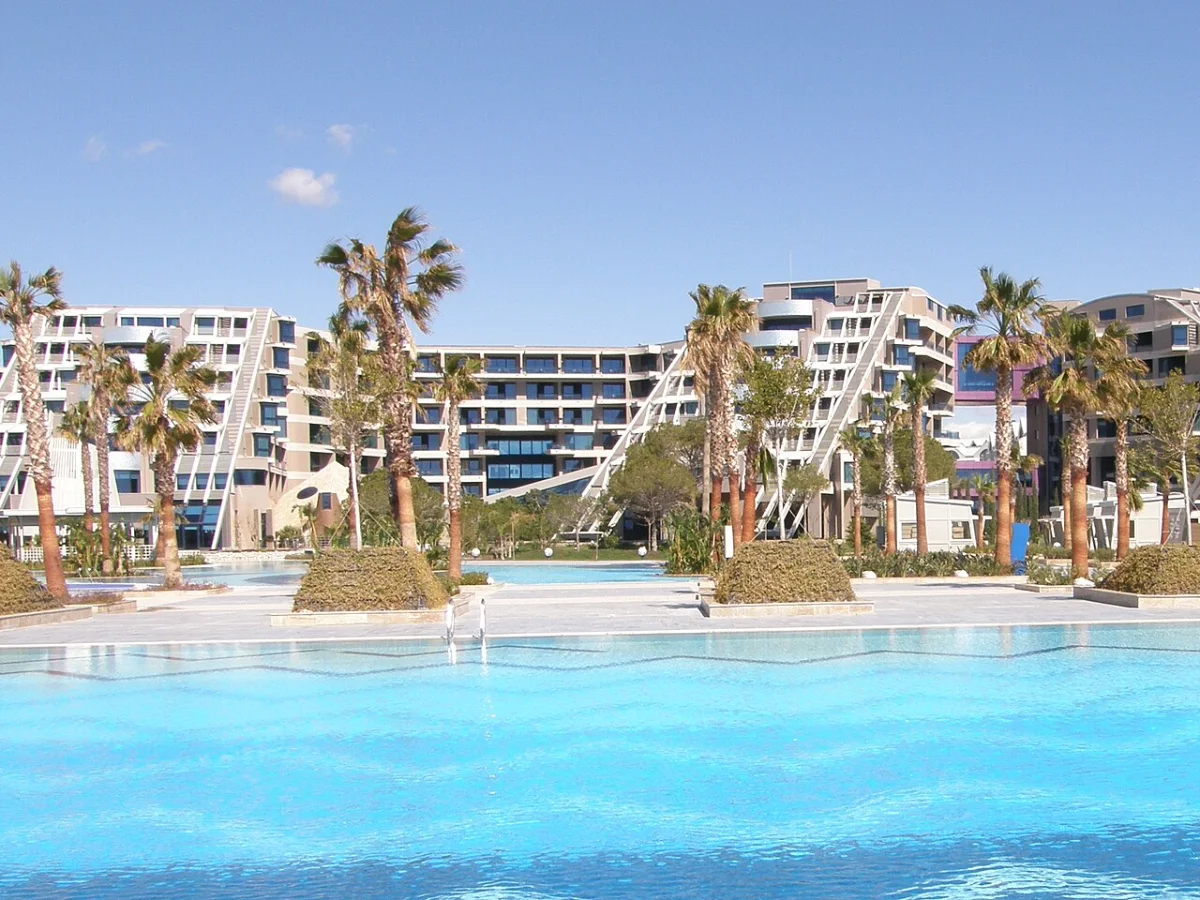
A resort hotel in Lara, Antalya. Photo: Abdullah Kıyga, CC BY 3.0, via Wikimedia Commons, resized.
How much is a week all-inclusive in Turkey? Google's answer on 11 November 2026 put a one-week package from the UK, flights and hotel, at about £250 to £600 per person, plus £150 to £300 of spending money. The same answer gave about £180 to £300 off-peak and £700 to £1,500 or more for luxury or peak summer. These are package-market ranges, not hotel rates, and they move with school holidays.
Is it worth going all-inclusive in Turkey? It suits a beach holiday where you stay mostly at the resort, especially with children, because the daily cost is fixed. It suits less well if you plan to explore towns, eat out and move between places, because you pay for meals you do not use.
Family hotels and adults-only hotels in Turkey
Turkey's family hotels and its adults-only hotels are mostly the same resort format seen from two sides. Family resorts cluster in Antalya and on the Muğla coast, where large properties have the space for kids' clubs, shallow pools and family rooms. Adults-only hotels set their own minimum age, usually 16 or 18, and are found in the same regions, plus boutique properties in Cappadocia and Bodrum. Neither label is a separate legal class: the certificate and the star class still tell you what the hotel must provide. For planning with children, see our family travel guide to Turkey.
Cappadocia cave hotels
Cappadocia's cave hotels are mostly in Nevşehir province, which had 414 licensed hotels with only 19,360 beds in October 2026, against 529,003 in Antalya. Rooms are carved into, or built against, the soft volcanic rock of Göreme, Uçhisar, Ürgüp and the surrounding valleys. That small capacity is the practical point: availability in Cappadocia tightens fastest in peak season, so book earlier than you would on the coast.
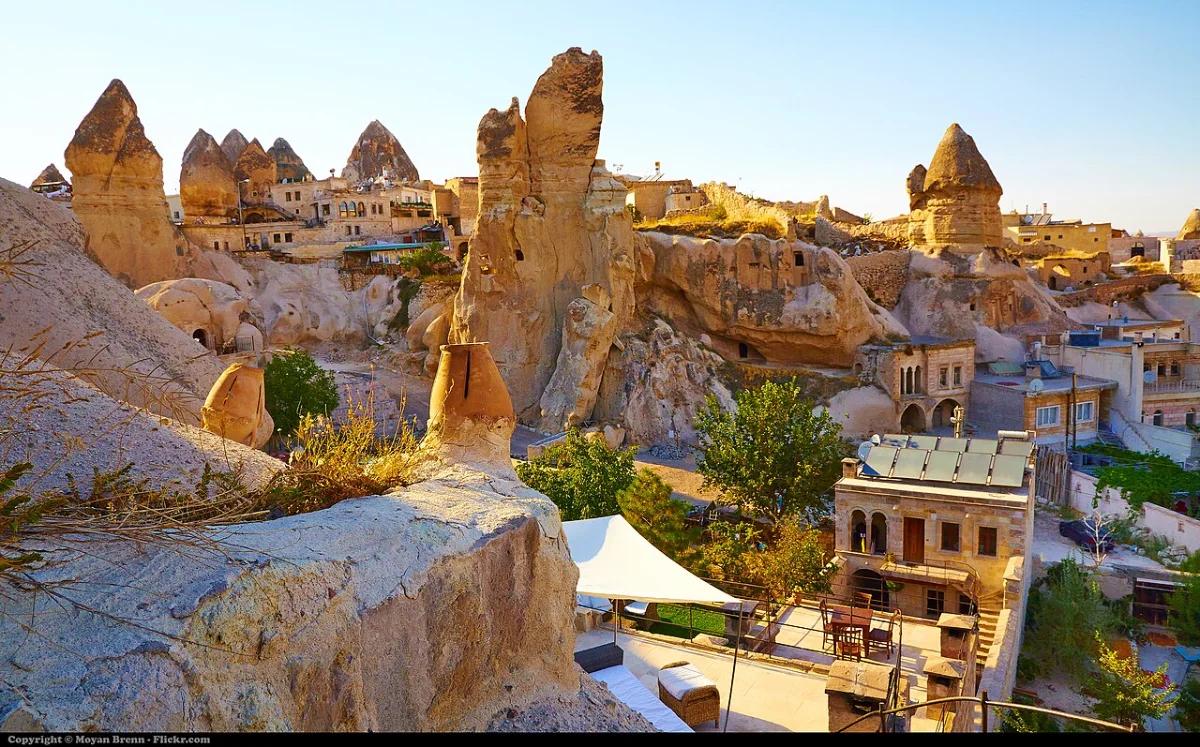
Göreme, the centre of Cappadocia's cave accommodation. Photo: Moyan Brenn, CC BY 2.0, via Wikimedia Commons, resized.
Is it worth staying in a cave hotel in Cappadocia? For most visitors yes, for the setting, the cool rooms in summer and the rooftop views at balloon time. Ask before booking about ventilation and natural light, since rock rooms can feel damp or dark, and about stairs and uneven floors if anyone in your group has limited mobility. Sights and routes are in our Cappadocia guide.
Where to stay in Turkey: the map of hotels by province
From the ministry's October 2026 file, leading provinces by tourism operation certificate:
| Province | Facilities | Rooms | Beds |
|---|---|---|---|
| Antalya | 1,275 | 244,817 | 529,003 |
| Istanbul | 1,365 | 85,901 | 174,191 |
| Muğla (Bodrum, Marmaris, Fethiye) | 884 | 60,640 | 130,423 |
| İzmir | 705 | 25,646 | 52,162 |
| Aydın (Kuşadası, Didim) | 160 | 18,277 | 39,043 |
| Ankara | 210 | 15,585 | 31,432 |
| Trabzon | 294 | 8,936 | 19,622 |
| Nevşehir (Cappadocia) | 414 | 9,340 | 19,360 |
| Bursa | 166 | 8,050 | 16,674 |
The paradox in this table is that Istanbul leads Antalya on facility count and trails it heavily on beds: 1,365 properties against 1,275, but 174,191 beds against 529,003. Istanbul's properties are comparatively small city hotels; Antalya's are large resorts. Average beds per property exceeds four hundred in Antalya and does not reach one hundred and thirty in Istanbul.
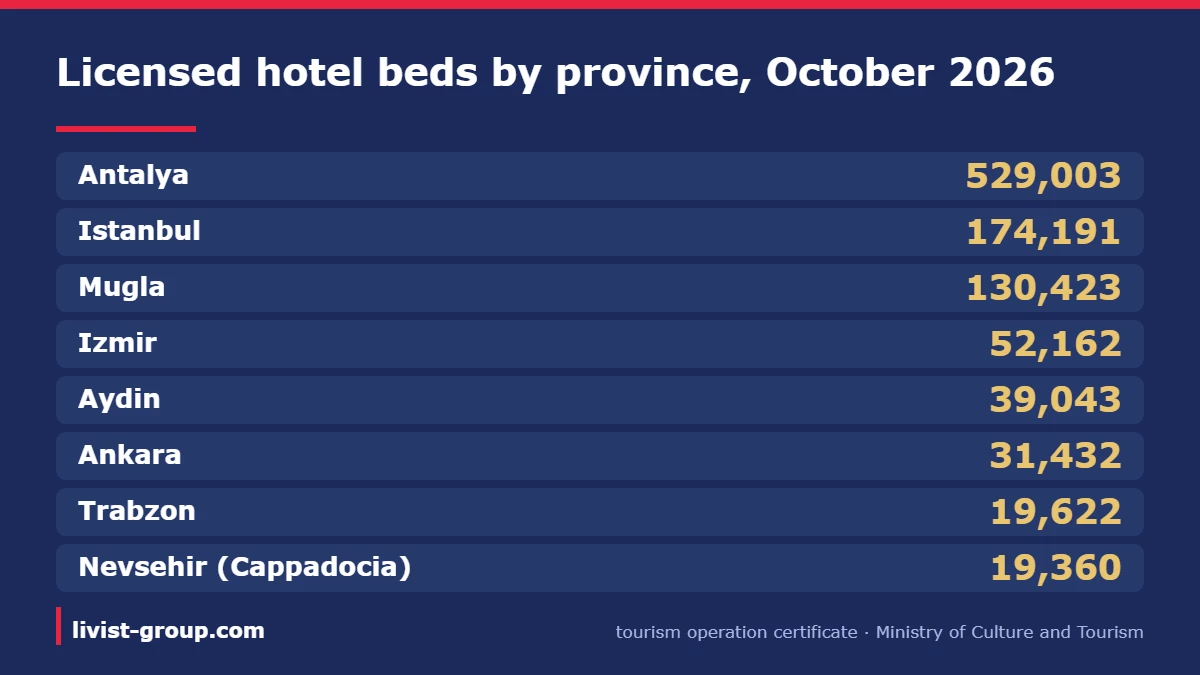
Beds holding a tourism operation certificate across the leading Turkish provinces in October 2026, per the Ministry of Culture and Tourism, provisional data.
What is the best area in Turkey to stay?
The question is a matter of taste, but the table above turns it into a decision. The widest accommodation choice is Antalya; the densest urban choice is Istanbul; the Turquoise Coast in Muğla sits between them; Cappadocia is the small, distinctive inland option. For destinations beyond the standard circuit see Turkish cities beyond Istanbul and the best time to visit Türkiye.
Should I go to Antalya or Istanbul?
Answer it by what each province physically holds. Antalya offers 529,003 licensed beds across 1,275 properties, overwhelmingly resort format, which is why all-inclusive dominates there. Istanbul offers 174,191 beds across 1,365 properties, overwhelmingly city format, where neighbourhood choice matters more than class because distances inside the city are long. If your trip is a beach holiday, Antalya. If it is a city trip with day excursions, Istanbul. See our Antalya guide and Istanbul travel guide.
Is Antalya or Bodrum better?
For choice and all-inclusive resorts, Antalya: its 529,003 licensed beds are about four times the 130,423 of all Muğla province, which contains Bodrum, Marmaris and Fethiye together. For a smaller, more design-led coast with marinas and boutique hotels, Bodrum. Both have their own airports. Details are in our Bodrum travel guide and Fethiye guide.
Istanbul within the map of hotels in Turkey
Istanbul is second by licensed beds (174,191) and first by facility count (1,365). Choosing the neighbourhood matters more than choosing the class, because crossing the city takes time. Full detail in our Istanbul hotels guide, and for airport routing see Istanbul airport transfer.
Trabzon and the north within the map of hotels in Turkey
Trabzon holds 294 certified properties and 19,622 beds, and is the gateway to the Black Sea region, including the lake village of Uzungöl. Detail in our Trabzon hotels guide, and for sights see Trabzon attractions.
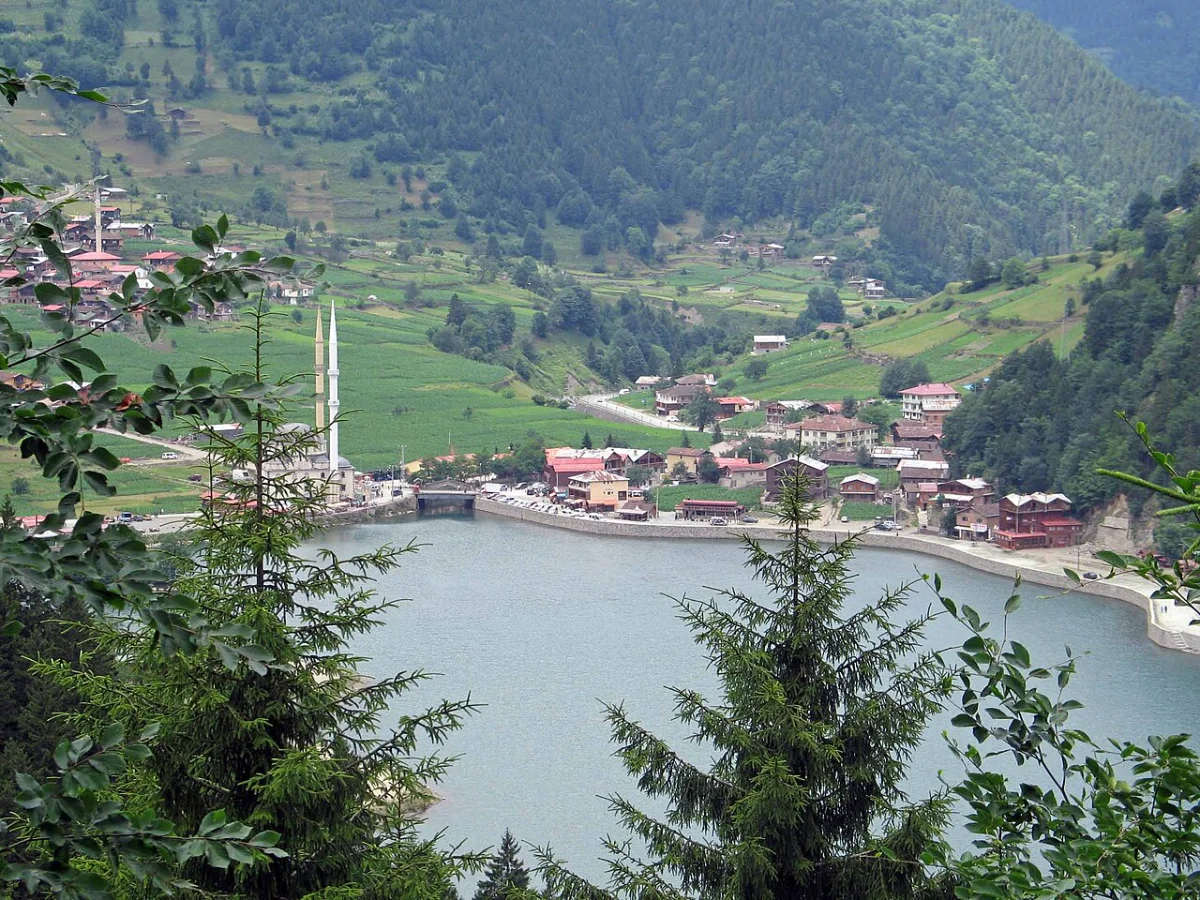
Uzungöl in Trabzon province. Photo: Aleksasfi, public domain, via Wikimedia Commons, resized.
What are the 3 best cities to visit in Turkey?
By licensed capacity rather than opinion, the three that carry the most visitors are Istanbul, Antalya and the Muğla coast, followed by İzmir, Aydın and Cappadocia in Nevşehir. Cappadocia is the outlier worth noting: only 19,360 beds, a fraction of Antalya's, which is why availability there tightens fastest in peak season.
Turkey tourist tax: the accommodation tax in 2026
The accommodation tax in Turkey is 1% of the room charge until 31 December 2026. The rate written in Article 34 of Expenditure Taxes Law No. 6802 is 2%. Presidential Decision No. 11263, published in the Official Gazette on 1 May 2026 and in force from that day, applies it at 1% until 31 December 2026, that date included (Official Gazette No. 33240, read on 11 November 2026). The decision says nothing about the rate from 1 January 2027, so check the Official Gazette for stays next year.
Four practical points:
- Who pays it? The statutory taxpayer is the service provider, meaning the facility, not the guest. It normally appears folded into the bill.
- On what base? On the consideration paid for the overnight service, excluding VAT. On a room charge of ₺5,000 before VAT, 1% is ₺50.
- On which properties? The law names hotels, motels, holiday villages, pensions, apart-hotels, guesthouses, campsites, mountain houses and highland houses — so simple accommodation is inside the scope too.
- Two exemptions: student accommodation, and services provided to diplomatic missions and international organisations holding immunity.
Some cities in other countries charge a fixed nightly tourist tax at check-in. Turkey's accommodation tax is a percentage built into the price, so you will not normally pay it separately.
Is Turkey very expensive?
Turkey is no longer a rock-bottom destination, because prices in lira rise fast, but it is still mid-priced for most visitors paying in foreign currency. Three official figures govern what you actually pay.
First, inflation. Türkiye's annual consumer price inflation was 29.77% in October 2026, and the restaurants and accommodation group rose 28.42% year on year (Turkish Statistical Institute, published 3 November 2026). A nightly rate published twelve months ago would need to rise by more than a quarter just to keep pace.
Second, the 1% accommodation tax, detailed above.
Third, the exchange rate, because the bill is in lira and you pay in something else:
| Currency | Turkish lira · bulletin of 10 November 2026 |
|---|---|
| US dollar | 50.1078 |
| Euro | 56.2781 |
| British pound | 67.2269 |
| Saudi riyal | 13.3495 |
| Qatari riyal | 13.6699 |
| UAE dirham | 13.5669 |
| Kuwaiti dinar | 161.7757 |
Buying rates from the Central Bank of the Republic of Türkiye, announced at 15:30 on 10 November 2026 (bulletin 2026/211).
How much does 7 days in Turkey cost?
About $350 to $910 per person for a budget to mid-range week, excluding international flights, according to Google's answer on 11 November 2026; luxury trips start around $2,450. The spread comes from three choices: accommodation class, province and season. Use the nightly table above for the room, add the 1% tax, and check prices against the current exchange rate. For a breakdown of cost components see the cost of travel in Türkiye.
Anyone moving to live rather than visit faces a different budget entirely, built on the statutory minimum wage and inflation, as set out in the cost of living in Turkiye.
Common mistakes when booking hotels in Turkey
- Reading stars as always meaning a state classification — 12,164 simple-accommodation properties sit outside star classification.
- Assuming five stars always means large — the law sets sixty rooms as a floor, not a ceiling.
- Expecting a restaurant in a three-star hotel — the restaurant obligation begins at four stars.
- Trusting prices published a year ago — restaurants and accommodation rose 28.42% in the year to October 2026.
- Booking a coastal resort for winter without checking it is open — many close outside the season.
- Not asking whether the displayed rate includes accommodation tax and VAT.
Book your hotels in Turkey with Livist Group
In summary, hotels in Turkey are chosen on three criteria rather than a platform's ordering: certificate type, star class and what the regulation obliges at that class, and location inside a province whose real bed capacity you know. Then check the price against current ranges and the 1% accommodation tax. Livist Group arranges stays on exactly that basis and ties them to your route and transfers.
Plan your hotels, route and transfers in Turkey with Livist TravelFor the top tier, we list nightly rates at the most luxurious hotels in Istanbul, Antalya and Bodrum in our guide to luxury travel in Turkey.
Sources
- Turkish Ministry of Culture and Tourism — certified accommodation facility statistics, October 2026 (provisional). Read 11 November 2026.
- Regulation on the Certification and Qualities of Tourism Facilities (Presidential Decision 1134, Official Gazette 1 June 2019, No. 30791, as amended), Article 19 — hotel classification from one to five stars. Official text on mevzuat.gov.tr. Read 11 November 2026.
- Presidential Decision No. 11263 on the accommodation tax rate, Official Gazette 1 May 2026, No. 33240. Read 11 November 2026.
- Turkish Expenditure Taxes Law No. 6802, Article 34 — accommodation tax. Read live 20 September 2026.
- Turkish Statistical Institute (TÜİK) — Consumer Price Index bulletin, October 2026, published 3 November 2026. Read 11 November 2026.
- Turkish Statistical Institute (TÜİK) — Tourism Statistics, Q3 (July to September) 2026, published 30 October 2026. Read 11 November 2026.
- Central Bank of the Republic of Türkiye — indicative exchange rate bulletin 2026/211, 10 November 2026, 15:30. Read 11 November 2026.
- Market price ranges — Google search answers in the UK on 11 November 2026, for nightly room rates, budget stays, cheapest months, seven-day budgets and one-week all-inclusive packages.
Frequently asked questions
Answers to the most common questions about this topic

Dalaman Turkey 2026: Airport, Things to Do and Is It Nice?
Dalaman, Turkey: is it a nice part of Turkey, Dalaman Airport distances, things to do, the nearby beaches, weather against Antalya, and safety advice.
Ephesus Turkey 2026: Entrance Fee, Tips and Kusadasi Guide
Ephesus, Turkey: entrance fee in 2026, hours, Library of Celsus, how long you need, the House of the Virgin Mary, and how Kusadasi fits your visit.
Hagia Sophia 2026: Tickets, History and How to Visit
Hagia Sophia in Istanbul: the €25 ticket, opening hours, its history from church to mosque, who can enter, dress code and how to plan your visit.