Turkish Cities Worth Visiting Beyond Istanbul (2026): 12 Cities With Travel Times, Seasons, Days & UNESCO Sites
12 Turkish cities beyond Istanbul in one planning table: flight time from Istanbul, best season, how many days, and UNESCO status — plus the verified number of UNESCO sites in Turkey.

Beyond Istanbul, the best Turkish cities are Cappadocia for balloon-filled valleys, Izmir for Ephesus and the Aegean, Antalya for the turquoise coast, and Bursa for the first Ottoman capital. Almost all sit under two hours from Istanbul by air, and each needs two to five days.
| Indicator | Value |
|---|---|
| Cities covered | 12 |
| UNESCO sites in Turkey | 22 |
| Newest listing | Sardis (2025) |
| Closest by ferry | Bursa (1.5–2h) |
| Cappadocia gateway | Kayseri (ASR) |
| UNESCO City of Gastronomy | Gaziantep (2015) |
Written and reviewed by Sara Murat, Livist Group — last verified 8 September 2026. Flight times are approximate for direct routes and vary by carrier and season — verify before booking.
Where should you go in Turkey besides Istanbul?
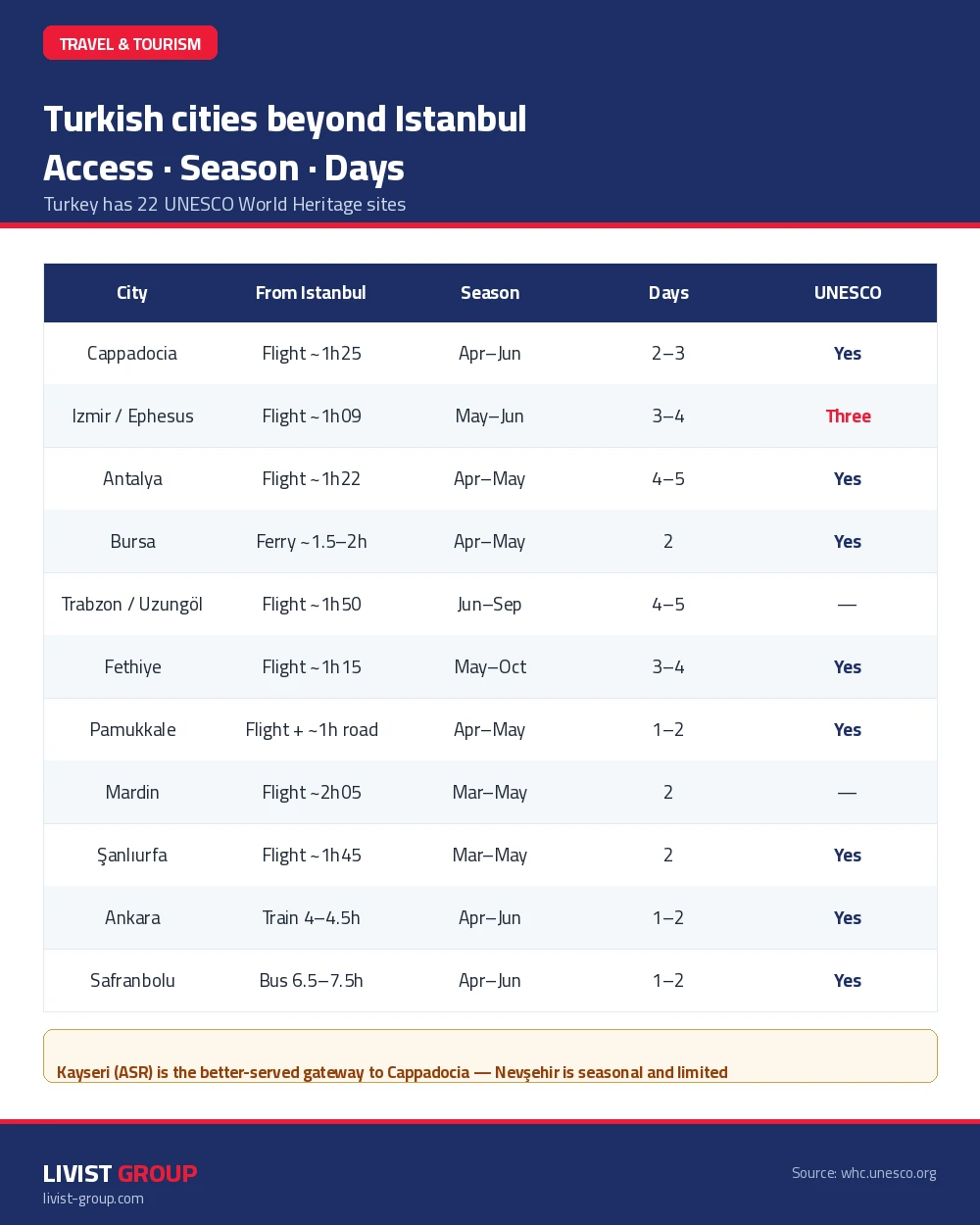
Turkish cities beyond Istanbul: the planning table of travel time, season, days and UNESCO
Four columns, twelve cities, one decision. This is the comparison that inspiration lists skip and that determines whether your trip actually works. Ordered here by the classic first-timer route, from balloons and ruins outward.
| City | Getting there from Istanbul | Best season | Days | UNESCO |
|---|---|---|---|---|
| Cappadocia / Nevşehir | Flight ~1h20 (NAV) or ~1h25 to Kayseri ASR | Apr–Jun, Sep–Oct | 2–3 | ✅ Göreme National Park (1985) |
| Izmir / Ephesus | Flight ~1h09 | May–Jun, Sep | 3–4 | ✅ Three: Ephesus · Pergamon · Sardis |
| Pamukkale / Denizli | Flight to Çardak + ~1h overland | Apr–May, Oct | 1–2 | ✅ Hierapolis-Pamukkale · Aphrodisias |
| Antalya | Flight ~1h22 | Apr–May, Sep–Oct | 4–5 | ✅ Xanthos-Letoon (regional) |
| Fethiye / Ölüdeniz | Flight to Dalaman ~1h15 + ~50 min overland | May–Oct | 3–4 | ✅ Xanthos-Letoon |
| Bursa | Fast ferry ~1.5–2h (İDO/BUDO) | Apr–May, or winter for snow | 2 | ✅ Bursa and Cumalıkızık |
| Safranbolu | Bus 6.5–7.5h | Apr–Jun, Oct | 1–2 | ✅ City of Safranbolu |
| Şanlıurfa / Göbekli Tepe | Flight ~1h45 | Mar–May, Oct | 2 | ✅ Göbekli Tepe |
| Mardin | Flight ~2h05 | Mar–May, Oct | 2 | ❌ Not inscribed |
| Gaziantep | Flight ~1h45 | Mar–May, Oct | 2 | ❌ Not inscribed — UNESCO Creative City of Gastronomy (2015) |
| Ankara | YHT high-speed train 4–4.5h, or flight ~1h | Apr–Jun, Sep | 1–2 | ✅ Gordion (2023) · Hattusha |
| Trabzon / Uzungöl | Flight ~1h50 | Jun–Sep | 4–5 | ❌ Nothing inscribed |
Read the table this way: the flight column tells you what's possible, the season column tells you what's pleasant, and the days column stops you from over-planning. Only Safranbolu and Ankara break the two-and-a-half-hour air rule — everything else is a short hop.
UNESCO World Heritage Sites in Turkey's cities beyond Istanbul: the count is 22
This matters more than it sounds. Most travel content still repeats "19+2" or "18" — counts that predate the 2025 inscription and are simply wrong. The figure of 22 is verified directly against the official UNESCO World Heritage listing for Türkiye (whc.unesco.org), re-read on 8 September 2026: 22 properties, 20 cultural and 2 mixed. The composition is telling too: Turkey's heritage is overwhelmingly built, not wild. You come here for what people made — cities, temples, tombs, terraces — and the two mixed sites (Göreme and Hierapolis-Pamukkale) are exactly the places where geology and human hands worked on the same canvas.
The twelve Turkish cities beyond Istanbul, one by one
Cappadocia (Nevşehir) from Istanbul: fairy chimneys and a sky full of balloons
A volcanic plateau eroded into spires locals call fairy chimneys, hollowed over centuries into churches, houses and entire underground cities. Göreme National Park has been on the World Heritage list since 1985 — one of Turkey's two mixed sites, inscribed for both the landscape and what people carved into it.
The experience: the balloons launch before sunrise and the valley goes silent except for the burners — it is the one Turkish cliché that fully earns itself. Mental map: Göreme sits in the middle, with Uçhisar, Ürgüp and the Ihlara Valley on a rough ring around it; two days covers the ring comfortably. Book smart: Nevşehir's NAV airport is seasonal and thin on routes — use Kayseri ASR (~1h25) as your default gateway, it has far more flights. Book the balloon for night one so a weather cancellation still leaves you a second chance.
Izmir and Ephesus from Istanbul: Turkey's greatest Roman city, and two more beside it
Ephesus is the finest Roman site in the country: the Library of Celsus, a theatre for 25,000, and a marble street you actually walk. Izmir itself is Turkey's most relaxed big city — a working Aegean waterfront rather than a stage set.
The experience: arrive at opening time and you get twenty minutes of Ephesus nearly to yourself before the coaches land. Mental map: Izmir is Turkey's densest UNESCO cluster — three inscribed sites in its orbit: Ephesus to the south, Pergamon to the north, and Sardis inland, added in 2025. Give Ephesus a full day; add Sardis if you want the newest site on the list before anyone else has heard of it. At ~1h09 this is the shortest flight in the table.
Pamukkale (Denizli) from Istanbul: white terraces over a Roman spa town
Calcium-carbonate terraces spill down a hillside in blinding white, and directly above them stand the ruins of Hierapolis, the Roman spa city that grew up around the same hot springs. Hierapolis-Pamukkale is Turkey's other mixed site — nature and empire in one frame.
The experience: you walk the terraces barefoot; it's mandatory to protect the travertine and far more comfortable than it looks. Mental map: this is a one-day destination done well, not a two-night stay. If you do add a night, spend it on Aphrodisias (~2h) — also inscribed, far quieter, and arguably the more moving ruin. Fly into Çardak, then roughly an hour overland.
Antalya from Istanbul: the turquoise coast with a Roman gate in the middle of town
Turkey's coastal capital: cliffs over clear water, the walled Ottoman quarter of Kaleiçi, Hadrian's Gate standing in the middle of the old town, and the Düden and Kurşunlu waterfalls inside the city limits.
The experience: Kaleiçi is a living neighbourhood, not a preserved façade — courtyards, cats, cafés, and it's best after sunset. Mental map: Antalya is the base, with Lycian sites strung west along the coast. Xanthos-Letoon is inscribed but sits well away from the centre — treat it as a Fethiye-side day, not an Antalya afternoon. Skip July and August: September and October give you warm sea without the furnace.
Fethiye and Ölüdeniz from Istanbul: the Blue Lagoon and the run off Babadağ
Ölüdeniz's Blue Lagoon is one of the most photographed stretches of coast in the country, and the paraglide off Babadağ above it is the thing people actually travel for.
The experience: the launch is a running start off a mountain into twenty minutes of silence over the lagoon — no experience needed, you fly tandem. Mental map: Dalaman airport (~1h15) then ~50 minutes overland; that transfer is part of the trip, so build it into day one. Xanthos-Letoon, the inscribed Lycian site, folds neatly into a coastal day here rather than being a detour.
Bursa from Istanbul: the first Ottoman capital, two hours by boat
Before Istanbul, there was Bursa. The empire's first capital holds the Grand Mosque, the Green Tomb, thermal baths that predate the Ottomans, and the village of Cumalıkızık — all inscribed together as Bursa and Cumalıkızık.
The experience: a 1.5–2 hour fast ferry (İDO/BUDO) across the Sea of Marmara makes this the easiest escape on the list — no airport, no early alarm. Mental map: mosque and bazaar in the centre, Cumalıkızık twenty minutes east, Uludağ mountain above by cable car. Two days is exactly right. Go in spring for the city, or in winter for snow on Uludağ.
Safranbolu from Istanbul: an Ottoman town that was never remodelled
Not a restored quarter but an entire town of timber-framed Ottoman houses, preserved because the trade routes moved on and left it alone. The whole settlement is inscribed as City of Safranbolu.
The experience: sleep in one of the houses — most of the best ones are now small guesthouses, and that is the entire point of coming. Mental map: this is the outlier: 6.5–7.5 hours by bus (varies by operator), with no practical airport nearby. Don't force it into a short trip. It rewards travellers on a longer, slower loop through the western Black Sea.
Şanlıurfa and Göbekli Tepe from Istanbul: the oldest temple on Earth
Göbekli Tepe is the reason this entry exists: the oldest known temple in the world, roughly 9,600 BCE — thousands of years older than Stonehenge or the pyramids, built by people who had not yet invented agriculture, writing or pottery. Şanlıurfa itself is the city of the Prophet Abraham, with the sacred carp pools at its heart.
The experience: standing before carved megaliths raised by hunter-gatherers quietly rearranges your sense of the timeline. Nothing else in Turkey does that. Mental map: ~1h45 flight, the site is a short drive from the city, and Urfa pairs naturally with Mardin into one three-day southeastern loop. Inscribed on the World Heritage list.
Mardin from Istanbul: a limestone city above the Mesopotamian plain
Honey-coloured stone terraced down a hill, with monasteries, minarets and the Mesopotamian plain rolling flat to the horizon below.
The experience: at sunset the stone turns gold and the plain goes violet — Mardin is the most atmospheric city in the country and one of the least visited by international travellers. Mental map: ~2h05 flight, not inscribed despite deserving it, with Diyarbakır's inscribed fortress and gardens about 1.5 hours away. Come in spring or October; the summer heat here is genuinely punishing.
Gaziantep from Istanbul: baklava, kebab and the Zeugma mosaics in a UNESCO City of Gastronomy
The city most first-timers skip and most Turks would send you to first. Gaziantep joined the UNESCO Creative Cities Network as a City of Gastronomy in 2015 — pistachio baklava, Antep kebabs and a market culture built around food — and the Zeugma Mosaic Museum holds the Roman mosaics rescued from the flooded city of Zeugma, the famous "Gypsy Girl" among them.
The experience: a morning in the copper and spice bazaars, lunch in a kebab house that has served one dish for generations, and the mosaics in the afternoon. Mental map: ~1h45 flight, two days, and it pairs naturally with Şanlıurfa (about two hours by road) into a food-and-archaeology southeastern loop. Not a World Heritage site — the UNESCO title here is for the kitchen, not the stones. Come in spring or October; summer is fierce.
Ankara from Istanbul: the museum that explains everything else
The capital everyone skips holds the Museum of Anatolian Civilizations — the single best key to every ruin you'll see elsewhere — plus Anıtkabir, Atatürk's mausoleum and the ideological centre of the republic.
The experience: visit the museum before Cappadocia and Urfa, not after. Hittite reliefs and Neolithic finds make every later stone legible. Mental map: Gordion, inscribed in 2023, is about an hour away; Hattusha, the Hittite capital, about three. The YHT high-speed train (4–4.5h) is a real alternative to flying — city centre to city centre, no airport friction.
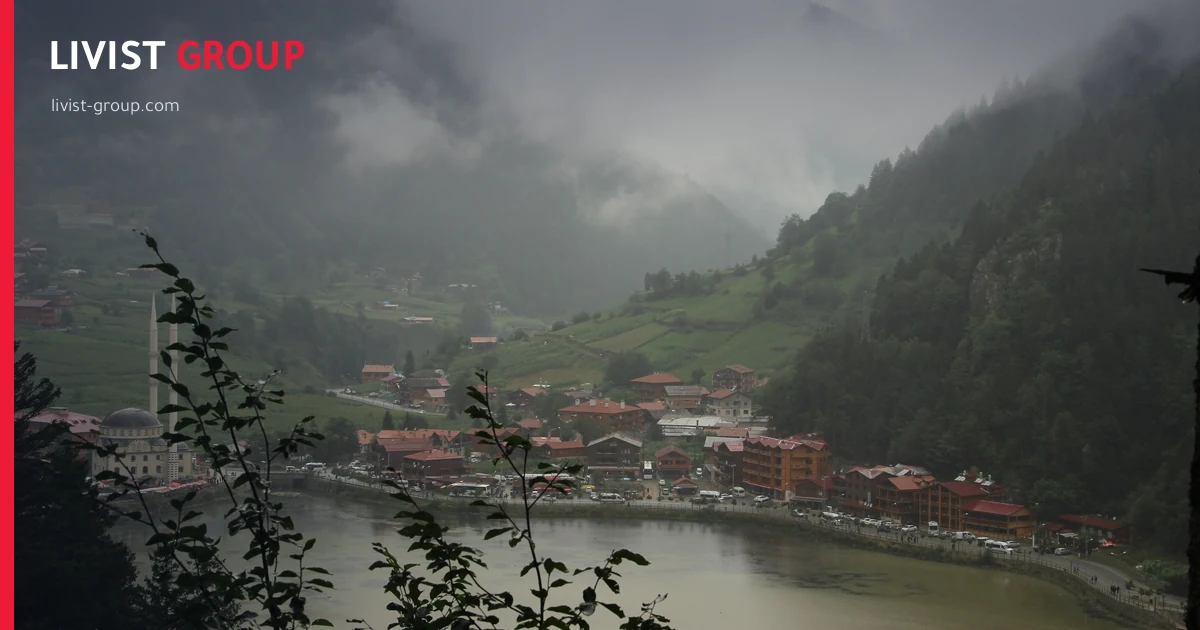
Trabzon and Uzungöl from Istanbul: green, mist and lakes on the Black Sea
The Black Sea coast is Turkey's other climate entirely: forested mountains, alpine pastures, and Uzungöl lake sitting in a bowl of trees and fog.
The experience: the mist rolls down over the lake in the late afternoon and the whole valley turns cinematic — stay a night in Uzungöl itself, not just Trabzon. Mental map: ~1h50 flight, then roughly 2.5 hours on winding mountain road to the lake. Nothing here is inscribed — the Sümela Monastery, dramatically pinned to a cliff face, sits on the Tentative List only. This is also the one place on the list that peaks in June–September, when everywhere else is too hot.
Routes through Turkish cities beyond Istanbul: five ready itineraries
| Route | Path | Length | Best for |
|---|---|---|---|
| The Classic | Istanbul → Cappadocia → Antalya | 8–9 days | First visit, spring or autumn |
| The Aegean Antiquity | Istanbul → Izmir/Ephesus → Pamukkale | 6–7 days | Ruins, three UNESCO sites, low friction |
| The Deep Southeast | Istanbul → Gaziantep → Şanlıurfa → Mardin | 6–7 days | Travellers who've done the classic |
| The Short Escape | Istanbul → Bursa (ferry) | 2 days | A UNESCO site with no flight at all |
| The Green North | Istanbul → Trabzon/Uzungöl | 5–6 days | Summer, when the rest of Turkey bakes |
The discipline that saves trips: two cities outside Istanbul per week, maximum. A third means you spend your holiday in airports rather than in places.
Best time to visit Turkish cities beyond Istanbul: timing is the whole game
Turkey's seasons split cleanly. April–June and September–October are the shoulder windows that make Cappadocia, Ephesus, Pamukkale and Antalya genuinely pleasant. June–September belongs to Trabzon and the Black Sea, which is precisely when the rest of the country is at its worst. The southeast — Urfa and Mardin — works in March–May and October and nowhere near summer.
Month-by-month detail lives in our best time to visit Turkey guide, and the full picture in the Turkey travel guide 2026. If your trip combines treatment with travel, see the medical tourism in Turkey guide; if you're considering staying longer, start with Turkish residence permit types.
Why Turkey's cities beyond Istanbul are busy: 56.7 million visitors in 2024
In 2024, Turkey received roughly 56.7 million international visitors, ranking fourth worldwide, according to the UNWTO World Tourism Barometer (May 2025). Turkey's official tourism body states it in its own words: "has risen to fourth place globally among the most-visited countries in 2024, welcoming 56.7 million international visitors, according to the May 2025 World Tourism Barometer published by the United Nations World Tourism Organization" — GoTürkiye, 2025, read 8 September 2026. That figure explains the table above: domestic aviation is dense enough to put nearly every city on this list within two hours of Istanbul — and it also explains why shoulder-season booking is not optional.
If Cappadocia is on your list, we set out official distances from every city, Göreme entry fees and balloon prices in our Cappadocia guide.
Plan your route through Turkish cities beyond Istanbul with Livist Group
We don't sell packages. We build routes that respect distance, season and the number of days you actually have. Livist Travel handles the itinerary, domestic flights, transfers and stays — and knows the difference between advice that reads well and advice that survives contact with a mountain road.
Frequently asked questions
Answers to the most common questions about this topic
Best Restaurants in Istanbul: MICHELIN, Prices 2026
Istanbul restaurants from official sources: the 2026 MICHELIN selection, municipal menu prices, famous dishes, and the 2026 ban on service charges.
Bodrum Turkey: Distances, Castle Fees and Guide 2026
Bodrum, Turkey from official sources: 804 km from Istanbul, Milas-Bodrum Airport, the castle museum at €20, and Bodrum against Marmaris and Antalya.

Cappadocia Turkey: Distances, Fees and Balloons 2026
Cappadocia, Turkey from official sources: 724 km from Istanbul, Göreme entry €20, balloon rides €150–300, airports compared and the best months to go.