
Best Time to Visit Turkey 2026: Month-by-Month Climate, Costs and the Worst Months to Avoid
Official Turkish State Meteorological Service normals, not blog estimates: Istanbul 1950–2025 and Antalya 1930–2025 month by month. July and August tie as the hottest at 29.7 °C in Istanbul and 34.2 °C in Antalya, while Antalya takes 250.9 mm of rain in December alone. Which month is cheapest, when peak season starts and ends, and the months to avoid.

For most travellers, late April to early June and September to October. You get warm days, swimmable sea from May onward, thinner crowds, and prices well below the July–August peak — when Istanbul averages 29.7°C and Antalya climbs to 34.2°C. Climate figures: Turkish State Meteorological Service (MGM).
| Indicator | Value |
|---|---|
| Best window | Apr–Jun · Sep–Oct |
| Hottest months | July & August (29.7°C) |
| Driest month | July (3.5 rain days) |
| Climate source | Turkish State Meteorological Service |
| Averaging period | 1950–2025 |
Reviewed by the Livist team. Climate figures come from the Turkish State Meteorological Service (MGM), measurement period 1950–2025. Resort and festival dates shift year to year — always confirm with the official source before booking.
What is the best time to visit Turkey?
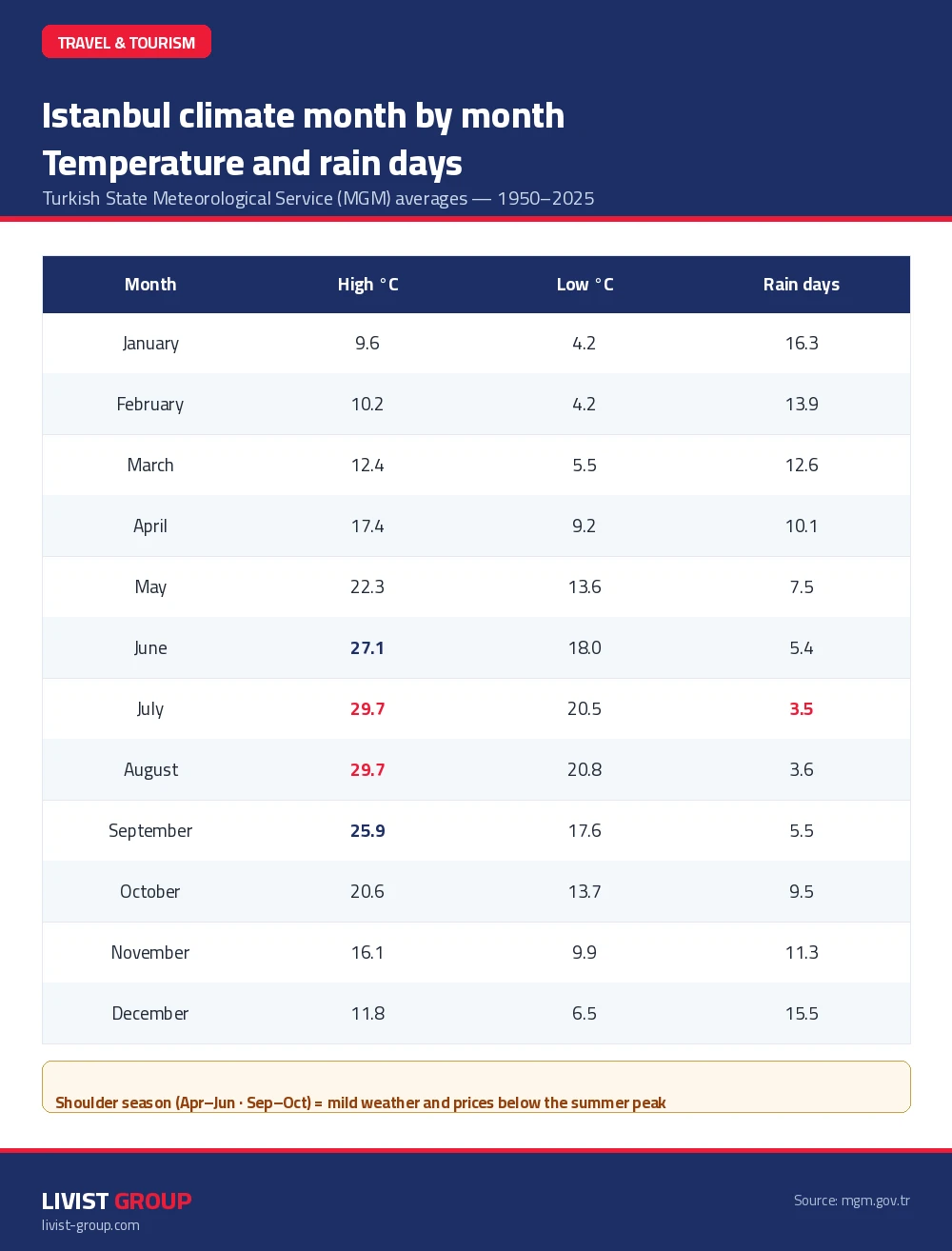
Istanbul climate month by month: official MGM normals, 1950–2025
| Month | High °C | Low °C | Rainy days |
|---|---|---|---|
| January | 9.6 | 4.2 | 16.3 |
| February | 10.2 | 4.2 | 13.9 |
| March | 12.4 | 5.5 | 12.6 |
| April | 17.4 | 9.2 | 10.1 |
| May | 22.3 | 13.6 | 7.5 |
| June | 27.1 | 18.0 | 5.4 |
| July | 29.7 | 20.5 | 3.5 |
| August | 29.7 | 20.8 | 3.6 |
| September | 25.9 | 17.6 | 5.5 |
| October | 20.6 | 13.7 | 9.5 |
| November | 16.1 | 9.9 | 11.3 |
| December | 11.8 | 6.5 | 15.5 |
Read the rainy-days column, not just the temperatures. Istanbul in January is not primarily cold — 9.6°C is a mild winter by most standards. It is wet: 16.3 rainy days means more than half the month. That is what ruins a walking itinerary through Sultanahmet, not the thermometer.
Why the shoulder season is the best time to visit Turkey
Turkey's shoulder months — April through June, then September and October — are not a compromise. They are the actual answer, and the climate table shows why.
Take May: 22.3°C, only 7.5 rainy days, and the Mediterranean swimming season already open. Or September: 25.9°C in Istanbul, the sea still holding its summer warmth, and the July–August crowds gone home. In both months you can walk a city all day without hiding from the sun at noon, then be on a beach the following week.
The July–August peak buys you exactly one thing the shoulder season does not: guaranteed beach heat. Antalya in July averages 34.2°C with 0.5 rainy days — a month that is essentially rainless. If a two-week beach holiday is the whole point of the trip, that certainty is worth the premium. For everyone else, you are paying peak prices and queuing at Ephesus in 34°C heat for weather you did not need.
Peak season sells certainty. The shoulder season sells everything else — and the climate data says the trade is usually worth making.
Turkey is not one climate: how the best time to visit changes by region
The most common planning mistake is treating Turkey as a single destination with a single forecast. On the same July day, the Mediterranean coast and the eastern highlands can differ by more than eight degrees — and in January, by nearly twenty. These MGM station figures decide where you go and when.
| Region (station) | July high °C | January high °C | July rainy days |
|---|---|---|---|
| Istanbul | 29.7 | 9.6 | 3.5 |
| Antalya (Mediterranean) | 34.2 | 15.0 | 0.5 |
| Cappadocia (Nevşehir) | 28.5 | 4.0 | 2.3 |
| Trabzon (Black Sea) | 26.1 | 10.9 | 7.7 |
| Erzurum (East) | 26.6 | −3.9 | 6.8 |
Three climate findings that should change when you visit Turkey
Antalya's warm winter is a wet winter. A 15.0°C January high looks like an off-season bargain — Mediterranean sun without Mediterranean prices. It is not. January is Antalya's wettest month of the year at 225.5 mm. Warm and rainy is a real climate type, and it makes for a strange beach holiday: shirtsleeves and an umbrella on the same afternoon.
Erzurum in winter is a different country. A January high of −3.9°C is only half the story; the January low averages −13.9°C, and the record there is −37.2°C. This is genuine continental cold. Go for the skiing and the winter landscapes, and pack accordingly — a city coat will not do.
Trabzon has no dry season at all. It is the only station here that rains year-round: 7.7 rainy days even in July, the driest month elsewhere in the country. That rain is the reason the Black Sea coast is green when the rest of Turkey has turned gold. Come for the tea hills and the mild summer — 26.1°C, the coolest July on this list — and bring a rain shell in August without embarrassment.
For which of these regions suits your trip, see our guide to Turkish cities beyond Istanbul.
What is the hottest month in Turkey, and what is the worst time to visit?
Direct answer: on the official 1950–2025 normals of the Turkish State Meteorological Service, July and August tie as the hottest months in Istanbul at 29.7 °C average high — but August is the harder month, because its nights are warmer (20.8 °C average low against 20.5 °C in July). On the coast the same two months are far more extreme: in Antalya the average high reaches 34.2 °C in July and 34.1 °C in August, with nights that do not drop below 22.9 °C.
So the worst time to visit Turkey depends on what you are protecting yourself from:
- Worst for heat — July and August. Sightseeing in Istanbul, Ephesus or Cappadocia in those weeks means walking in 30 °C or more, and on the Mediterranean coast in 34 °C.
- Worst for rain — December and January. Istanbul records 15.5 and 16.3 rainy days respectively; Antalya, despite its summer reputation, takes 250.9 mm of rain in December alone — nearly three times Istanbul’s 99.2 mm in the same month.
- Worst for crowds and prices — mid-July to late August, when the domestic and Gulf holiday seasons overlap.
What is the worst time to visit Antalya? The official Antalya numbers
Antalya rewards the reader who checks two columns rather than one. Its driest months are also its hottest — July and August average 0.54 and 0.55 rainy days, effectively none — while December and January are the wettest months of any major Turkish destination.
| Antalya | Avg high °C | Avg low °C | Rainy days | Rainfall mm |
|---|---|---|---|---|
| January | 15.0 | 6.1 | 12.4 | 225.5 |
| April | 21.4 | 11.3 | 6.4 | 48.5 |
| May | 25.7 | 15.3 | 5.2 | 33.3 |
| July | 34.2 | 22.9 | 0.5 | 4.7 |
| August | 34.1 | 22.9 | 0.6 | 4.3 |
| October | 26.6 | 15.4 | 5.4 | 70.6 |
| December | 16.7 | 7.7 | 11.9 | 250.9 |
Read together, the two columns give Antalya’s answer plainly: May and October are the months that combine warm sea, tolerable air and low rainfall. Turkish State Meteorological Service, Antalya station, measurement period 1930–2025.
Peak season and tourist season in Turkey: when it starts and when it ends
Direct answer: Turkey’s tourist season runs roughly from April to October, and peak season is mid-June to the end of August. Turkey has four full seasons, not two — the country spans several climate zones, which is why a single national answer to “when is the season” is always wrong for somewhere.
- Season opens — April. Istanbul’s average high crosses 17.4 °C and rainy days fall to 10.1; the coast is warm but the sea is not yet.
- Peak — mid-June to end of August. Highest prices, fullest flights, hottest air.
- Second peak — September and October. The sea is still warm, the air has dropped to 25.9 °C and then 20.6 °C in Istanbul, and prices fall before the weather does.
- Season closes — November, as rainy days climb back to 11.3 and coastal resorts begin to wind down.
Which month is Turkey the cheapest to visit? What each season costs
| Season | Months | What it means |
|---|---|---|
| Peak | July–August | Highest prices, heaviest crowds, guaranteed beach weather |
| Shoulder | April–June · September–October | The best price / weather / crowd balance |
| Low | November–March | Cheapest prices, unsettled weather, some seasons closed |
The clearest number: in Antalya, three hotel nights cost roughly $137 in low season versus about $256 at peak — an 87% increase. What makes that figure useful is how consistent it is across tiers: budget rooms rise about 88%, luxury rooms about 88% too. The premium is not a luxury-only phenomenon; it applies to whatever you were going to book anyway. Which also means an off-peak upgrade is cheaper than you would guess. (Source: budgetyourtrip.)
Flights follow their own curve. November is roughly 24% cheaper than the annual average — the single best month for airfare. If the budget matters more than the beach, November is your month, provided you accept 16.1°C and 11.3 rainy days in Istanbul.
Best time to visit Turkey by activity: swimming, skiing, tulips and balloons
Swimming season in Turkey
On the Antalya coast the swimming season runs May through October — six months. That is the number worth planning around: you do not need July to swim in Turkey, which is precisely why the shoulder season works.
Ski season in Turkey
The two resorts most reachable from a Turkey itinerary are Uludağ, above Bursa and within reach of Istanbul, and Erciyes, above Kayseri and pairable with Cappadocia. The cold window is narrow and it is measurable: Bursa’s average low sits at or below 3.6 °C only from December through March (3.6, 1.8, 2.2, 3.6 °C), and both resorts stand roughly two kilometres above the city stations that record those figures. Opening and closing dates are announced by each resort every year and depend on actual snowfall, so check the resort’s own site before you book flights around it — no article, this one included, can tell you the date the lifts turn on. Bursa figures: Turkish State Meteorological Service, 1927–2025.
Istanbul Tulip Festival: the best time to visit Turkey in April
April, peaking 10–20 April. Emirgan Park is the place to see it. Tulips are Turkish before they were ever Dutch, and April in Istanbul is built around them.
Cappadocia balloon season: the best months to fly
Dates change every year, so we do not print one here — check the official festival site before planning a trip around it. Balloon flights themselves run nearly year-round and are cancelled or cleared day by day on wind conditions, so build in a spare morning either way.
Best time to visit Turkey for a medical trip: September to November
If your trip combines travel with a medical procedure, the calculus changes. September through November is the optimal window: moderate temperatures, lower humidity, and gentler sun.
To be precise about why — there is no medical reason to avoid summer surgery. The real constraint is recovery, not the operation: most procedures require avoiding direct sun for 3–4 weeks afterwards, and no sauna or steam room for about a month. In July, that means spending your entire recovery avoiding the exact thing you flew in for. In October, the sun is already mild and the restriction costs you almost nothing. It is recovery management, not a prohibition.
Full detail in our medical tourism in Turkey guide, and the clinical side at livistmedical.com.
Turkey public holidays to plan your visit around
This is the only section of this guide that needs a yearly review. Everything above it is stable.
Turkey national holidays with fixed dates
| Date | Holiday |
|---|---|
| 1 January | New Year's Day |
| 23 April | National Sovereignty and Children's Day |
| 1 May | Labour and Solidarity Day |
| 19 May | Commemoration of Atatürk, Youth and Sports Day |
| 15 July | Democracy and National Unity Day |
| 30 August | Victory Day |
| 28 October (half day) + 29 October | Republic Day |
Government offices and banks close; museums and restaurants generally stay open. Expect domestic crowds at major sites.
Turkey religious holidays with moving dates
Ramadan, Eid al-Fitr and Eid al-Adha follow the Hijri calendar and shift about 11 days earlier each year. We do not print fixed dates for them here — any date we published today would be wrong within months.
What matters practically: the two Eids are the heaviest domestic travel periods in Turkey. Domestic flights and coastal hotels sell out weeks in advance and prices spike. Book far ahead or avoid those weeks entirely.
For exact dates, use the Turkish Presidency of Religious Affairs (Diyanet) calendar and nothing else: vakithesaplama.diyanet.gov.tr. It is the only official source inside Turkey, and major news outlets have published dates that contradict it.
Cappadocia is a special case as a high plateau: its January mean is below freezing and October averages 12.1 °C per the Turkish Met Service; see Cappadocia weather by month.
Plan the best time to visit Turkey with Livist Group travel and trip planning
We plan trips around the month you can actually travel, not the month a listicle recommends. Start at livist-travel.com, or read our full Turkey travel guide for the wider picture.
Plan your trip with Livist — pick your month, we handle the rest →
Frequently asked questions
Answers to the most common questions about this topic

Best Restaurants in Istanbul: MICHELIN, Prices 2026
Istanbul restaurants from official sources: the 2026 MICHELIN selection, municipal menu prices, famous dishes, and the 2026 ban on service charges.

Bodrum Turkey: Distances, Castle Fees and Guide 2026
Bodrum, Turkey from official sources: 804 km from Istanbul, Milas-Bodrum Airport, the castle museum at €20, and Bodrum against Marmaris and Antalya.

Cappadocia Turkey: Distances, Fees and Balloons 2026
Cappadocia, Turkey from official sources: 724 km from Istanbul, Göreme entry €20, balloon rides €150–300, airports compared and the best months to go.