
Istanbul Hotels 2026: Choose the District First — A Guide by Area, Not by Name
Taksim, Beyoğlu, Sultanahmet, Beşiktaş and Kadıköy: who each area suits, how to tell a real Bosphorus view from an advertised one, and how to calculate the true nightly price.

There is no best hotel in Istanbul, only a district best suited to your purpose. Sultanahmet for sights on foot, Taksim and Beyoğlu for transport and evenings, Beşiktaş and Ortaköy for the Bosphorus, Kadıköy for longer stays and value, and the airport area for a transit night only. Choose the district first, then the hotel inside it.
| District | Suits | Trade-off |
|---|---|---|
| Sultanahmet | First visit, sights on foot | Purely touristic, quiet evenings |
| Taksim & Beyoğlu | Transport, shopping, evenings | Noise, street-by-street variation |
| Beşiktaş & Ortaköy | Bosphorus with a local feel | Higher prices and traffic |
| Kadıköy | Long stays and better value | A crossing for every European appointment |
| Near the airport | Transit or dawn flights | Far from everything |
| The deciding metric | Minutes walking to the metro | Not distance to the square |
Searching for Istanbul hotels almost always ends in the wrong question: "which is the best hotel?" There is no best hotel in Istanbul, because the city spans two continents and its districts serve completely different purposes. The right question is where should I sleep relative to what I am doing — and this guide answers it by district, not by name.
The governing rule: neighbourhood before hotel
Istanbul is a city of travel time, not distance. Ten kilometres can mean ninety minutes at rush hour, and crossing the Bosphorus twice a day will eat your trip. Choose the district by your reason for visiting, then choose the hotel inside it.
Istanbul hotels by district
| District | Suits | Trade-off |
|---|---|---|
| Sultanahmet (Fatih) | A first visit, historic sights on foot | Purely touristic · limited evening dining |
| Beyoğlu, Taksim, Şişli | Walking, shopping, evenings, transport | Noise · building quality varies street to street |
| Beşiktaş and Ortaköy | Bosphorus proximity with a local feel | Higher prices · heavy traffic |
| Kadıköy (Asian side) | Longer stays and value for money | A crossing for every appointment in Europe |
| Near the airport | Transit or a dawn flight | Far from everything — a night, not a stay |
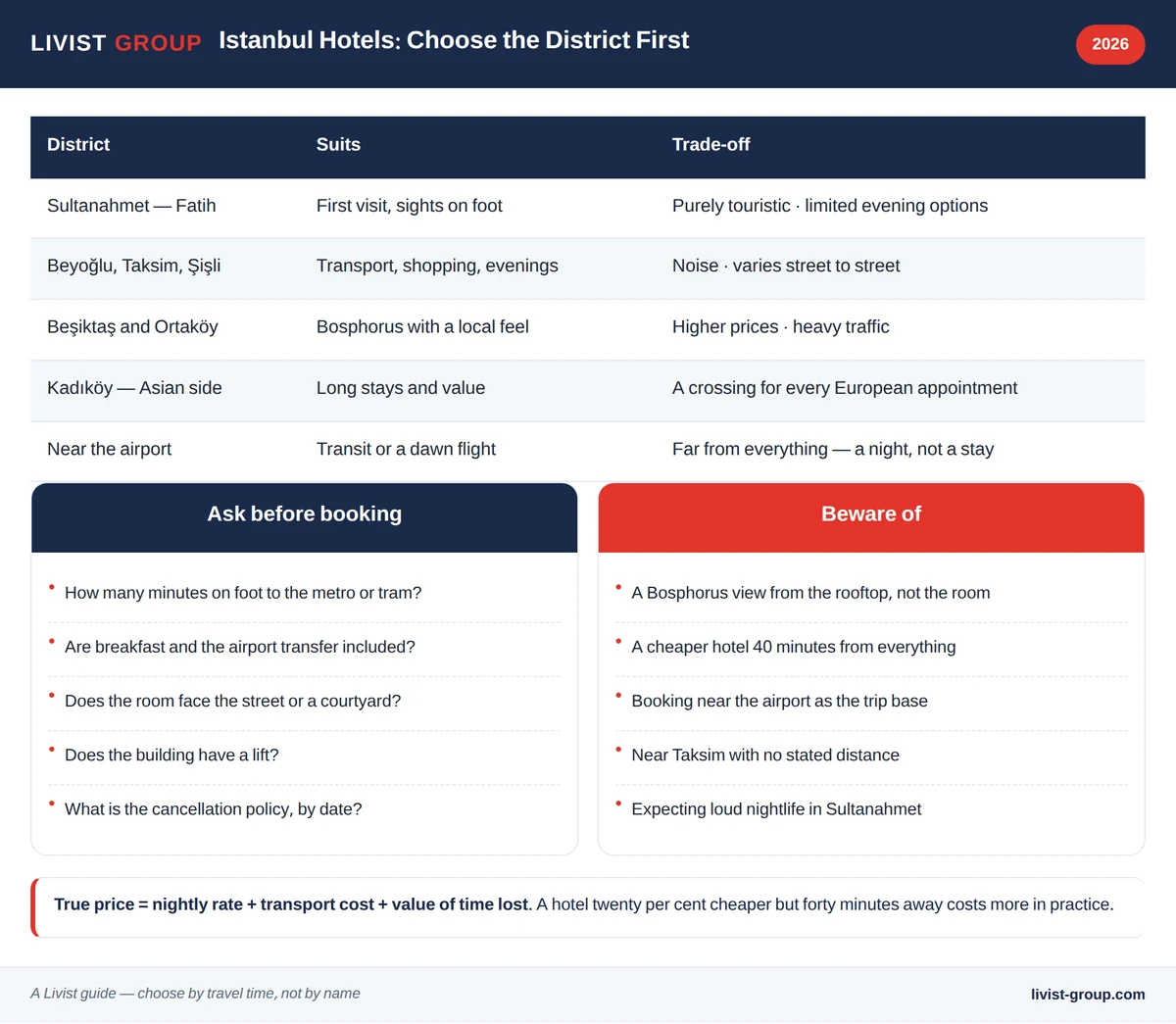
Livist infographic — data from the official sources listed at the end of this article.
Hotels in Taksim specifically
Taksim is the default for many visitors, with good reason: a central square, a metro line, İstiklal Street, and restaurants open late. But "Taksim" is a wide address — the difference between a hotel on the square and one three streets into a narrow lane is real, in quiet, in walking back at night, and in arriving with luggage. Always ask for the walking distance to the metro station, not to "the square".
Bosphorus-view and seafront hotels
"Bosphorus view" is the most elastically used phrase in Istanbul hotel copy. Check three things before booking: is the view from the room or only from the rooftop restaurant? Is it full or partial? And is the hotel actually on the waterfront or on a hill behind it? The price gaps between those cases are large and photographs will not settle them.
Note too that "by the sea" in Istanbul can mean the Sea of Marmara rather than the Bosphorus — a different experience and further from the centre.
Five-star Istanbul — what you are actually paying for
At the luxury end the difference is not the stars but three things: location (waterfront or inland street), room size (converted historic buildings give far smaller rooms than modern towers), and what is genuinely included — breakfast, airport transfer, spa. A cheaper hotel including transfers and breakfast can cost less overall than an expensive one that does not.
Cheap Istanbul hotels — where to look and where not to
Real economy is not the nightly rate but rate plus transport plus time. A hotel twenty per cent cheaper but forty minutes from everything costs more in practice. The genuine value in this city is usually on the Asian side or in the back streets of Beyoğlu near the metro — not on the far outskirts.
Seven questions to ask before booking
- How many minutes on foot to the nearest metro or tram stop?
- Is breakfast included, and is the airport transfer included?
- Does the room face the street or an internal courtyard? (noise)
- Does the building have a lift? (many historic Beyoğlu buildings do not)
- What is the actual cancellation policy, by date?
- Is the view from the room or from a shared facility?
- Is the neighbourhood comfortable to walk in at night with a family?
By type of visitor
- Short first visit: Sultanahmet or Taksim — sights on foot and transport links.
- Family with children: a hotel near the metro with connecting rooms, not a distant "view" property.
- Long stay or work: Kadıköy or Şişli — better value and easier daily life.
- Honeymoon: the Bosphorus waterfront — and verify the view as above.
- One-night transit: near the airport only, and never as the trip's base.
Once your hotel is chosen, the nearest restaurants in Fatih and Taksim and the municipal dining halls on the Bosphorus are in the best restaurants in Istanbul.
Where Livist fits
We do not book a hotel and disappear. We start from your daily plan, pick the district that minimises your travel, then the hotel inside it, and arrange transfers between the airport and your appointments. See also the Turkey travel guide 2026, Turkey tour itineraries, travel and living costs, family travel in Turkey, and the best time to visit.
Frequently asked questions
Answers to the most common questions about this topic

Best Restaurants in Istanbul: MICHELIN, Prices 2026
Istanbul restaurants from official sources: the 2026 MICHELIN selection, municipal menu prices, famous dishes, and the 2026 ban on service charges.

Bodrum Turkey: Distances, Castle Fees and Guide 2026
Bodrum, Turkey from official sources: 804 km from Istanbul, Milas-Bodrum Airport, the castle museum at €20, and Bodrum against Marmaris and Antalya.

Cappadocia Turkey: Distances, Fees and Balloons 2026
Cappadocia, Turkey from official sources: 724 km from Istanbul, Göreme entry €20, balloon rides €150–300, airports compared and the best months to go.