Real Estate Residence Permit in Turkey 2026: What the Official Source Actually Says
Every agency quotes a dollar threshold. Turkey's Directorate General of Migration Management publishes none. Here is the verbatim official condition, the dated fee schedule, and the rejection risks nobody selling you property will mention.

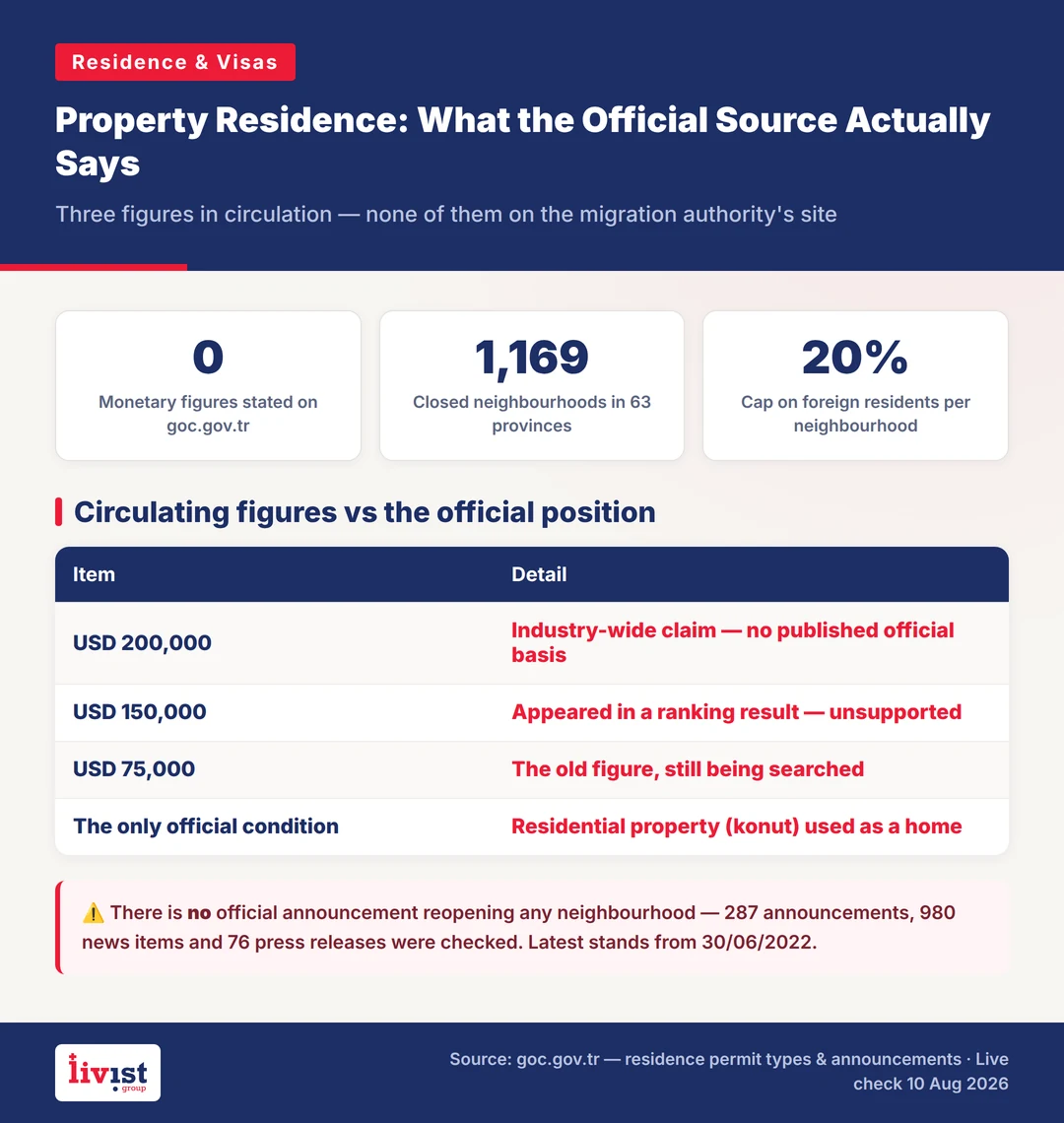
Turkey's real estate residence permit has not been cancelled. However, the Directorate General of Migration Management publishes **no monetary threshold** — not on its Turkish site, its English site, or its official FAQ. The only published condition is qualitative: the property must be a **house (konut)** used as a residence.
| Item | Verified value | Source | Verified on |
|---|---|---|---|
| Monetary thresholds published by the migration authority for property-based residence | **Zero** — no 200,000 USD, no 150,000 USD, no 75,000 USD | goc.gov.tr · en.goc.gov.tr · official FAQ | 10 Aug 2026 |
| The condition actually published | Property must be a **house (konut)** and **used for this purpose** | goc.gov.tr / en.goc.gov.tr — Residence Permit Types | 10 Aug 2026 |
| Neighbourhoods closed to new foreign registration | **1,169 neighbourhoods across 63 provinces** | DGMM announcement 30.06.2022, effective 01.07.2022 | 10 Aug 2026 |
| Closure trigger | Foreign density exceeding **20%** of the Turkish-citizen population | DGMM press statement 16.07.2023 | 10 Aug 2026 |
| Closed neighbourhoods in Istanbul | **54** | DGMM press statement 16.07.2023 | 10 Aug 2026 |
| Istanbul districts closed to new residence applications | **10 districts** | DGMM press statement 16.07.2023 | 10 Aug 2026 |
| Official announcements reopening any neighbourhood | **None found** — after reviewing 287 announcements, 980 news items, 76 press statements | Full DGMM archive | 10 Aug 2026 |
| Residence card document fee 2026 | **964.00 TRY** — no nationality exemption | Treasury Accounting General Communiqué, Official Gazette 24.12.2025 No. 33117 | 10 Aug 2026 |
| Daily residence permit fee (harç) | **348.10 TRY** per day up to one month | Fees Law General Communiqué, Official Gazette 31.12.2025 No. 33124 | 10 Aug 2026 |
| First-month floor and ceiling per permit | **653.70 – 3,359.90 TRY** | Same source | 10 Aug 2026 |
| Each month after the first | **2,232.30 TRY** | Same source | 10 Aug 2026 |
| Official statement denying any fee increase | **Published 30.04.2026** | goc.gov.tr | 10 Aug 2026 |
| Long-term residence permit requirement | **8 uninterrupted years** of legal residence (Arts. 42–43, Law 6458) | goc.gov.tr | 10 Aug 2026 |
| Minimum outpatient insurance coverage required | **15,000 TRY** | SEDDK Circular 2024/34, in force 01.04.2025 | 9 Aug 2026 |
Search this topic in English and you will find three different dollar thresholds on the first page of results, each stated with complete confidence, most of them undated, and nearly all of them published by companies that sell property or immigration services. This guide takes a different approach: it separates what the Turkish migration authority actually publishes from what the market asserts, attaches a date to every figure, and tells you plainly where the official record is silent.
What the official source says — and what it does not
The Republic of Türkiye Directorate General of Migration Management (DGMM) publishes property ownership as a ground for a short-term residence permit. Read on 10 August 2026, the English page states verbatim:
"Foreigners who will own immovable property in Turkey; If foreigners who own immovable property demand residence permit, the immovable property must be house and used for this purpose. Moreover, immovable property used as house in shared or cooperated property covering family members gives residence permit application right also to the family members."
— DGMM, Residence Permit Types, English site, read 10/08/2026. The Turkish text is identical in substance, and the official FAQ (question 54) repeats it. "Family members" is defined as the applicant's spouse, minor child, and dependent adult child.
Now the part that matters just as much. Across the Turkish page, the English page, and the official FAQ entry written specifically about property-based residence, there is no monetary amount of any kind, and no value criterion of any kind — no appraised value, no registered title-deed value, no purchase price. The published requirement is entirely qualitative.
The three circulating figures, audited
| Circulating figure | Typically published by | Found in official DGMM material? | Our editorial verdict |
|---|---|---|---|
| 200,000 USD | Most brokerages and immigration consultancies, in English and Arabic | No — absent from both language versions and the FAQ | Not publishable as official fact. Presidential Decision No. 7709 exists (dated 15.10.2023, gazetted 16.10.2023), but we did not read its text and therefore attribute no figure to it |
| 150,000 USD | Recently updated pages ranking on page one | No | The weakest-sourced of the three. A recent "last updated" stamp is not evidence of accuracy |
| 75,000 USD | Older unrevised content; still actively searched | No | Reference it only as a formerly circulating figure, never as a current or former official threshold we can evidence |
| "Title-deed / appraised value, not the price paid" | Brokers and specialist sites | No value criterion is published at all | Market practice, not published text Verify before publishing — يُراجع قبل النشر |
This is not a claim that no threshold exists anywhere in Turkish administrative practice. It is a narrower and more useful claim: the authority that decides your application does not publish one, so anyone quoting a number to you is quoting something other than the decision-maker. Ask them for the publication and the date. If you want that audit run against a specific property before you commit, Livist will review a specific property's eligibility against the published conditions before you sign.
Residence route versus citizenship route
The costliest mistake foreign buyers make in Turkey is treating these as two rungs of one ladder. They are separate programmes, administered by different bodies, tested against different criteria, producing different outcomes.
| Dimension | Residence via property ownership | Citizenship by investment |
|---|---|---|
| Outcome | Renewable short-term residence permit | Turkish citizenship for applicant and family |
| Deciding authority | Directorate General of Migration Management | A separate programme under other authorities |
| Published condition | Property must be a house (konut), used as a house | Investment threshold plus a resale restriction period Verify before publishing — يُراجع قبل النشر |
| Monetary threshold on DGMM pages | None published | Outside DGMM's published scope |
| Valuation basis | No value criterion published | Licensed appraisal report rather than price paid Verify before publishing — يُراجع قبل النشر |
| Right to work | Not automatic — a separate work permit is required | Inherent in citizenship |
| Family members | Family members holding a shared or joint ownership right in the residence may apply under the same provision | Spouse and children per programme rules |
Neither route escalates into the other automatically. Buying a property that satisfies the residence condition brings you no closer to citizenship, and the reverse is equally true. For the investment route in detail, see our guide to Turkish citizenship through real estate.
Why applications get rejected
Below, reasons grounded in published official text are separated from procedural causes we see repeatedly in practice. That distinction is itself part of the answer — a checklist that presents both as equally official would be misleading you.
- The property is not a house, or is not used as one — land, a shop, an office, or a unit registered for commercial use. Grounded in explicit published text. Check the designation recorded on the title deed itself, not the seller's description.
- The property sits in a closed neighbourhood — see the section below. Grounded in a published announcement.
- The applicant is not the registered owner — the published provision covers the owner and family members holding a shared or joint ownership right in the residence. Anyone outside that definition is not applying under this ground.
- Health insurance from an insurer not licensed in Turkey — a residence applicant is treated as resident in Turkey for insurance purposes, and non-conforming policies are not processed. The one carve-out concerns applications filed from outside Turkey, where a foreign policy may be accepted provided it delivers the minimum limits inside Turkey.
- Coverage below the mandatory minimum — limits in force since 01.04.2025 are 15,000 TRY for outpatient treatment, with inpatient treatment uncapped at contracted institutions. Policies still carrying the old 2,000 / 20,000 TRY limits are non-compliant.
- Unregistered address — a routine procedural failure, usually surfacing before the appointment.
- Name-spelling mismatch between title deed and passport — very common for applicants whose names are transliterated from non-Latin scripts. Fix it before the deed is registered, not after.
- Adverse immigration history — a prior overstay or an active entry ban. Check this before any financial commitment, not after.
Closed neighbourhoods: 1,169 across 63 provinces
The governing announcement was issued by the DGMM on 30 June 2022, effective 1 July 2022, raising the count from 781 to 1,169 neighbourhoods across 63 provinces, under a rule closing any neighbourhood where foreign density exceeds 20% of the Turkish-citizen population. The closure is broader than residence permits alone: it also covers temporary protection registration, international protection registration, and changes of province of residence, with newborns and nuclear-family reunification excepted.
Three points that sellers rarely volunteer:
- No reopening has ever been announced. We reviewed the site's full archive — 287 announcements, 980 news items, 76 press statements — and found no reopening announcement in 2023, 2024, 2025 or 2026.
- The claim that "only Fatih and Esenyurt remain closed" is false. The most recent official document (press statement of 16.07.2023) names 10 Istanbul districts closed to new residence applications: Fatih, Esenyurt, Avcılar, Bahçelievler, Başakşehir, Bağcılar, Esenler, Küçükçekmece, Sultangazi and Zeytinburnu. Istanbul's closed-neighbourhood count is 54.
- The claim that the threshold "was reduced from 25%" appears nowhere in any announcement, news item or press statement on the official site. The 20% figure is confirmed; its alleged predecessor is not.
One freshness caveat that changes how you should use any list: the closed-neighbourhood spreadsheet attached to the announcement is dated 31.08.2022. The newest published neighbourhood-level data is therefore four years old. Do not rely on a republished list from any intermediary — verify the specific neighbourhood with the provincial migration directorate before signing. Our dedicated guide covers this in depth: closed neighbourhoods in Turkey.
What the permit gives you — and what it does not
| It gives you | It does not give you |
|---|---|
| Lawful, renewable residence in Turkey | The right to work — a separate work permit is required |
| Visa-free entry and exit while the permit is valid | Turkish citizenship — an entirely separate programme |
| Time counting toward the eight uninterrupted years required for long-term residence | Automatic residence for every family member — each files individually |
| An application right for family members holding a shared ownership interest in the residence | Any guarantee of renewal if the property's status or designation changes |
| A practical basis for day-to-day administrative life in Turkey | Exemption from the valid health insurance requirement |
Since a bank account is usually the first practical obstacle after the permit, read our separate guide on opening a bank account in Turkey as a foreigner — the rules there work very differently from what most buyers expect.
Property-based versus tourist residence, and the eight-year myth
Both are the same permit category: the short-term residence permit governed by Articles 31–33 of Law No. 6458. The difference lies in the ground relied upon — registered ownership of a residential property versus purpose of visit. In practice, a registered ownership interest supplies an objective, documentable basis that does not depend on restating an intention each cycle, which is why it tends to be more stable at renewal.
Correction: the widely repeated "eight-year cap on tourist residence" does not exist. Eight uninterrupted years is the qualifying period for the long-term residence permit (Arts. 42–43), which is granted for an indefinite term and requires four further conditions: no social assistance in the previous three years, sufficient and regular income, valid health insurance, and no threat to public order or security. Student residence counts at half value, and holders of temporary or humanitarian protection are expressly excluded from converting to long-term residence.
For the full picture across all six permit categories, see types of residence permits in Turkey, and for extension mechanics see tourist residence permit renewal.
The official 2026 cost of the permit
| Item | 2026 amount | Legal basis |
|---|---|---|
| Residence card document fee | 964.00 TRY | Treasury Accounting General Communiqué — Official Gazette 24.12.2025 No. 33117, in force 01.01.2026 |
| Daily permit fee, up to one month | 348.10 TRY per day | Fees Law No. 492 General Communiqué — Official Gazette 31.12.2025 No. 33124 |
| First-month floor / ceiling per permit | Not below 653.70, not above 3,359.90 TRY | Same source |
| Each subsequent month | 2,232.30 TRY | Same source |
| Health insurance premium | Not regulated — set by the market | No regulation prices premiums; regulation sets minimum coverage limits only |
Three qualifications that materially change the arithmetic. First, the card fee admits no nationality exemption whatsoever, whereas the permit fee itself is waived on reciprocity grounds for nationals of ten jurisdictions including Syria and Palestine. Second, the figures above apply to nationals of countries not assigned to any country group — other groups have separate schedules, so do not assume the number applies to your passport. Third, premiums must be paid upfront since 01.04.2025, and intermediary commission is capped by regulation at 25% of the premium (30% on renewals), which explains much of the price spread you will be quoted.
On 30 April 2026 the migration authority published a statement rejecting circulating claims of a fee increase, confirming that residence fees are set annually by the Ministry of Treasury and Finance under Law No. 492 and that no change had been made. Another reminder that in this field the rumour consistently outruns the text.
Verify it yourself, in this order
- Confirm the property's designation on the title deed — is it registered as a house (konut)? See title deed (tapu) steps in Turkey.
- Verify the specific neighbourhood with the provincial migration directorate, never from a republished list.
- Match the spelling of your name across passport and title deed before registration.
- Buy insurance from a Turkey-licensed insurer and confirm the coverage limits meet the standard in force since 01.04.2025.
- File through the official system and retain your reference number. See e-ikamet application steps.
- Sanity-check the location commercially before committing: Istanbul investment districts.
Bottom line
The permit exists, and the published condition is qualitative: a residential property used as a residence. The dollar thresholds presented to you as "the official requirement" have no trace in the migration authority's published material in either language or in its FAQ, as verified on 10 August 2026 — and you deserve to know that before you transfer funds, not afterwards.
The greater risk is not the number anyway. It is buying in a closed neighbourhood, or buying a unit that is not registered as a house, and discovering that money was never the issue. Verify the neighbourhood, the designation and the documents before you pay, and make anyone quoting you a threshold show you where it is published and when. If you want that review done independently before you commit, Livist runs the title deed, neighbourhood and document check and manages the permit file end to end.
Frequently asked questions
Answers to the most common questions about this topic

Universities in Turkey 2026: Rankings, Fees, Admission
Universities in Turkey by official figures: 128 state and 75 foundation universities, QS 2027 ranks, tuition under Decision 11625, and scholarships.

Driving Licence Exchange Turkey 2026: The Six-Month Rule
Driving licence exchange turkey rules: six months for foreigners and two years for citizens from the date of entry, plus documents and fees.

Company Formation in Turkey for Foreigners 2026 Guide
Company formation in turkey for foreigners: minimum capital after the 2024 decision, the MERSIS steps and the 2026 corporate tax rates.