Tapu Registration in Turkey 2026: The Official Steps, the Real Fees, and Five Legal Traps
The complete 2026 fee schedule with its legal basis, the eight steps in the order they happen, and the mistake that carries a 100% penalty.

Tapu registration takes place at the Land Registry Directorate with both parties and a sworn translator present. Official 2026 costs: a 4% title deed fee in total (2% per party) on the declared price, a service charge with a 1,504 TRY floor, and a 20,868 TRY foreigner charge per property. A valuation report, DASK insurance and a sworn translator are all mandatory.
| Item | Official 2026 figure |
|---|---|
| Title deed fee | 4% total (2% per party) |
| Service charge floor | 1,504 TRY |
| Foreigner charge per property | 20,868 TRY |
| Valuation report validity | 3 months (6 for citizenship) |
| Individual ownership ceiling | 30 hectares |
| Foreign share of a district | 10% of privately-owned land |
| Under-declaration penalty | 100% of the fee shortfall |
Legal and financial content (YMYL). Every figure is attributed: Fees Law No. 492, Foreign Ownership Law No. 2644, Condominium Law No. 634, DASK Law No. 6305, the Land Registry Regulation, the 2026 TKGM tariff, and the Central Bank's Capital Movements Circular. Where we found no official basis, we say so. Fees are revised annually — check the current tariff before your appointment.
Welcome — this is not paperwork, it is the moment ownership moves
The tapu is not a certificate collected after a purchase. It is the legal instant at which ownership transfers to you. Until you sign at the Land Registry Directorate, you are not the owner — no matter what you have paid, and no matter what you signed with the developer. That makes this one appointment worth more preparation than everything preceding it.
There is a striking mismatch in the English results for this topic: people search for cost and procedure, while the pages that rank explain definitions. The single specific figure we found on page one — "$300–$500, 1–3 business days" — comes from a site with negligible authority, and it is not close. The foreigner charge alone is far higher, before the 4% is counted.
2026 fees, with their legal basis
| Item | Official 2026 figure | Basis |
|---|---|---|
| Title deed fee (Tapu Harcı) | 2% per party — 4% in total of the declared consideration, and never below the property's assessed tax value | Law 492, Tariff (2) item 20 + Art. 63 |
| Service charge (Döner Sermaye) | Base indicator 2,227 TRY × regional coefficient, plus 307 TRY — floor of 1,504 TRY | TKGM tariff 2026 |
| Additional charge for foreign nationals | 20,868.00 TRY per property or independent section | TKGM tariff 2026 |
| Appointment booking (WebTapu / ALO 181) | No charge | No line item in the 2026 tariff |
| Valuation report · DASK policy · sworn translator | Mandatory — and not officially priced; these are market rates | See below |
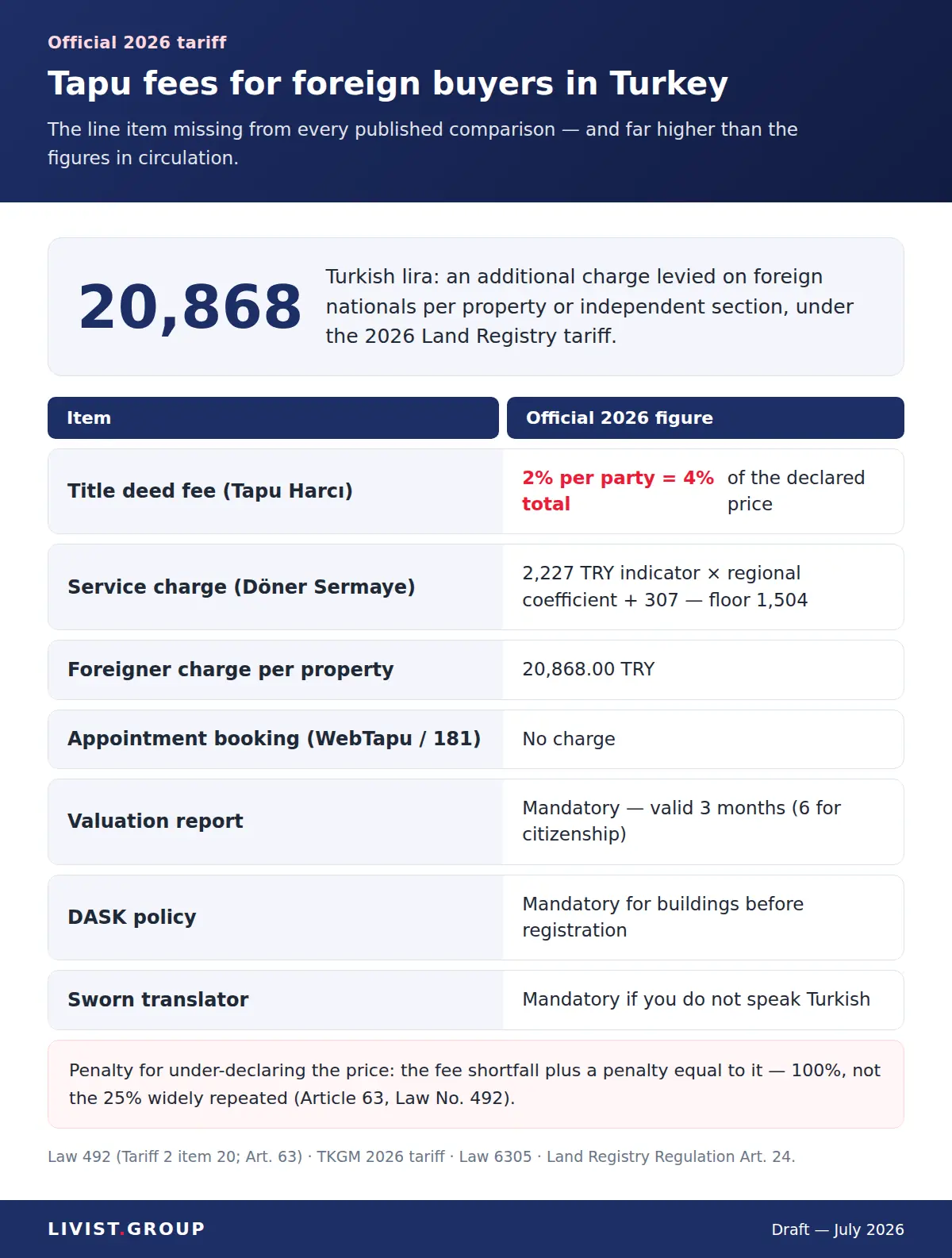
Official 2026 tapu fees for foreign buyers · Livist Group
What ambushes foreign buyers is never the price of the property. It is the line items nobody mentioned before signing day.
Two notes on the arithmetic
First: the title deed fee is split by statute — 2% seller, 2% buyer. The market convention of the buyer absorbing all 4% is exactly that: a negotiating custom, not a legal rule. It is a negotiable line in your contract. Raise it before you sign.
Second: the service charge is a formula, not a fixed sum — it moves with the regional coefficient of the specific registry office. Any site quoting one final number is oversimplifying. Ask your office for its coefficient.
The official steps, in order
- Confirm the property can be sold to a foreign national. Before any payment: is it within a military or security zone, and has the foreign-ownership quota for that district been exhausted?
- Preliminary sale contract and reservation payment. Ideally notarised, with a translation you can actually read.
- Turkish tax number and bank account. Both are required for the official payment route and for what follows.
- Transfer the funds through a Turkish bank and obtain the DAB. Mandatory for every foreign buyer since 24 January 2022 — see trap five.
- Property valuation report. Issued by an expert licensed by the Capital Markets Board (SPK). Valid for three months; six months on the citizenship route.
- DASK compulsory earthquake insurance. No registration without a valid policy for buildings (not required for land).
- File the application and book the appointment via WebTapu or the 181 line — free of charge.
- Signing day at the Land Registry: both parties (or an attorney), a sworn translator accredited by the judicial justice commission if you do not speak Turkish, payment of fees, and issuance of the title deed.
Five legal traps
1. Under-declaring the price — and the penalty is not 25%
Some buyers are offered a lower declared value "to save on the fee". This is a straightforward breach, and Article 63 of Law 492 provides for recovery of the shortfall plus a penalty of "bir kat" — one times the amount, i.e. 100%. Not the 25% repeated across property blogs.
The loss does not end there. Your declared value is the base for capital-gains tax when you sell, and the figure your file is assessed on if you later pursue citizenship by investment. You save today and pay twice later.
Under-declaring is not tax cleverness. It is a loan from your future self at 100% interest, repaid at the worst possible moment.
2. The open-ended power of attorney
Buyers are routinely asked to sign a notarised power of attorney so paperwork can proceed in their absence. The instrument is legitimate and often useful — but a broadly drafted PoA is, in practice, authority to buy, sell and sign in your name. The rule: purpose-limited, time-limited, in text you have read in your own language, granted to someone whose legal accountability you can identify.
3. Kat İrtifakı is not Kat Mülkiyeti
Law 634 (Articles 2 and 3) distinguishes construction servitude (Kat İrtifakı) — a right over a unit in a building not yet completed — from condominium ownership (Kat Mülkiyeti) over a completed, habitable unit. Many off-plan buyers believe they hold "the tapu" when they hold a servitude. Conversion happens ex officio once the occupancy permit issues. Ask directly: which type will I receive on signing day?
4. The limits: 30 hectares and 10% — but 10% of what?
Article 35 of Law 2644 sets two ceilings: a foreign individual may hold up to 30 hectares in Turkey, and foreign ownership may not exceed 10% of the privately-owned land within a district (İlçe). Note the double precision: the percentage is measured neither against the neighbourhood (mahalle), as commonly repeated, nor against the district's total area — but against its privately-owned land. The distinction matters when checking a specific project. Military and security zones require permission on top.
5. The Foreign Exchange Purchase Certificate (DAB)
Since 24 January 2022, a foreign buyer must convert the purchase price into Turkish lira through a Turkish commercial bank, which in turn sells the currency to the Central Bank, producing the Döviz Alım Belgesi that forms part of the registry file. Basis: the Central Bank's Capital Movements Circular, Article 13. A cash handover produces no such certificate — and without it, your file stalls at the desk.
Citizenship by property: confirmed, and needing verification
Per TKGM's most recent published guidance dated 9 December 2024: the threshold is USD 400,000, with a three-year non-sale undertaking annotated on the title, and a valuation report valid for six months. We have not verified whether an amendment issued after that date, and we will not assert it is "current for 2026" without one. Confirm the latest position before building a decision on it. Full detail in our Turkish citizenship through real estate guide.
Checklist before signing day
- Have you confirmed the property's status — military/security zone, district quota?
- Is the valuation report still valid (three months; six for citizenship)?
- Is the DASK policy in force for the property?
- Do you hold the foreign exchange purchase certificate from the bank?
- Did you book the appointment directly via WebTapu or 181, without paying a "booking" fee?
- Is the translator sworn and accredited, rather than simply an English-speaking companion?
- Is the declared value the price actually paid?
- Do you know which type of title you will receive?
- Is it agreed in writing who bears the 4%?
If the purchase is tied to a residence plan, review the Turkey residence permit guide and the closed neighbourhoods list before fixing on a location — a property in a closed neighbourhood can be a sound investment and an impossible address at the same time.
Why Livist
We do not sell you a property and then "handle the paperwork". We review the file independently: the property's legal status, the type of title, the validity of the valuation report, and the full fee structure before you pay — including who bears what. If the property you have chosen carries a problem in the register, our job is to say so before the first instalment, not after.
Have your title file reviewed before you sign — Livist Real EstateFrequently asked questions
Answers to the most common questions about this topic

Where to Live in Istanbul 2026: Neighbourhoods for Expats
Where to live in Istanbul comes down to two questions: which neighbourhood suits you, and which one will register your residence address at all.

Property Tax in Turkey 2026: Rates, Dates and Exemptions
Property tax in Turkey from Law 1319: the annual rates, the metropolitan doubling, the two instalments and compulsory earthquake cover.
Turkish Citizenship by Investment 2026: All Seven Routes, and Who Attests Each Amount
The full official list from the Investment Office — thresholds, three-year lock-ins and the ministry or regulator that must certify each one — plus how to check a title deed yourself before anyone’s paperwork.