Types of Residence Permits in Turkey 2026: The 6 Official Types (Not 28)
Turkey has exactly six residence permit types under Article 30 of Law 6458 — not 28. Full comparison table, the real path to permanent residency, the $200,000 property rule, and 2026 fees.

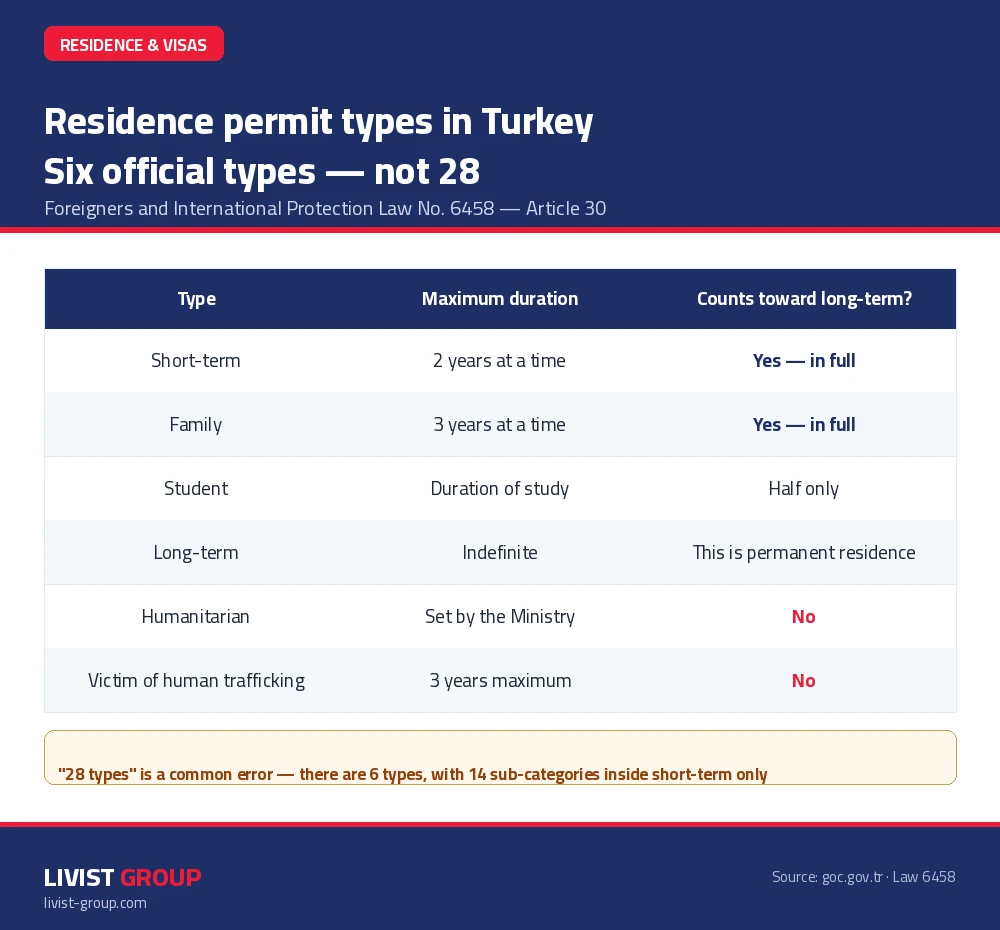
Turkey has exactly six residence permit types under Article 30 of Foreigners Law 6458: 1) Short-Term · 2) Family · 3) Student · 4) Long-Term · 5) Humanitarian · 6) Victim of Human Trafficking. Any larger number — such as the widely repeated "28 types" — confuses these six types with sub-categories inside the short-term permit.
| Indicator | Value |
|---|---|
| Official types | 6 |
| Legal basis | Law 6458, Art. 30 |
| Short-term | Up to 2 years each |
| Long-term | 8 continuous years |
| "28 types" | Common error |
Reviewed by the Livist team on 15 July 2026 against the text of Law 6458 and the Directorate of Migration Management (goc.gov.tr). Fees are revised periodically — confirm the official figure before paying.
How many types of residence permits does Turkey have?
Comparison table: the six residence permit types
Articles 30 through 49 of Law 6458, compressed into one page. The last column is the one that matters if you are planning a long stay — whether the permit builds toward permanent residency:
| Permit type | Maximum duration | Core requirement | Counts toward permanent? |
|---|---|---|---|
| Short-Term Kısa Dönem (Art. 31–33) |
2 years at a time; 5 years for investors and Turkish Cypriot nationals | Supporting documents proving your stated purpose + compliant accommodation | Yes — counted in full |
| Family Aile (Art. 34–37) |
3 years at a time, never exceeding the sponsor's permit | Sponsor meets income, insurance and criminal-record conditions | Yes — counted in full |
| Student Öğrenci (Art. 38–41) |
Duration of studies | Active enrolment at a recognised institution | Yes — but counted at half value only |
| Long-Term Uzun Dönem (Art. 42–45) |
Indefinite (süresiz) | 8 years of uninterrupted residence + sufficient income + insurance | This is permanent residency |
| Humanitarian İnsani (Art. 46–47) |
Set by the Ministry, renewable | Discretionary Ministry decision on exceptional grounds | No — and the time never counts |
| Victim of Human Trafficking İnsan Ticareti Mağduru (Art. 48–49) |
30 days + 6-month extensions, capped at 3 years | Strong indication the person is a victim | No |
Why do so many sites claim "28 types"? — the confusion, explained
The number is simply wrong. The law defines six types. But inside the first type — the short-term permit — Article 31 lists 14 eligible sub-categories, including scientific research, property ownership, establishing commercial links or business, tourism, medical treatment, and attending a Turkish language course.
Those are grounds for applying within one permit type, not separate permit types. Count the sub-categories alongside the six types in a single list and you get an inflated number like 28. In practice, there is no "tourist permit" on your card — there is a short-term residence permit whose stated purpose is tourism.
Six types, many grounds. Anyone counting grounds as types is handing you a number that appears in no legal text.
Two sub-category limits that most English guides omit entirely:
- Turkish language course: this permit may be granted a maximum of two times.
- Graduates of Turkish universities: one year, once only, and the application must be made within 6 months of graduation.
What is the difference between short-term and long-term?
They are not two grades of the same thing — they are structurally different permits.
The short-term permit is purpose-bound and time-boxed: it is issued for a declared reason (tourism, property, treatment, business, study of the language), granted for up to 2 years at a time (5 years for investors), and must be renewed with fresh evidence that the purpose still holds. Article 32 requires all of the following together:
- Supporting documents for the stated purpose.
- Not falling under the grounds listed in Article 7.
- Accommodation meeting health and safety standards.
- Criminal record certificate if requested.
- A registered address in Turkey.
The long-term permit is purpose-free and open-ended: it is indefinite (süresiz), requires no renewal cycle, and does not ask what you are doing in Turkey. You earn it through time, not through purpose. The step-by-step application mechanics for either are in our separate guide: e-ikamet application steps.
How long until permanent residency?
8 years of uninterrupted residence. The long-term permit (Uzun Dönem) is what people mean by permanent residency, and Article 43 sets the conditions:
- 8 years of uninterrupted residence in Turkey.
- No social assistance received in the last 3 years.
- Sufficient and stable income to support yourself and dependants.
- Valid health insurance.
- No threat to public order or public security.
Three details that decide whether your eight years actually arrive:
- Permanently excluded: refugees, subsidiary protection holders, humanitarian permit holders, and temporary protection holders cannot apply for the long-term permit at all. Moving from humanitarian to long-term is prohibited by the text of the law.
- The permit is cancelled if you are absent from Turkey for more than one continuous year.
- If you reapply after cancellation, the 8-year requirement is not imposed again, and the application is decided within one month.
The counting rule is where plans go wrong. Student years count at half value only — four years of study count as two. Short-term and family years count in full. Humanitarian time never counts. If your plan is a degree followed by permanent residency, budget for the halving before you commit.
Can a residence permit lead to citizenship?
A residence permit does not confer citizenship automatically. Citizenship is a separate track with its own conditions, and the long-term permit — despite being indefinite — is permanent residency, not a Turkish passport. Details of the citizenship track should be verified from the official source.
What a permit does give you is legal, renewable presence, and — for the four types that count — an accumulating clock toward indefinite status.
What is the minimum property value?
USD 200,000, for residential property (konut) only. Land and commercial units are not accepted for this purpose. The value is calculated at the Central Bank rate on the day of the title deed (tapu).
⚠️ Date this correctly: the $200,000 threshold has been in force since 16 October 2023, when it was raised from $75,000. It is not a 2026 change. Any guide presenting it as this year's news is recycling a two-and-a-half-year-old rule.
One more thing property buyers miss: the address must sit in an open neighbourhood. As of the announcement of 30 June 2022 (effective 1 July 2022), 1,169 neighbourhoods are closed to foreigner registration, after the permitted foreigner share was reduced from 25% to 20%. The often-quoted figure of "1,200" is incorrect — it traces back to a ministerial statement made before the actual list was published. Claims that the closure was lifted in 2026 have no official basis; we checked goc.gov.tr on 15 July 2026 and found no such announcement. Full list and detail: closed neighbourhoods in Turkey.
Is the tourist permit capped at 8 years? No — and here is the source
The claim that short-term tourist residence is capped at 8 years has no official basis whatsoever. No provision in Law 6458 and no Migration Management announcement sets such a ceiling.
The likeliest origin is confusion with the 8 years required for the long-term permit — a figure belonging to a different permit that works in the opposite direction. Eight years qualify you; they do not expire you.
The only official page on restricting tourist residence is dated 15 September 2020, and it states that the restriction has been suspended since 8 September 2020. Nothing more recent imposes a time cap.
Eight years is an entry ticket to permanent residency, not an eviction notice for your tourist permit.
What actually changed (2023 vs 2025 vs 2026)
Keep the dates apart — this is where most guides blur together.
- 2023: the property threshold moved to $200,000 on 16 October 2023. Legislative, and old news.
- 2025: an enforcement tightening, not a legislative one. Article 32 is applied far more strictly — especially the clause on using the permit outside its stated purpose — and third and fourth renewals of tourism-purpose short-term permits are widely refused without a compelling justification. The text did not change; administrative assessment did. Calling this a "new law" is inaccurate.
- 2026: the official fees below. Nothing structural.
| Item | 2026 amount |
|---|---|
| Residence card fee (kart bedeli) | 964,00 TL |
| Daily fee (harç) | 348,10 TL / day |
| First month — minimum / maximum | 653,70 TL / 3.359,90 TL |
| After the first month | 2.232,30 TL / month |
Figures verified 15 July 2026. Fees are revised periodically — check the official source before paying.
Which permit is easiest to get in 2026?
Highest acceptance
- Student permit — an institutional basis that leaves no room for interpretation.
- Family permit — an explicit legal right once the sponsor qualifies: comprehensive health insurance, monthly income of at least one third of the minimum wage per family member, a clean record of offences against the family order for the last 5 years, and at least one year of prior residence in Turkey. In polygamous marriages the permit is granted to one spouse only, though all children are entitled.
- Property-based short-term permit at ≥ $200,000 in an open neighbourhood.
Effectively stalled
- Tourism-purpose renewals into year 3 and beyond without a convincing justification.
- Tourism-purpose applications in a closed neighbourhood.
- Moving from humanitarian to long-term — prohibited by the text.
Health insurance is non-negotiable across every type; see health insurance prices in Turkey 2026 to pick a policy that is accepted first time. The wider picture is in our Turkey residence permit guide.
A student residence permit starts with admission and university registration; admission rules and fees are in our universities in Turkey guide.
Why Livist
Most refusals we see are not caused by a missing document. They are caused by choosing the wrong permit type at the start — often on the basis of a number someone read online. We read your case, identify the type the law actually places you in, and map a realistic route to the long-term permit before you move, not after.
Frequently asked questions
Answers to the most common questions about this topic

Universities in Turkey 2026: Rankings, Fees, Admission
Universities in Turkey by official figures: 128 state and 75 foundation universities, QS 2027 ranks, tuition under Decision 11625, and scholarships.

Driving Licence Exchange Turkey 2026: The Six-Month Rule
Driving licence exchange turkey rules: six months for foreigners and two years for citizens from the date of entry, plus documents and fees.

Company Formation in Turkey for Foreigners 2026 Guide
Company formation in turkey for foreigners: minimum capital after the 2024 decision, the MERSIS steps and the 2026 corporate tax rates.