Open a Bank Account in Turkey as a Foreigner (2026): Documents, the New Passport-Only Remote Route, and What the Branch Decides
The published requirements are a passport, a Turkish tax number and proof of address. Since 27 June 2026 a remote passport-and-video route also exists under MASAK Communiqué No. 32. Here is what we verified from the official texts, and what still depends on the branch.

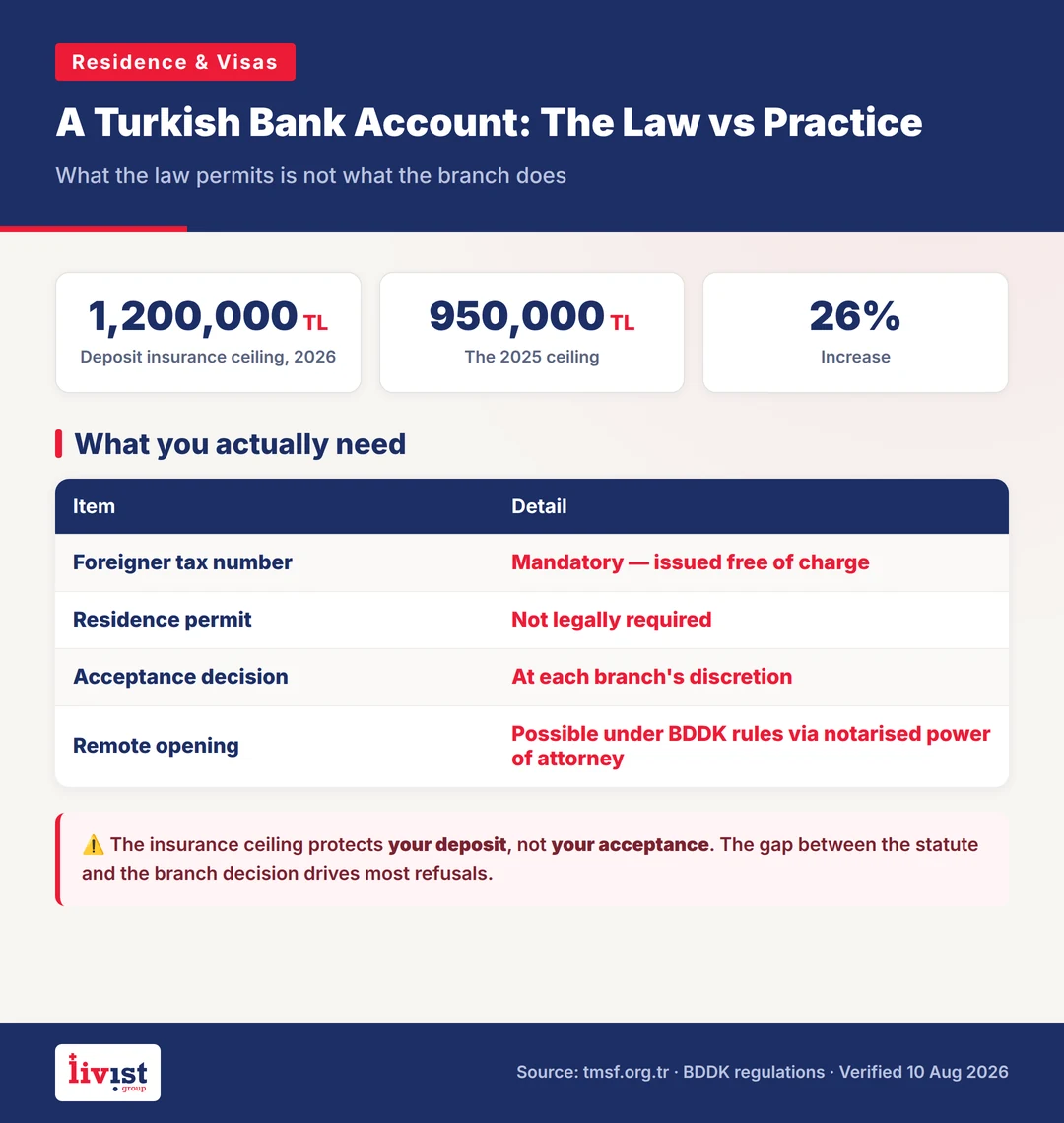
A foreigner opens a bank account in Turkey with a valid passport (under 10 years old), a Turkish tax identification number and proof of address; on İşbank's official checklist a residence permit is an alternative ID, not a condition. Since **27 June 2026**, MASAK Communiqué No. 32 also permits remote onboarding by NFC-chip passport and video call. Your deposits are insured up to **1,200,000 TRY** for 2026 under Banking Law No. 5411.
| Item | Verified value | Source | Verified on |
|---|---|---|---|
| Deposit insurance ceiling, 2026 | **1,200,000 TRY** per person, per credit institution | Savings Deposit Insurance Fund (TMSF), official FAQ | 8 Sep 2026 |
| Ceiling in 2025 | **950,000 TRY** | TMSF | 8 Sep 2026 |
| Historical series | 2022: 200,000 · 2023: 400,000 · 2024: 650,000 · 2025: 950,000 · **2026: 1,200,000 TRY** | TMSF | 8 Sep 2026 |
| Effective date of the 2026 ceiling | **01.01.2026** — raised annually by Fund Board decision using the revaluation rate | TMSF | 8 Sep 2026 |
| Legal basis | Article 63(3), Banking Law No. **5411**, and the regulation gazetted 07.11.2006 No. 26339 | TMSF | 8 Sep 2026 |
| Coverage scope | Lira **plus foreign-currency and precious-metal deposits**, participation accounts and special current accounts at domestic branches — **mandatorily including branches of foreign banks operating in Turkey** | TMSF | 8 Sep 2026 |
| Excluded from coverage | Deposits of official institutions and of credit and financial institutions | TMSF | 8 Sep 2026 |
| Ceiling in USD | approx. **25,200 USD** at a selling rate of 47.6085 TRY | Central Bank of Türkiye bulletin 2026/146, dated 07.08.2026 | 8 Sep 2026 |
| Ceiling measured against wages | approx. **43×** the 2026 net monthly minimum wage (28,075.50 TRY) | Ministry of Labour and Social Security | 8 Sep 2026 |
| Online tax number service for foreigners | **Officially live and public** — form requires no login and has no payment step | Turkish Revenue Administration (GİB), dijital.gib.gov.tr | 8 Sep 2026 |
| Banks publishing a minimum opening deposit on their official site | **Zero out of six** | Six banks' official websites | 8 Sep 2026 |
| Only bank with a confirmed dedicated foreigner section and Arabic interface | **Kuveyt Türk** — Expat Banking | kuveytturk.com.tr | 8 Sep 2026 |
| Remote account opening for foreigners by passport | **Permitted since 27.06.2026** — NFC-chip passport (ICAO 9303) + video call; address confirmed within 3 months | MASAK Communiqué No. 32, Art. 4/C — Official Gazette No. 33293 | 8 Sep 2026 |
| Residence permit as a condition | **No** — İşbank's official checklist: passport (not older than 10 years) **or** residence permit; tax number **or** Foreigner's ID number; proof of address | isbank.com.tr, Become Our Customer | 8 Sep 2026 |
Direct answer: A foreigner can open a bank account in Turkey in person with a valid passport (not older than 10 years), a Turkish tax identification number and proof of address; on İşbank's official checklist a residence permit is an alternative to the passport, not an extra condition. Since 27 June 2026, MASAK Communiqué No. 32 also lets Turkish financial institutions onboard foreigners remotely, by NFC-chip passport and video call, with address confirmation due within three months. The final decision still sits with each bank's policy and the branch.
Search this question in English and one results page will hand you four incompatible answers: private banks refuse non-residents; nothing is legally required; every branch applies its own discretion; and people who actually tried report difficulty even with a residence permit. They are describing one reality from four angles — and none of them names it. The gap is between what is regulated and what the counter decides. This guide is built on that gap, and states plainly what we verified and what we could not.
Does a foreigner need a residence permit to open a bank account in Turkey?
The honest answer is more precise than yes or no. We found no published regulation that requires a residence card to open a bank account in Turkey. What we could read, on 8 September 2026, is a bank's own official checklist: İşbank asks for "your valid passport, not older than 10 years, or (if applicable) valid residence permit", a Foreigner's Identification Number or Tax Identification Number, and proof of address. On that list the residence permit is one of two accepted identity documents — not a condition.
What is not in dispute is that the decision is made at branch level, within the bank's own policy and its know-your-customer and anti-money-laundering procedures. That single fact explains the phenomenon everyone finds baffling: same nationality, same documents, two branches, two outcomes.
Bank account in Turkey for foreigners: what is published vs. what the branch asks for
| Element | What we could evidence from a published source | What happens at the branch |
|---|---|---|
| Residence card | Not a condition on the one official bank checklist we could read: İşbank lists "valid passport, not older than 10 years, or (if applicable) valid residence permit" — the permit is an alternative ID, not a requirement (isbank.com.tr, read 8 September 2026) | Frequently requested; alternatives accepted at some branches |
| Tax identification number | The Revenue Administration's online service for foreigners is officially live | Required in practice, without exception |
| Proof of address | İşbank's official list: proof of a valid residence address in Turkey — e.g. an electricity, water, gas or phone bill in your name issued in the last three months — or the printed address on your passport (read 8 September 2026) | Usually requested — registered lease, utility bill, or address registration |
| Turkish mobile number in your name | Absent from the banks' official pages | A near-universal practical condition for app activation and security messages |
| Deposit protection | Officially confirmed — 1,200,000 TRY for 2026 (TMSF) | Applies automatically; nothing to request |
| Final decision | Within the bank's policy | Branch and officer discretion |
One more thing most guides omit because it undercuts the sales pitch: users who have actually gone through it report difficulty even holding a valid residence permit. That is not a rare edge case, and not evidence that you did something wrong. Treat refusal as a live possibility and prepare a fallback — covered at the end of this guide.
Documents to open a bank account in Turkey as a foreigner, in the order to obtain them
The sequence is not cosmetic. Each item depends on the one before it, and skipping ahead is the most common cause of a second and third trip to the branch.
| # | Document | Where from | Note |
|---|---|---|---|
| 1 | Valid passport | Your home country | Some branches request a certified translation of the data page |
| 2 | Tax identification number | Revenue Administration digital portal ("potential tax ID for foreigners") or a tax office | Public online form on dijital.gib.gov.tr — no login and no payment step in the form (read 8 September 2026) |
| 3 | Proof of address | Registered lease · utility bill · address registration | Usually required, though absent from the banks' published lists |
| 4 | Turkish mobile number in your name | A local operator | Practical prerequisite for digital banking activation |
| 5 | Residence card or title deed | Migration directorate / land registry | Not a published requirement, but materially improves your odds |
The Turkish tax number: the real starting line for a foreigner's bank account
The Turkish Revenue Administration (GİB) operates an official service for foreigners to request a potential tax identification number through its digital portal, "Yabancılar İçin Potansiyel Vergi Kimlik Numarası Başvurusu". We opened the form on 8 September 2026: it is public, requires no login, and asks for your name, gender, date and place of birth, parents' names, country, passport number with issue and expiry dates, a mobile number and an address. There is no fee field and no payment step in the form. The number is what every bank, and the remote-onboarding rules below, will key your file to — obtain it first.
How to open a bank account in Turkey as a foreigner: step by step at the branch
- Obtain the tax identification number. Everything downstream depends on it.
- Assemble proof of address in a form the branch accepts — a registered lease or a bill in your name.
- Activate a Turkish mobile number in your own name before the visit, not after.
- Phone the specific branch first and ask for its checklist, not the website's. This single call prevents most refusals.
- Choose a branch in an area with a substantial foreign population, or one advertising language support; procedural familiarity is a real variable.
- Attend with originals, sign, and activate digital banking and the card before you leave — testing the login in front of the officer.
Opening a Turkish bank account online or remotely: two mechanisms, not one
This is where the most widely repeated error in the field lives, including on pages that look authoritative:
- Remote identity verification (uzaktan kimlik tespiti): a regulated mechanism based on a video call and the reading of an electronic identity document. Until mid-2026 the anti-money-laundering rules (MASAK General Communiqué No. 19) built it around the Turkish ID card, which is why foreigners were in practice sent to a branch. That changed on 27 June 2026 — see the next section.
- Opening via notarised power of attorney (vekâletname): a civil-law instrument by which you appoint a representative. This is not "remote opening" in the regulatory sense, and its acceptance is a matter of each bank's policy.
The very common phrasing "you can open remotely under BDDK rules via a notarised power of attorney" fuses the two into one sentence and produces an inaccurate claim even though each half may be defensible alone. Do not sign a power of attorney or pay notary fees until the bank confirms in writing that it accepts that route for your situation.
Remote bank account opening for foreigners by passport since 27 June 2026: MASAK Communiqué No. 32
On 27 June 2026 the Official Gazette (No. 33293) published MASAK Communiqué No. 32, in force the same day, which adds Article 4/C to General Communiqué No. 19. For the first time it lets Turkish financial institutions — banks included — identify a non-Turkish national remotely, using the passport alone. We read the full text on 8 September 2026; these are its conditions, stated as the regulation states them:
| Condition in Article 4/C | What it means for a foreigner opening a Turkish bank account remotely |
|---|---|
| Passport compliant with ICAO 9303 and equipped with NFC (near-field communication) | Only a chip passport qualifies; the chip data must match the printed page, and if that check fails, no remote relationship can be opened |
| Video call with specially trained staff | A live interview, not an upload; AI liveness and photo-matching tools may assist but do not replace it |
| Address confirmed within three months | Residence document, a utility bill in your name from the last three months, a public-institution document, or the home country's public databases — no transfers or cash withdrawals until the address is confirmed |
| First transaction: a transfer from an account or card in your own name | From a bank in Turkey or abroad; it must arrive before any other operation on the account |
| Funds flow only to and from your own accounts abroad | Third-party transfers are excluded until identity is later verified in person under Article 6(2) |
| High-risk monitoring and country exclusions | Every institution decides which nationalities it will not onboard this way and must notify MASAK of its procedures within a month of starting |
"Yükümlüler Türk uyruklu olmayan gerçek kişilerin kimlik tespitini ... Uluslararası Sivil Havacılık Teşkilatının (ICAO) 9303 sayılı standardına uygun, yakın alan iletişimi özelliği olan pasaport kullanılmak suretiyle uzaktan kimlik tespiti yoluyla yapabilirler."
— "Obliged parties may perform the identification of natural persons who are not Turkish nationals ... by remote identification using a passport that complies with ICAO standard 9303 and has a near-field communication feature." MASAK General Communiqué No. 19, Article 4/C(1), as amended by Communiqué No. 32, Official Gazette No. 33293, 27 June 2026.
Two cautions keep this honest. First, the communiqué permits the route; it does not oblige any bank to offer it, and each bank must first build its own procedures — so "does your bank onboard foreigners by passport under Communiqué No. 32?" is now the precise question to ask, in writing. Second, an account opened this way is deliberately restricted until you confirm an address and complete an in-person check; it is a door, not a full-service account on day one.
Ziraat Bank account opening online for foreigners: the specific answer
"Ziraat Bank open account online" is one of the most searched phrasings in English, so it deserves a direct answer: Ziraat Bankası operates an English-language site and the widest branch network in Turkey, but like the other five banks reviewed it publishes no minimum opening deposit, and its account-opening conditions are JavaScript-rendered and could not be extracted. Ask the branch in writing whether it has launched the passport-based remote route under MASAK Communiqué No. 32 before assuming an online path exists for a non-resident.
Best bank in Turkey for foreigners: six banks compared, including what is not published
This table differs from every comparison table circulating on this topic in one respect: the blanks are written out instead of filled in with guesses. Any bank that publishes no figure on its official site appears here as "not published", and that is itself information you can act on.
| Bank | Type | Minimum deposit published officially | Language support confirmed on site | Note |
|---|---|---|---|---|
| Ziraat Bankası | Conventional — state | Not published | English: yes · Arabic: unverified | Widest branch network in Turkey |
| İş Bankası | Conventional — private | Not published | English: yes · Arabic: unverified | Strong digital banking presence |
| Kuveyt Türk | Participation | Not published | English and Arabic: confirmed | The only one with a dedicated Expat Banking section |
| Albaraka Türk | Participation | Not published | English: yes · Arabic: unverified | Highest domain authority of the three participation banks |
| Ziraat Katılım | Participation | Not published | English: yes · Arabic: unverified | Participation arm of a state bank |
| HSBC Türkiye | Conventional — international | Not published | English: yes · Arabic: unverified | Its YUVAM lira deposit is, per HSBC's own listing, for citizens of the Republic of Turkey resident abroad — not a route for a non-Turkish foreigner |
Method: all six official sites were opened on 9 August 2026. Their account-opening pages are JavaScript-rendered and could not be read, so no figure was carried over from any intermediary site or blog. The material conclusion stands on its own: not one of the six publishes a minimum opening deposit. If someone quotes you a number, ask for the link.
Participation (Islamic) bank accounts in Turkey for foreigners, briefly
Three of the six are participation banks (Kuveyt Türk, Albaraka Türk, Ziraat Katılım), operating on profit-sharing rather than interest. Practically, returns are presented as a profit-share ratio rather than an interest rate — and, importantly, participation accounts and special current accounts are covered by deposit insurance on the same footing as conventional deposits. That last point is routinely omitted and is worth knowing before you choose.
Cost of opening a bank account in Turkey for foreigners: why no minimum deposit is published
Because in most cases the minimum opening deposit is not an institutional published figure at all. It is a practice that varies by branch and account type and changes without notice. Any article handing you a per-bank table of deposit figures is almost certainly relaying blog content rather than bank disclosure.
What you can pin down at opening, and should request in writing: account maintenance charges, card issuance and annual renewal fees, international transfer (SWIFT) charges and who bears the correspondent bank's cut, the currency conversion margin, and any dormancy fee. For most foreigners the conversion margin and transfer charges outweigh every other line item combined.
A Turkish bank account deposit is not proof of funds for a residence permit
This confusion costs people real money in needlessly frozen balances. An opening deposit is what the bank wants in order to run the account. Proof of sufficient and regular income is a separate requirement imposed by the migration authority for specific permit categories — the long-term residence permit being the clearest example — assessed by a different body against different criteria. Never freeze funds on an intermediary's advice without seeing the requirement attributed to the authority that imposes it. See types of residence permits in Turkey for which category requires what.
How protected is a foreigner's money in a Turkish bank account? TMSF cover for 2026
This is the single most solidly verified fact in this guide — and the one where competing content is most often out of date, still quoting the 2025 figure.
| Year | Coverage per depositor, per institution |
|---|---|
| 2022 | 200,000 TRY |
| 2023 | 400,000 TRY |
| 2024 | 650,000 TRY |
| 2025 | 950,000 TRY |
| 2026 | 1,200,000 TRY — effective 01.01.2026 |
Source: the Savings Deposit Insurance Fund (TMSF); legal basis Article 63(3) of Banking Law No. 5411 and the regulation gazetted on 07.11.2006 under No. 26339. The ceiling is raised annually by Fund Board decision using the revaluation rate announced for the preceding year — meaning the 2027 figure will certainly differ. Always read the number together with its year.
The Fund's own FAQ, re-read on 8 September 2026, answers the non-resident question directly: "Yurtdışında yaşayan yerli veya yabancı kişilere ait yurtiçi şubelerde bulunan mevduat hesaplarının anaparaları ... 1.200.000 TL'ye kadar sigorta kapsamındadır" — deposits held at domestic branches by Turkish or foreign persons living abroad are covered up to 1,200,000 TRY.
Three details rarely mentioned: coverage includes foreign-currency and precious-metal deposits, not only lira; it includes participation accounts and special current accounts; and it mandatorily includes branches of foreign banks operating in Turkey. Excluded are deposits of official institutions and of credit and financial institutions.
For scale: 1,200,000 TRY is roughly 25,200 USD at the 47.6085 selling rate in Central Bank bulletin 2026/146 dated 07.08.2026, and about 43× the 2026 net monthly minimum wage of 28,075.50 TRY. In practice, the overwhelming majority of personal accounts are fully covered.
If you would rather not learn the branch-by-branch variation through trial and error, Livist shortlists the bank and the branch against your actual profile — resident, property owner, student or company — before you travel to one.
If a Turkish bank refuses your account: the fallback plan for foreigners
- Try a different branch of the same bank. The decision is branch-level, not institutional; this is the single highest-yield move.
- Try a branch in an area with a large foreign population — procedural familiarity genuinely changes outcomes.
- Ask whether the bank onboards foreigners remotely by passport. Since 27 June 2026 MASAK Communiqué No. 32 permits it with an NFC-chip passport and a video call; a bank that has built the procedure can open the account without a branch visit. Do not confuse this with YUVAM, which is a deposit product for Turkish citizens living abroad.
- Re-check your paperwork before a third attempt. The blocker is usually proof of address or the phone number, not your nationality.
- Regularise your residence status if you can. A residence card is not a published requirement, but it materially improves your odds — see e-ikamet application steps, and for property owners, our guide to the real estate residence permit in Turkey.
Do you need a Turkish bank account at all? The question sellers avoid
If your need is hotel bookings and holiday spending, you very likely do not need a Turkish account; an international card handles it without branch queues or maintenance fees. The account becomes genuinely necessary once recurring local obligations enter the picture — rent and utilities, salary, school fees, instalments, or transactions attached to a title deed or a company. See title deed (tapu) steps in Turkey if a purchase is your driver, and tourist residence permit renewal if you are planning to stay. Start from the use case, then choose the bank — reversing that order is how people end up with accounts they never use and fees they keep paying.
Open your bank account in Turkey with Livist Group: file preparation and branch support
Three sentences carry this guide. First: a passport, a tax number and proof of address are the published requirements, a residence permit is an alternative ID rather than a condition, and since 27 June 2026 a remote passport-and-video route exists on paper — but in practice the branch, or the bank's remote-onboarding policy, decides. Second: none of the six banks publishes a minimum opening deposit, so any figure presented to you needs a link behind it. Third: your deposits are protected up to 1,200,000 TRY for 2026 under Banking Law No. 5411, across lira, foreign currency and precious metals alike.
And a caveat we would rather state than bury: the decision remains the bank's alone and no intermediary can guarantee it — what Livist can do is prepare the tax number, proof of address and bank file in the right order and accompany you at the branch, which is where most avoidable refusals are actually lost.
Frequently asked questions
Answers to the most common questions about this topic

Universities in Turkey 2026: Rankings, Fees, Admission
Universities in Turkey by official figures: 128 state and 75 foundation universities, QS 2027 ranks, tuition under Decision 11625, and scholarships.

Driving Licence Exchange Turkey 2026: The Six-Month Rule
Driving licence exchange turkey rules: six months for foreigners and two years for citizens from the date of entry, plus documents and fees.

Company Formation in Turkey for Foreigners 2026 Guide
Company formation in turkey for foreigners: minimum capital after the 2024 decision, the MERSIS steps and the 2026 corporate tax rates.