Closed Neighborhoods in Turkey 2026: Official vs. Circulated vs. Rumor
The official figure is 1,169 closed neighborhoods per the Migration Directorate announcement of 30 June 2022 — not 1,200. A dated breakdown of what is official, what is copied, and what the 2026 removal rumor is actually based on.

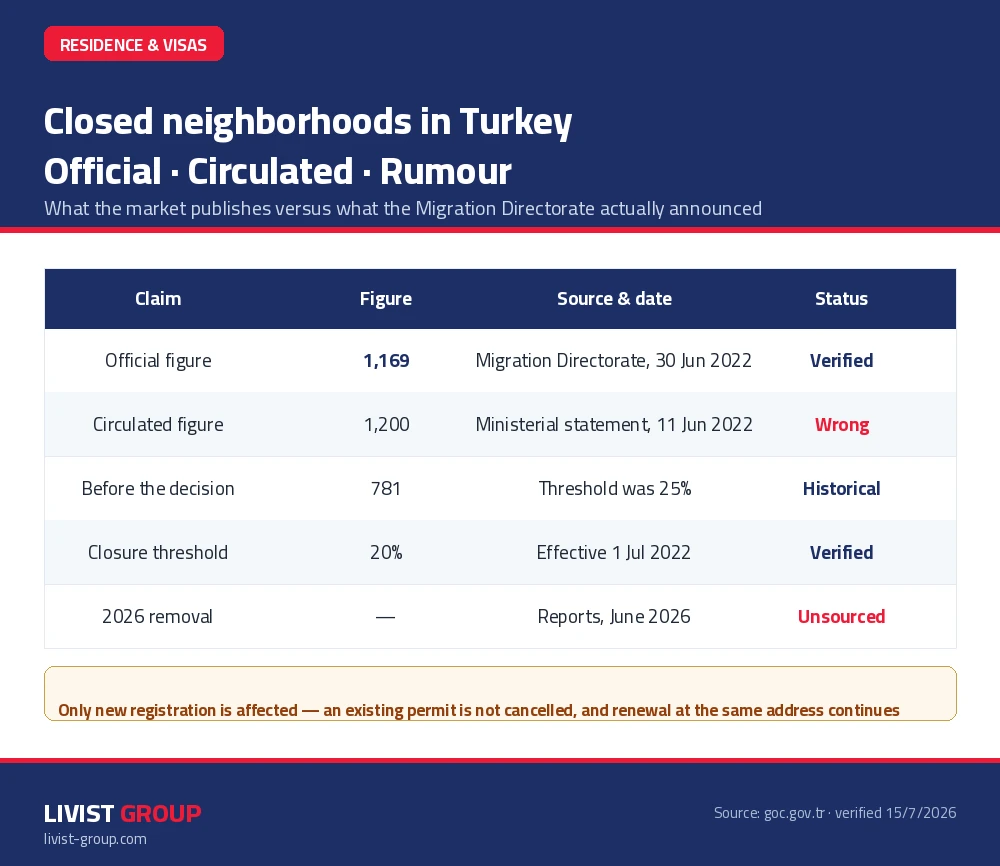
Closed neighborhoods are mahalle-level areas where the Migration Directorate will not register a new foreign address. The official figure is 1,169 neighborhoods across 63 provinces, per the announcement issued 30 June 2022, effective 1 July 2022. Closure blocks new registration and address transfers only — it does not cancel an existing permit or stop renewal at the same registered address.
| Indicator | Value |
|---|---|
| Official figure | 1,169 neighborhoods |
| Provinces | 63 |
| Announced | 30 June 2022 |
| Closure threshold | 20% |
| "1,200" | Circulated, not official |
Reviewed by the Livist team. Every figure below is dated to its source. Last verification of the official Migration Directorate page: 15 July 2026. Administrative lists can be updated without prior notice — verify your specific neighborhood before any financial commitment.
Which districts are closed for residence permits in Turkey?
The dated table: official vs. circulated vs. rumor
This table is the article. Each row is dated to its source and sorted into one of three tiers of reliability that should never be blended.
| Claim | Tier | Source & date | Verdict |
|---|---|---|---|
| 1,169 closed neighborhoods | ✅ Official | Migration Directorate (goc.gov.tr) announcement, 30 June 2022, effective 1 July 2022, with an attached Excel file listing every neighborhood | The correct figure. Live check 15 July 2026: the page still shows 1169, unchanged |
| "1,200 neighborhoods" | ⚠️ Circulated (wrong) | Interior Minister Süleyman Soylu — Anadolu Agency, 11 June 2022: "781 will rise to 1,200" | A statement made before the actual list was published. The official list later came in at 1,169. Not a current official figure |
| 781 neighborhoods | ✅ Official (superseded) | The position before the 1 July 2022 decision | Historically accurate, now obsolete |
| Foreign-resident cap cut from 25% to 20% | ✅ Official | The basis that raised the count from 781 to 1,169 as of 1 July 2022 | Correct |
| "The rule was removed in 2026" | ❌ Rumor | Heavy circulation on Facebook and X since June 2026; the only root source is a Türkiye Today article dated 6 June 2026 whose headline literally contains the word reportedly | No official basis. No announcement on goc.gov.tr and no coverage in any major Turkish outlet (checked 15 July 2026) |
| Property-based residence is exempt | ❌ Market myth | No property exemption appears in the text of the 2022 announcement | False. The only exemptions in the text are newborns and nuclear-family reunification |
| USD 200,000 property-residence threshold | ✅ Official | In force since 16 October 2023 | Correct — but it is a 2023 change, not a 2026 one as it is sometimes presented |
The official number: 1,169 since 1 July 2022
Per the Turkish Migration Directorate (Göç İdaresi) announcement issued 30 June 2022 and effective 1 July 2022, the number of neighborhoods closed to new foreign address registration is 1,169. This is not a press quote — it is a published administrative decision, and it ships with an Excel file listing every neighborhood and its province. That attachment is precisely what makes it the only citable reference on this topic.
In a check performed by the Livist team on 15 July 2026, the official page still displays 1169, unchanged.
A simple professional test: any figure on closed neighborhoods that does not trace back to the 30 June 2022 announcement and its Excel attachment is a copied number, not a sourced one.
Where "1,200" came from — and why it is wrong
This is the most widespread error in both English and Arabic coverage of the topic. On 11 June 2022 — roughly three weeks before the actual list was published — then-Interior Minister Süleyman Soylu told Anadolu Agency that the existing 781 closed neighborhoods "will rise to 1,200."
That was a pre-announced projection, not a final count. When the actual list landed on 30 June 2022, the figure was 1,169 — 31 short of the ministerial estimate.
What happened next is ordinary content decay: outlets and agencies picked up the headline number, copied it from each other for four years, and now present "1,200" as the current official figure. It is not. It is a projection that a subsequent official list superseded.
The sequence in three lines
| Date | Event | Figure |
|---|---|---|
| Before 1 July 2022 | Prior position (25% foreign-resident cap per neighborhood) | 781 neighborhoods |
| 11 June 2022 | Soylu statement to Anadolu Agency — a forward projection | "will rise to 1,200" |
| 30 June 2022 (effective 1 July 2022) | Official list + Excel file — cap cut to 20% | 1,169 neighborhoods |
What is the 20% rule?
The administrative basis is a ceiling on the share of foreign residents in a single neighborhood. The cap was 25%. When it was lowered to 20% effective 1 July 2022, a larger set of neighborhoods automatically crossed the threshold — which is the entire explanation for the jump from 781 to 1,169. The policy logic is not to exclude foreigners from a given city; it is to distribute foreign residential density across neighborhoods.
For an investor, the practical consequence is that closure status is a function of a demographic ratio, not a permanent designation. A neighborhood's status can move as its ratio moves — which is exactly why a four-year-old list should never be treated as today's answer.
Where the closures are concentrated: 63 provinces
The 1,169 neighborhoods span 63 provinces — so this is not the Istanbul-only phenomenon it is usually assumed to be. The leaders:
| Province | Closed neighborhoods |
|---|---|
| Şanlıurfa | 169 — the highest |
| Hatay | Second |
| Kilis | 82 |
(Source: Enab Baladi, New Turk Post — reporting the official list. The remaining detailed distribution should be read from the official Excel file or confirmed with the provincial migration directorate.)
Istanbul — per the 2022–2023 announcements
In Istanbul, the districts of Fatih and Esenyurt were announced as fully closed. Eight further districts were then added per Soylu's statements and Anadolu Agency reporting:
Küçükçekmece · Başakşehir · Bağcılar · Avcılar · Bahçelievler · Sultangazi · Esenler · Zeytinburnu.
Methodological warning: this list reflects 2022–2023 announcements. It is not a definitive 2026 list. The administrative status of any specific neighborhood may differ today. Do not underwrite a purchase against this list — verify your target neighborhood using the methods below.
Is the closed-neighborhood rule removed in 2026?
Since June 2026, posts claiming Turkey has lifted the closed-neighborhood restrictions have circulated heavily on Facebook and X, drawing thousands of interactions. The Livist team traced the claim to its root. Here is the result of that verification, as of 15 July 2026:
- No official announcement. The announcements (duyurular) page on goc.gov.tr contains no 2026 announcement concerning neighborhoods whatsoever.
- No Turkish media coverage. Nothing in Anadolu Agency, Hürriyet, NTV, Habertürk, or Milliyet. A policy change of this scale does not pass silently through the Turkish press.
- A single root source. One article in Türkiye Today dated 6 June 2026, whose headline literally contains the word "reportedly." Its author is an immigration consultant at a private firm. Its sole evidence is the behavior of the e-ikamet system — block messages disappearing on address entry — not a published decision.
The neutral conclusion: the reports exist and we do not dismiss them; but there is no official basis for them to date. A change in an online system's behavior could mean an actual policy shift — or a technical update, a temporary fault, or an ungeneralized change. For an investor, the gap between those readings is the gap between a functioning residency plan and a seven-figure asset that cannot support one.
The operating rule: do not buy property, sign a lease, or transfer your address on the strength of these reports. Verify administratively with the provincial migration directorate first — and get the answer fixed before any financial commitment.
Can I get residency if I buy property in a closed district?
No — and this is the most expensive error in the entire file, because unlike the others it costs real money.
Property-based residence is sometimes marketed as a key that "opens" closed neighborhoods. It is not. No property exemption appears anywhere in the text of the 2022 announcement. The only two exemptions in the text are newborns and nuclear-family reunification. The practical outcome is that a buyer can hold clean title to an apartment, be unable to register their address in it, and therefore be unable to obtain the property-based residence permit that justified the purchase.
On the threshold itself, for accuracy: the property-residence minimum is USD 200,000 for a residential property, a change in force since 16 October 2023 — not a new 2026 rule, however often it is presented as one in recycled content.
What this means for your underwriting
- Neighborhood status is a due-diligence line item, ranking alongside title, valuation, and the USD 200,000 threshold — not below them.
- Meeting the financial threshold is necessary, not sufficient. A compliant USD 200,000 apartment in a closed neighborhood still yields no residence permit.
- Verify at the mahalle level, not the district level. Closure is decided per neighborhood; a popular district can contain both open and closed neighborhoods.
- Rental yield is unaffected by closure — the asset still performs as an asset. What closure removes is the residency utility. Know which of the two you are actually buying.
For how the permit types differ and which one your capital actually supports, see Turkish residence permit types.
Does closure cancel an existing permit?
No — and this distinction matters for portfolio planning as much as for individuals.
Closure applies to new registration and address transfers into a closed neighborhood. It does not cancel an existing permit. Anyone registered in a neighborhood before it closed continues to renew at the same previously registered address in practice.
| Scenario | Effect |
|---|---|
| New foreign address registration in a closed neighborhood | ❌ Not accepted |
| Transferring your address into a closed neighborhood | ❌ Not accepted |
| Your existing permit in a neighborhood that closed after you registered | ✅ Not cancelled |
| Renewal at the same previously registered address | ✅ Continues in practice |
| A newborn in the neighborhood | ✅ Exempt per the announcement text |
| Nuclear-family reunification | ✅ Exempt per the announcement text |
The exposure, then, is on acquisition and mobility, not on incumbency. If you already hold and occupy, closure is not your problem. If you are buying, relocating, or housing staff or family in a new address, it is the first thing to check.
How do I check if a neighborhood is open?
Start with the uncomfortable fact: there is no official neighborhood lookup tool — no page where you type a neighborhood name and get its status. Anything claiming to be one is not official.
The three methods that actually work
- The official file. The Excel attachment to the announcement at goc.gov.tr/mahalle-kapatma-duyurusu-hk2. This is the published reference — but note that it reflects the 2022 list.
- The provincial migration directorate. The most accurate and most current route. Ask about the neighborhood by name and province, and get the answer fixed in writing where possible.
- An e-ikamet entry attempt. If the system rejects the address, that is a practical signal. See the e-ikamet system guide for the entry steps.
Beware unofficial "neighborhood checkers"
Various agencies circulate tools branded as neighborhood checkers, or internal lists. These are not official — they are typically built on the same 2022 list or on stale information, and they are not a defensible basis for a capital decision.
A pre-commitment checklist
- Identify the neighborhood by its official mahalle name and province — not by the colloquial district name in the listing.
- Confirm with the provincial migration directorate what the status is today, rather than per any published list.
- Classify your case: new registration, or renewal at an existing address? The second is unaffected.
- Do not price in the 2026 removal rumor until an announcement appears on goc.gov.tr.
- Before signing: verify the property's neighborhood before any deposit or contract.
- Complete the file: a residence permit requires valid health insurance — see health insurance in Turkey.
The full residency picture is in the Turkey residence permit guide 2026.
Why Livist
Our position on this file is simple: we do not relay numbers, we date them. The difference between 1,169 and 1,200 may look like a detail, but it is the difference between an advisor who reads the source and one who copies a four-year-old headline. And where we have no basis — as with the 2026 removal rumor — we say so plainly rather than sell you a certainty we do not have.
We help you fix your neighborhood's status administratively before you commit capital, and structure a residence file that will not be refused over an address. For execution on the ground — property, field procedures, administrative accompaniment — our services arm operates at livist-services.com.
Verify your neighborhood before you commit — talk to Livist →
Frequently asked questions
Answers to the most common questions about this topic

Universities in Turkey 2026: Rankings, Fees, Admission
Universities in Turkey by official figures: 128 state and 75 foundation universities, QS 2027 ranks, tuition under Decision 11625, and scholarships.

Driving Licence Exchange Turkey 2026: The Six-Month Rule
Driving licence exchange turkey rules: six months for foreigners and two years for citizens from the date of entry, plus documents and fees.

Company Formation in Turkey for Foreigners 2026 Guide
Company formation in turkey for foreigners: minimum capital after the 2024 decision, the MERSIS steps and the 2026 corporate tax rates.