Gastric Bypass in Turkey: Cost, Criteria, Risks and Recovery
Gastric bypass in Turkey: what search results quote from €2,750, the official 178,605-lira floor, sleeve and band costs compared, NHS criteria and recovery.

Gastric bypass in Turkey is quoted from about €2,750 to €6,700 for an all-inclusive package in search results, against an official Ministry of Health floor of 178,605 lira (about $3,650). The NHS describes it as keyhole surgery under general anaesthetic, about two hours, that staples a small pouch and joins it to the lower small intestine.
| Item | Detail |
|---|---|
| What it is | Gastric bypass is obesity surgery that staples the stomach into a small upper pouch and connects that pouch to the lower small intestine, cutting both how much you can eat and how much you absorb. |
| Who qualifies | BMI of 40 or above, or 35 to 40 with a qualifying condition. A Middle Eastern family background may lower the threshold (NHS). |
| Operation time | Around 2 hours (NHS). |
| Stay and recovery | 1 to 3 days in hospital; normal activities resume after 4 to 6 weeks (NHS). |
| The risk | 30-day mortality after laparoscopic bypass was **0.22%** in a meta-analysis of 69,494 patients. |
| In Türkiye | Licences are checkable on Ministry of Health lists — for the facility **and** the intermediary agency. |
| Mini bypass cost | €2,350–€4,000 (about $2,670–$4,540) — search-result range, 1 October 2026. |
Gastric bypass in Turkey: on this page
- What gastric bypass surgery actually is
- How gastric bypass surgery is done
- What gastric bypass achieves
- Gastric bypass risks and downsides
- Gastric bypass versus sleeve
- Gastric bypass recovery and the post-op diet
- Who qualifies for gastric bypass
- Having gastric bypass in Turkey
- Gastric bypass cost in Turkey and Istanbul: the official floor first
- Gastric bypass in Turkey in summary
- Sources for this gastric bypass guide
- Plan your gastric bypass in Turkey with Livist Group
What gastric bypass surgery actually is
Gastric bypass is weight loss surgery that works on two fronts at once: it shrinks the stomach, and it shortens the route food takes through the intestine. The stomach is divided in two using a surgical staple, creating a small pouch at the top. That pouch is then attached to the lower part of the small intestine. The stomach holds less, and a stretch of intestine that would have absorbed calories is skipped. This description is the NHS's.
The standard version is known clinically as Roux-en-Y gastric bypass, which is the name you will find in the peer-reviewed studies cited on this page.
Mini gastric bypass: not another name for the same operation
The standard operation (Roux-en-Y) creates two connections between the pouch and the small intestine. The mini version — One Anastomosis Gastric Bypass, OAGB — creates one. They are two different operations, not two names for one, which is why the quote and the discharge report must say which one, in full, before you sign. An abbreviation alone (RYGB, OAGB) is not always enough for a health system back home to act on.
Türkiye's official tariff does not separate them: both are billed under the same line, SP609871 "Obesity — bypass" (tariff table in the cost section below).
How gastric bypass surgery is done
Gastric bypass is keyhole surgery under general anaesthetic that usually takes around two hours; the NHS describes it in four steps:
- Anaesthetic: you are asleep under general anaesthetic.
- Keyhole access: the surgeon works through small cuts in the abdomen.
- Dividing the stomach: "your stomach is divided in 2 using a stomach staple", creating a small pouch at the top.
- Connecting: the pouch is attached to the lower part of the small intestine, so food passes straight into it.
Three mechanisms, in sequence:
1. A smaller stomach. The surgeon staples the stomach into a small upper pouch. The larger part stays in place but food no longer passes through it. A small pouch fills on a small meal, so fullness arrives early.
2. A rerouted path. The pouch is connected directly to the lower small intestine, so food bypasses the rest of the stomach and the first section of intestine.
3. Reduced absorption. Because food skips a stretch of intestine that absorbed sugars and fats, fewer calories enter the body from the same meal.
Gastric bypass operation time against sleeve and band
Source for every figure in this table: NHS, read live on 3 September 2026.
| Procedure | Operation time | Note |
|---|---|---|
| Gastric bypass | Around 2 hours | Stomach stapled in two; pouch joined to small intestine |
| Gastric sleeve | 1 to 3 hours | Around 80% of the stomach is removed |
| Gastric band | 3 to 4 hours | Adjustable band around the upper stomach |
Gastric bypass video: watching the operation without being sold it
"Video of the operation" is a standing search for this procedure, and we do not link a clinic's video. A marketing video shows the best case, not the median one, and the party selling you the operation is not the party who should be explaining it to you.
The animation published by University College London Hospitals NHS Foundation Trust explains it in under two minutes, with no graphic surgical footage and nobody selling anything:
What gastric bypass achieves
Weight loss. Restriction and reduced absorption together produce faster and larger weight loss than diet alone achieves in people with severe obesity.
Effect on associated conditions. Bariatric surgery exists because severe obesity is itself a life-threatening condition; the intended benefit is a reduced disease burden, not an appearance. That is precisely why the eligibility criteria list conditions such as diabetes and high blood pressure as grounds for surgery at a lower BMI — see the eligibility section below.
Early satiety. A small pouch means fullness on a small meal, which is what makes the post-operative diet workable in practice rather than in theory.
What you will not find here: no figure for kilograms lost, and no percentage of excess weight loss. The reason is in the cost section below.
Gastric bypass risks and downsides
Weight loss surgery is common, but its risks are documented. This list is from the NHS risks page:
| Risk | What it is |
|---|---|
| Blood clots | Often start in the lower leg (deep vein thrombosis) and may dislodge and travel to the lungs (pulmonary embolism) |
| Stomach leak | A small chance food leaks into the abdomen after bypass or sleeve, causing serious infection |
| Wound infection | A standard surgical complication |
| Blocked gut | The stomach or small intestine can narrow or become blocked after surgery |
| Gallstones | Small cholesterol stones that can form when weight is lost quickly |
| Excess skin | Folds and rolls remaining after weight loss |
| Malnutrition | The procedure reduces absorption of some essential vitamins and minerals |
Gastric bypass death rate: the number everyone is looking for
A meta-analysis and meta-regression published in Obesity Surgery in 2016 covered 69,494 patients across seventeen studies (literature from 2000 to 2014):
| Surgical approach | 30-day mortality | 95% CI |
|---|---|---|
| Laparoscopic (the approach used today) | 0.22% | 0.09 – 0.40 |
| Open | 0.82% | 0.49 – 1.23 |
The difference between the two was highly significant (p < 0.001), and the authors concluded that laparoscopy is the approach of choice in bariatric surgery.
Two caveats, stated because omitting them would mislead: the paper was published in 2016 and covers literature to 2014, and technique has improved since (the study itself measured a mean mortality reduction of 0.069% as experience accumulated). And the rate is a general one — it belongs to no particular hospital or surgeon.
Gastric bypass side effects: three layers, not one list
The NHS list above is more useful read by when each item appears, because the three layers are not managed the same way:
| Layer | From the NHS list above | When it shows | What reduces it |
|---|---|---|---|
| Direct surgical risk | blood clots · gastric leak · wound infection | days to weeks | the laparoscopic approach — 0.22% 30-day mortality against 0.82% open |
| Later complications | bowel obstruction · gallstones · excess skin | months to years | scheduled follow-up and early detection |
| Permanent, by design | malnutrition — reduced absorption of vitamins and minerals | from month one and never ends | supplements and blood tests for life |
What commercial offers drop is not either of the first two — it is the third. The third layer is not a complication that might happen; it is a certain consequence of how the operation works. Skip the supplements and the periodic blood tests and the bill arrives in years, not in weeks. Which is why "who follows me up after I fly home?" is settled before booking, not after.
Gastric bypass versus sleeve
The mechanical difference is simple: the sleeve removes around 80% of the stomach and leaves the food path intact, so it works on volume alone. The bypass removes no stomach — it divides it and reroutes the path, working on volume and absorption together. Prices and risks are in our guide to gastric sleeve in Turkey.
As for which is "better", the honest answer is that it depends on what you measure. The most recent meta-analysis, published in Surgery for Obesity and Related Diseases in May 2025, compared the two across 333,713 patients (sleeve 172,909; bypass 160,804) at a weighted median follow-up of 34.4 months:
| Outcome | Hazard ratio, sleeve vs bypass | 95% CI | Reading |
|---|---|---|---|
| All-cause mortality | 0.85 | 0.79 – 0.92 | Sleeve lower risk |
| Reoperation | 0.69 | 0.59 – 0.80 | Sleeve lower risk |
| Reintervention | 0.74 | 0.66 – 0.81 | Sleeve lower risk |
| Hospitalisation | 0.86 | 0.77 – 0.97 | Sleeve lower risk |
| Endoscopic procedure | 0.55 | 0.40 – 0.76 | Sleeve lower risk |
| Revision | 2.18 | 1.52 – 3.14 | Bypass lower risk |
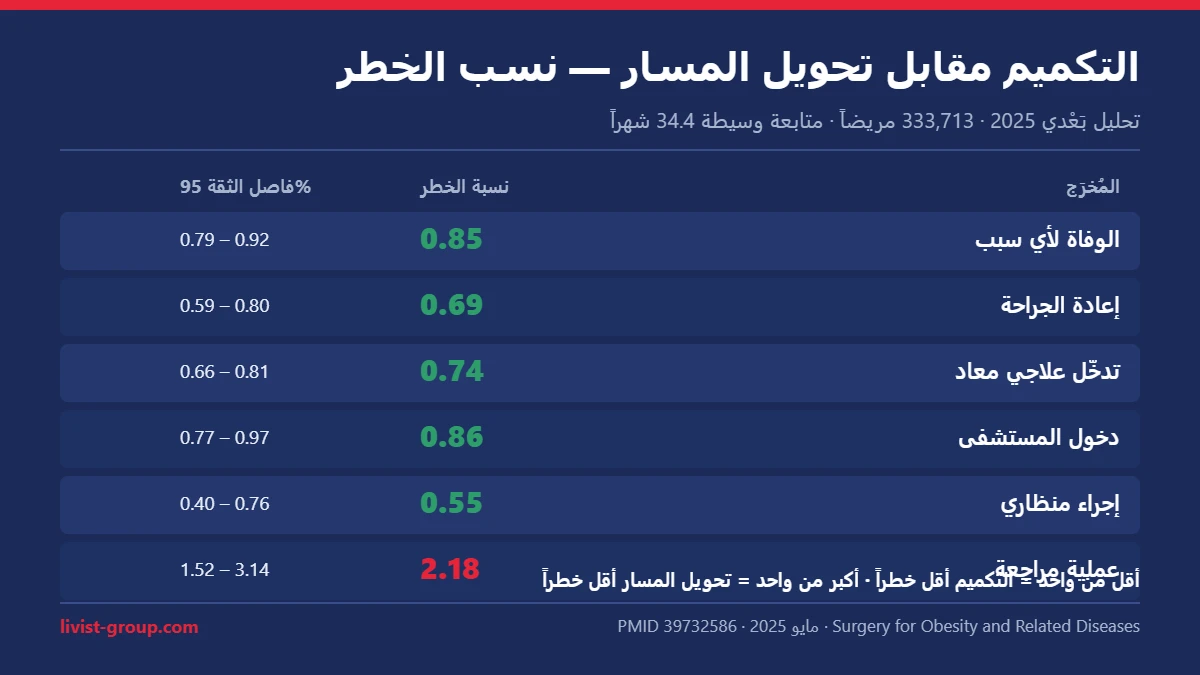
Sleeve gastrectomy versus gastric bypass across six outcomes, from a 2025 meta-analysis rather than a commercial claim.
The honest summary: the sleeve came out ahead on mortality, reoperation, reintervention and hospitalisation — but needed a later revision operation at more than twice the rate. The choice is therefore not "which is safer" but "which risk do you prefer: a slightly higher one now, or a greater chance of a second operation years later". The authors themselves noted that a large randomised trial with long-term follow-up is still needed for confirmation.
This is a clinical decision made with your surgical team, not one made from a table.
Gastric bypass recovery and the post-op diet
Source for every figure below: NHS, read live on 3 September 2026.
| Stage | Duration | What happens |
|---|---|---|
| Hospital stay | 1 to 3 days | — |
| Weeks 1 and 2 | Two weeks | Water and fluids, for example thin soup |
| Weeks 3 and 4 | Two weeks | Runny food, for example yoghurt or puréed food |
| Weeks 5 to 8 | Four weeks | Soft food, for example mashed potato |
| Week 8 onwards | — | Gradual return to a healthy, balanced diet |
| Normal activities | 4 to 6 weeks | — |
| Medical follow-up | For life | Regular follow-up appointments for the rest of your life |
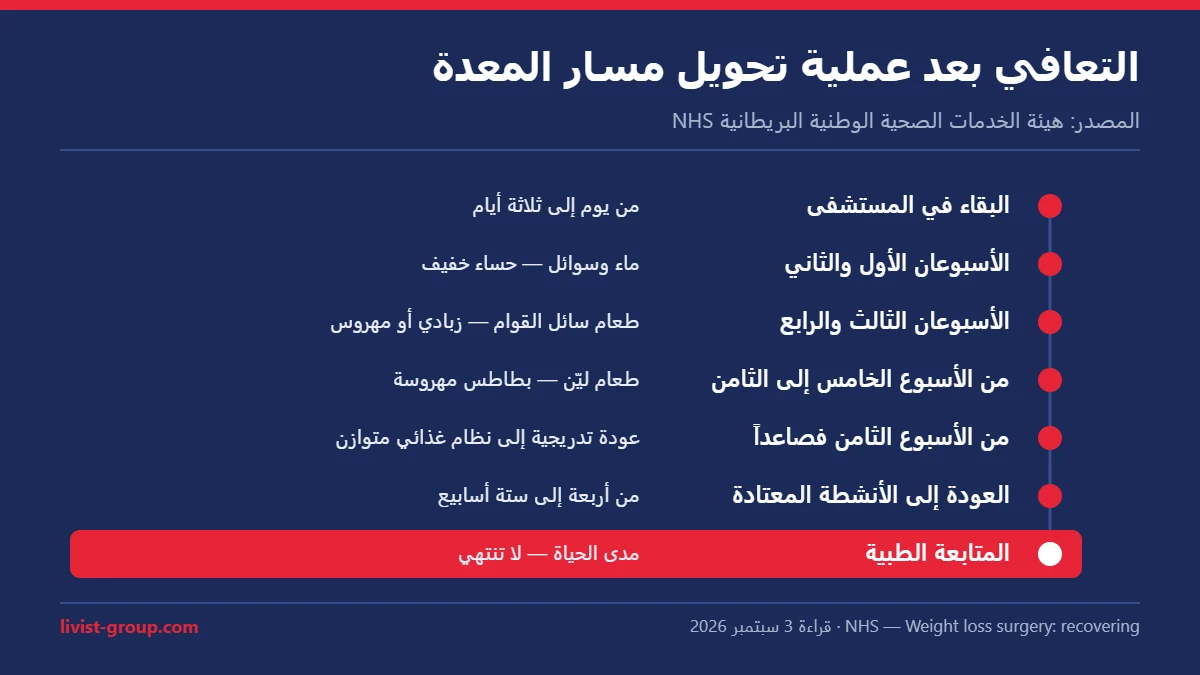
The recovery timeline: one to three days in hospital, the staged post-operative diet, four to six weeks back to normal activity — and lifelong follow-up.
Lifelong follow-up after gastric bypass
The last two rows are not procedural detail — they are a condition of the operation working. The NHS states you will be asked to attend regular follow-up appointments for the rest of your life, and that you must take vitamin and mineral supplements because the procedure reduces absorption.
Which is exactly where treatment abroad gets complicated: the surgery takes two hours, the follow-up takes a lifetime. Who monitors you after you fly home? Settle that before booking, not after. Ask the facility directly: what is the remote follow-up protocol, which vitamin panels are required and when, and which doctor in your own country will read the results.
See also the pre-travel health checkup and what a medical package includes.
How long does gastric bypass surgery take
The question is asked in four different senses and usually answered in only one. Here are all four, separated:
| What are you actually asking? | Duration | Source |
|---|---|---|
| The operation itself | about two hours | — |
| Hospital stay | one to three days | NHS |
| Back to normal activities | four to six weeks | NHS |
| Medical follow-up | for life — it does not end | NHS |
And if the question is really about the length of the trip rather than the length of the operation, the deciding factor is not the surgery but the surgeon's clearance to fly after discharge. Ask for it explicitly before you book the return leg, and do not book a non-changeable one.
Who qualifies for gastric bypass
These are the NHS criteria, the clearest publicly available reference:
| Criterion | Status |
|---|---|
| BMI of 40 or above | Eligible |
| BMI between 35 and 40 with a qualifying condition | Eligible |
| Qualifying conditions | High blood pressure · diabetes · arthritis · breathing problems · asthma |
| South Asian, Chinese, other Asian, Middle Eastern, Black African or African-Caribbean family background | Surgery may be considered at a BMI below 40 |
| Commitment to lifestyle change and post-surgery check-ups | A condition that does not lapse |
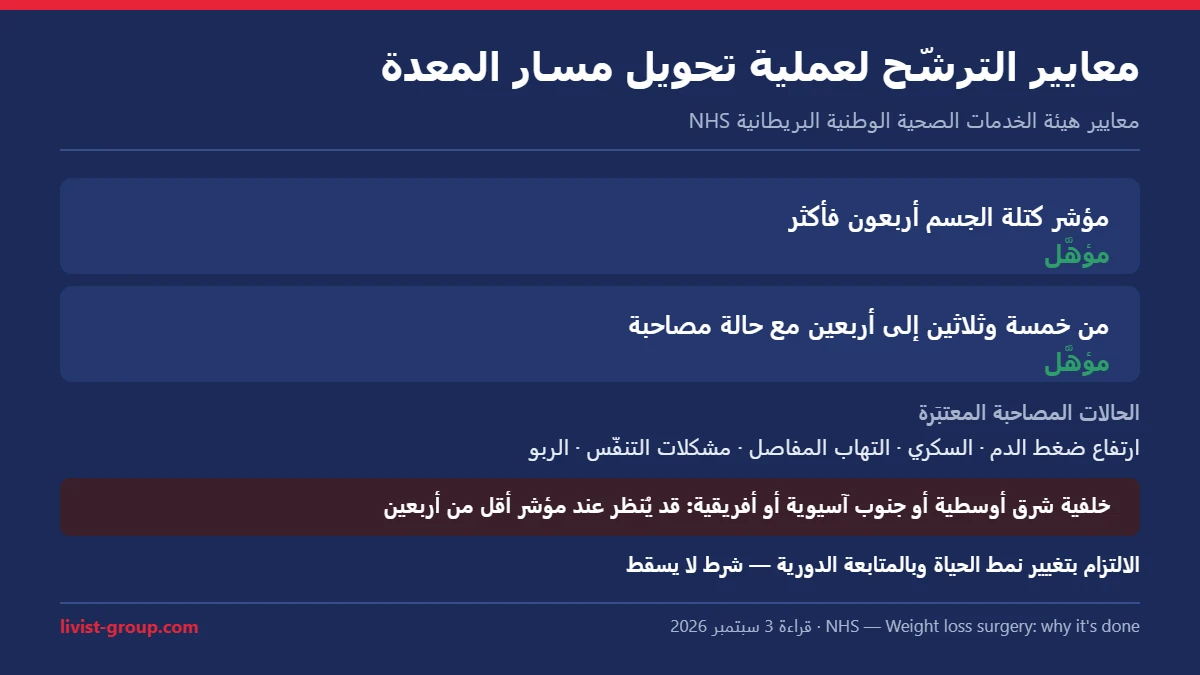
Eligibility criteria as published by the UK National Health Service: body mass index and accompanying conditions.
Gastric bypass BMI threshold for Middle Eastern and Asian backgrounds
The NHS states explicitly that people with a Middle Eastern family background — among others — may be considered for surgery at a BMI below 40. The widely quoted numeric threshold is not one number for everybody, and ruling yourself out because your BMI is "under 40" may be ruling yourself out wrongly.
Equally: eligibility is decided by a clinical team that examines you, not by a table or a BMI calculator. The last row is as much a criterion as the number is.
Having gastric bypass in Turkey
Bariatric surgery licensing in Turkey
Health tourism in Türkiye is governed by the International Health Tourism and Tourist Health Regulation (Uluslararası Sağlık Turizmi ve Turistin Sağlığı Hakkında Yönetmelik), overseen by the Health Tourism Department of the General Directorate of Health Services at the Ministry of Health. The system has two tiers:
- An International Health Tourism Authorisation Certificate for facilities — issued to hospitals and clinics meeting the health tourism certification criteria set.
- Separate authorisation for intermediaries — the agencies and travel companies that refer patients need their own authorisation, and the Ministry publishes updated lists of authorised intermediary organisations.
Checking a gastric bypass facility on the Ministry lists
Check both — the facility and the intermediary. Many patients verify the hospital and forget that the company that booked, corresponded and invoiced is a separate entity with separate authorisation that may not exist. The Ministry's lists are revised periodically, so verify at the time of booking rather than trusting an old screenshot.
What the NHS says about bariatric surgery abroad
The UK Foreign, Commonwealth and Development Office publishes a medical tourism warning in its Türkiye travel advice, noting that 7 British nationals died in Türkiye in 2025 following medical procedures, and that others suffered complications requiring further treatment or surgery.
⚠️ Read that figure precisely. It is a count of deaths among one nationality across all medical procedures combined — the most common of which, per the same text, are cosmetic surgery, dental procedures and cardiac surgery. It is not a mortality rate for gastric bypass and must not be converted into one. For the procedure-specific rate, see the risks section above.
The FCDO also advises discussing your plans with your own healthcare provider first, and warns that a private company's literature should not be your only source of information, since it has a financial interest in booking your treatment. It notes that the Turkish Ministry of Health maintains an approved provider list, while stating plainly that the FCDO itself does not endorse any practitioner or facility.
Travel arrangements for gastric bypass in Turkey
Check Türkiye e-visa requirements before booking, along with health insurance and Istanbul airport transfer — flying home after abdominal surgery is not flying home after a holiday, and the arrangement is settled in advance. If you are comparing destinations within Türkiye, see the best hospitals and clinics in Türkiye and Türkiye travel tips.
Gastric bypass cost in Turkey and Istanbul: the official floor first
"Gastric bypass cost Turkey" is a standing query, and almost every figure circulating for this operation is published by a clinic or an agency — parties with a direct interest in the number. So we start from the government figure, not the market one.
Official gastric bypass floor price — Ministry of Health tariff
Obesity surgery is priced by name in the Public Health Services Price Tariff (EK-2) issued by the Turkish Ministry of Health. Article 12(a) of the implementing provisions (EK-1) makes that tariff a binding floor, not a guide price, for an international patient — in both the public and the private sector:
| Procedure | Tariff code | Turkish lira | US dollars | Pounds sterling |
|---|---|---|---|---|
| Obesity — bypass | SP609871 | 178,605 | 3,650 | 2,754 |
| Obesity — sleeve | SP609872 | 123,038 | 2,515 | 1,897 |
| Obesity — banding | SP609873 | 71,445 | 1,460 | 1,102 |
| Duodenal switch / biliopancreatic diversion | SP609877 | 33,893 | 693 | 523 |
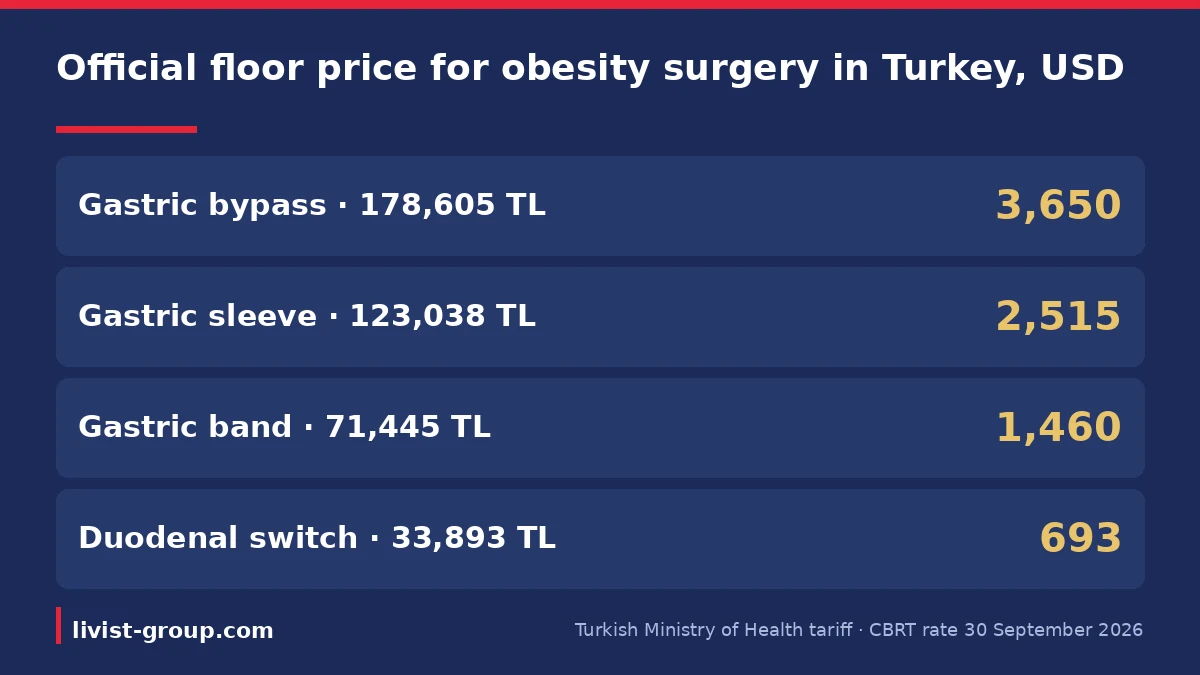
The official price floor for bariatric surgery from the Turkish Ministry of Health tariff, in lira, riyals and dollars.
Conversion: the Turkish central bank's official buying rate, bulletin 2026/165 dated 3 September 2026 (USD 48.2238 · GBP 64.9761). Article g.4 of the tariff provisions requires the invoice to be issued in lira, with collection in a foreign currency at the lira equivalent using the central bank's buying rate on the day of collection — not a rate the facility picks.
Why this table matters more than any marketing figure: it is the one number on this page that no clinic can change. A quote below the line for your procedure is not a better deal — it is a quote that deserves a written question: which items were removed?
Mini gastric bypass Turkey cost
Mini gastric bypass in Turkey is quoted at €2,350 to €4,000 (about $2,670 to $4,540) in search results on 1 October 2026, against the same official floor as a standard bypass, because the Ministry tariff has no separate line for one-anastomosis bypass: 178,605 lira under SP609871.
Gastric bypass market price range — from search results, dated
For comparison only, and because knowing the circulating figure protects you from sticker shock rather than serving as a reference: the ranges search results show for this operation in Türkiye, read live on 4 September 2026, were:
| As presented in the market | EUR | USD (approx.) |
|---|---|---|
| Standard all-inclusive package | €2,750 – €6,700 | $3,120 – $7,610 |
| Mini gastric bypass (OAGB) | €2,350 – €4,000 | $2,670 – $4,540 |
We do not name the sources of those ranges and we do not adopt them. They are commercial package prices whose contents differ fundamentally, and the search results themselves attribute the spread to technique, surgeon experience, facility grade and what the package includes. Comparing two figures without comparing their line items is comparing nothing.
What a gastric bypass offer must include before you compare
The surgery · the hospital nights · pre-operative tests · vitamins and supplements · and the follow-up protocol after you fly home.
That last item is the one that usually disappears from an offer and reappears on a later invoice — and in this operation specifically it is not a luxury but a lifelong safety condition, as set out under side effects above. Package line items are broken down in what a treatment package includes, and other procedure costs in cosmetic surgery in Türkiye.
Gastric surgery in Turkey: bypass, sleeve and gastric band compared
Gastric surgery in Turkey typically costs £2,250–£4,500 (about $3,015–$6,030) for a package that includes the operation, hospital stay, hotel and transfers, according to Google UK search results in October 2026. A gastric band is quoted lower, at $1,500–$4,600. Turkey's Ministry of Health sets a different official minimum for each bariatric operation (EK-2 tariff for international patients, converted at the Central Bank of Turkey rate of 23/10/2026):
| Bariatric surgery in Turkey | What it does | Official minimum (EK-2) | Approx. |
|---|---|---|---|
| Gastric bypass (SP609871) | Small stomach pouch joined to the small intestine | TRY 178,605 | $3,597 / £2,684 |
| Gastric sleeve (SP609872) | Removes most of the stomach, leaving a narrow tube | TRY 123,037.50 | $2,478 / £1,849 |
| Gastric band (SP609873) | Adjustable band around the upper stomach; removable | TRY 71,445 | $1,439 / £1,074 |
Search results describe the usual trip as 3–4 nights in hospital and 6–7 days in Turkey in total, with eligibility generally from a BMI of 35, or 30 with conditions such as type 2 diabetes. Your surgeon decides which operation fits your health, not the price.
Gastric band in Turkey
A gastric band is placed laparoscopically and can be adjusted or removed, unlike a bypass or sleeve. Search results quote $1,500–$4,600 in Turkey and generally list a BMI of 40, or 35 with obesity-related conditions, as the threshold. The official minimum fee for banding is TRY 71,445.
Is weight loss surgery in Turkey safe?
Weight loss surgery carries the same surgical risks in Turkey as anywhere: leaks, bleeding, clots and nutritional problems after a bypass, set out in the risks section above. What changes abroad is follow-up. Choose a licensed hospital, check the surgeon's bariatric experience, and arrange dietitian and blood-test follow-up at home before you fly.
Who is the best bariatric surgeon in Turkey?
There is no official ranking. Look for a general surgeon who specialises in bariatric surgery, operates in a licensed hospital, explains which operation suits you and why, and gives you a written follow-up plan.
Gastric bypass in Turkey in summary
Gastric bypass shrinks the stomach and shortens the absorption path at once. It takes around two hours, is followed by 1 to 3 days in hospital, and normal activities resume within 4 to 6 weeks. Thirty-day mortality for the laparoscopic approach was 0.22% across 69,494 patients.
Against the sleeve, the most recent meta-analysis (2025, 333,713 patients) found the sleeve lower risk for mortality, reoperation and hospitalisation — but the bypass needed a later revision at less than half the rate. The trade-off is a type of risk, not a degree of safety.
And the decisive choice is not the procedure but who performs it and who follows you afterwards: verify the authorisation of the facility and the intermediary on the Turkish Ministry of Health lists at the time of booking, and ask about the lifelong follow-up protocol before you pay.
Sources for this gastric bypass guide
Every source below was opened and read during the session of 3 September 2026.
- NHS — Weight loss surgery, why it's done. Eligibility, BMI thresholds, qualifying conditions, family background. https://www.nhs.uk/conditions/weight-loss-surgery/why-its-done/ — read live 2026-09-03.
- NHS — Weight loss surgery, how it's done. Bypass mechanism and operation times for all three procedures. https://www.nhs.uk/conditions/weight-loss-surgery/how-its-done/ — read live 2026-09-03.
- NHS — Recovering from weight loss surgery. Hospital stay, return to activity, staged diet, lifelong follow-up and supplements. https://www.nhs.uk/tests-and-treatments/weight-loss-surgery/recovering/ — read live 2026-09-03.
- NHS — Risks of weight loss surgery. Clots, leak, blocked gut, gallstones, wound infection, excess skin. https://www.nhs.uk/conditions/weight-loss-surgery/risks/ — read live 2026-09-03.
- Rausa E, Bonavina L, Asti E, Gaeta M, Ricci C. Rate of Death and Complications in Laparoscopic and Open Roux-en-Y Gastric Bypass. A Meta-analysis and Meta-regression Analysis on 69,494 Patients. Obes Surg. 2016 Aug;26(8):1956-63. PMID: 27189352. — read live 2026-09-03.
- Sakurai Y, Balakrishnan P, Kuno T, et al. Comparative survival of sleeve gastrectomy versus Roux-en-Y gastric bypass in adults with obesity: a systematic review and meta-analysis. Surg Obes Relat Dis. 2025 May;21(5):559-569. PMID: 39732586. — read live 2026-09-03.
- UK Foreign, Commonwealth and Development Office — Türkiye travel advice, health. Medical tourism, 2025 death count, Ministry of Health approved provider list. https://www.gov.uk/foreign-travel-advice/turkey/health — read live 2026-09-03.
- Turkish Ministry of Health — Health Tourism Department, General Directorate of Health Services. International Health Tourism Authorisation Certificate, authorised intermediary lists, and the International Health Tourism and Tourist Health Regulation. https://shgmturizmdb.saglik.gov.tr/ — read live 2026-09-03.
- Republic of Türkiye Ministry of Health, General Directorate of Health Services — Public Health Services Price Tariff 2026, Annex EK-2 "Health Services Price Tariff". Obesity surgery codes: SP609871 bypass · SP609872 sleeve · SP609873 banding · SP609877 duodenal switch. https://shgmsgudb.saglik.gov.tr/TR-116727/kamu-saglik-hizmetleri-fiyat-tarifesi-2026-yili.html — file opened and read live 2026-09-04.
- Annex EK-1 "Price Tariff Principles and Procedures" — article 12(a) and article g.4. The first makes the tariff a binding floor for an international patient; the second requires invoicing in lira and collection at the Turkish central bank's buying rate on the day of collection. https://dosyamerkez.saglik.gov.tr/Eklenti/54055/0/ek1-fiyat-tarifeleri-usul-ve-esaslari.pdf — read live 2026-09-04.
- Türkiye Cumhuriyet Merkez Bankası (TCMB) — exchange-rate bulletin 2026/165 dated 3 September 2026, the reference article g.4 itself names for currency conversion.
- University College London Hospitals NHS Foundation Trust — animations of the standard and one-anastomosis bypass. https://www.youtube.com/watch?v=WscSZJu9htY and https://www.youtube.com/watch?v=1AgW8o4ICbg — read live 2026-09-04.
- Live Google search results — circulating market price ranges for this operation in Türkiye, read live 2026-09-04. The publishing parties are deliberately unnamed: they are commercial and their figures are not adopted here.
Plan your gastric bypass in Turkey with Livist Group
We coordinate an assessment with a contracted institution on the Ministry of Health's international health tourism list, and you receive a written, itemised quote set against the official floor before any payment.
Gastric bypass in Turkey: frequently asked questions
Answers to the most common questions about this topic

Hair Transplant Turkey 2026: Cost, Clinics, Risks & Recovery
Hair transplant Turkey: $2,000–5,000 per search results. What decides the result, how to check a clinic licence, and the honest recovery timeline.
BBL Turkey 2026: Cost, All-Inclusive Packages, Safety and Recovery
How much a BBL in Turkey costs in 2026, what all-inclusive packages cover, the official minimum price, BAAPS safety rules, recovery time and how to check a surgeon.
Knee Replacement Turkey 2026: Cost, Total vs Partial, Recovery
Knee replacement in Turkey costs in 2026 for one or both knees, partial and robotic surgery, what packages include, the official minimum fee, NHS recovery timeline and risks.