Hair Transplant Turkey: What Decides Your Result — and How to Check a Clinic’s Licence
A neutral 2026 guide with official sources: how the procedure works, who actually performs it, and how to verify your clinic and agency on Turkey’s public Ministry of Health licence lists before you pay.

A hair transplant in Turkey moves your own follicles from a finite donor area that never regrows into thinning zones. The result is decided by who performs the extraction and how the donor reserve is managed — not by the technique name. Before booking, confirm the facility and the agency appear on the Turkish Ministry of Health licence lists.
| Item | Documented detail | Source |
|---|---|---|
| Governing regulation | International Health Tourism and Tourist Health | Resmî Gazete 26 Apr 2025 — issue 32882 |
| Licence certificate | Mandatory for the facility and the intermediary | MoH Health Tourism Department |
| Licence lists | Public · last updated 2 July 2026 | shgmturizmdb.saglik.gov.tr |
| Who extracts | A physician — not an unlicensed technician | ISHRS (published position) |
| Donor area | Never grows back once harvested | ISHRS |
| Time to result | Several months minimum · often a year or more | ISHRS (~1 cm growth per month) |
Search hair transplant Turkey and you get two kinds of page: clinics selling themselves, and "Top 10 clinics" lists that are usually paid placements. The one place people go for an unfiltered answer is a Reddit thread. That gap is why this guide exists — and it is why the most useful thing we can give you is not another ranking, but a verification method you can run yourself, on a government website, before you pay anyone.
What actually decides your result
A hair transplant moves your own follicles from a finite donor area into thinning zones. Three things decide how that looks in a year, and none of them is the technique name in the advertisement:
- Who physically performs the extraction — a licensed surgeon, or an unlicensed technician.
- How your donor reserve is managed — because it does not grow back.
- Whether the facility and the agency are licensed under Turkey's health tourism regime.
The black market problem — in the profession's own words
This is not a claim we are making. The International Society of Hair Restoration Surgery (ISHRS) states it directly: whatever harvesting method is chosen, the procedure must be physician-driven and physician-performed. The surgeon carries the ethical and legal obligation to perform the harvesting — set against what the Society explicitly calls the problematic rise of the "black market": unlicensed technicians assigned that duty.
ISHRS explains why the distinction matters clinically, not just legally: harvesting skill depends on the surgeon's mastery and experience, because it demands a delicate touch, stamina and judgement on every graft.
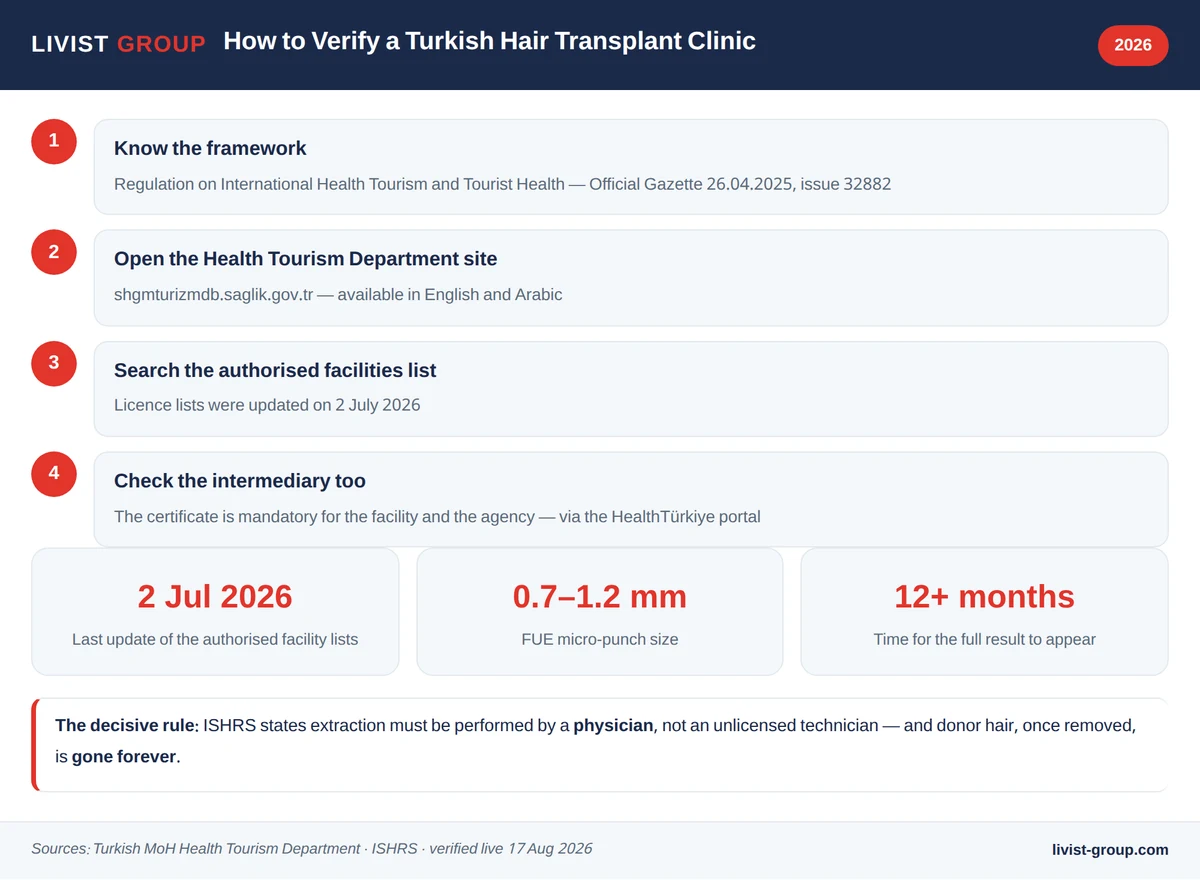
Livist infographic — data from the official sources listed at the end of this article.
How to verify a Turkish clinic's licence in four steps
Turkey regulates international health tourism under a dedicated regulation and publishes its licence lists publicly. Almost no clinic page mentions this, because it is a check a clinic can fail.
- Know the framework. The Regulation on International Health Tourism and Tourist Health was published in Turkey's Resmî Gazete on 26 April 2025, issue 32882, replacing the 2017 regulation.
- Open the Ministry of Health's Health Tourism Department site: shgmturizmdb.saglik.gov.tr. It runs Turkish, English and Arabic interfaces.
- Search the authorised health facilities list. The department's own notice states these licence lists were updated on 2 July 2026.
- Check the intermediary too. The certificate is mandatory for the facility and for the agency that coordinated your trip; authorised intermediaries are published through the HealthTürkiye portal. The official international health services call centre is 0090 850 288 38 38.
A facility absent from the list is not a cheaper option. It is an operator outside the framework built to protect foreign patients.
FUE, FUT, DHI and Sapphire — what the words actually mean
These are not quality tiers. FUE and FUT are two ways to harvest. Choi implanter pens (marketed as DHI) and sapphire blades belong to the placement and site-creation stages.
| Term | What it is | What it means for you |
|---|---|---|
| FUE | Follicular unit excision using micro-punches of 0.7–1.2 mm (ISHRS) | No linear scar (not scarless) · faster recovery than FUT · allows beard and body harvesting |
| FUT | A linear strip is excised, sutured, then dissected into grafts | Leaves a linear scar · usually cheaper because it takes less surgeon labour |
| DHI | Implanter pen that opens the site and places the graft in one motion | A placement style, not a separate harvesting technique |
| Sapphire | Sapphire blades used to create recipient sites | Concerns site creation, not extraction |
Our detailed comparison: FUE vs DHI hair transplant.
Who is a good candidate — and who should wait
ISHRS describes the ideal FUE candidate as someone whose loss is stabilised with medical therapy, who is preferably older (the twenties are riskier because future loss is unpredictable), who has donor hair sufficient for the transplant and for future reserves, who holds realistic goals, and who is medically fit for surgery.
ISHRS also notes anatomy matters: wavier hair, thicker hair, and low contrast between hair colour and scalp all make a result look denser. And it makes a point worth repeating — a surgeon willing to tell you no, when no is the right answer, is practising ethical medicine.
Recovery and the honest timeline
Tiny scabs form in donor and recipient areas and are usually gently removed after one to two weeks, though surgeon policies differ. The transplanted hairs then shed while the roots stay in place, and you enter what ISHRS calls the "invisible" phase. Temporary telogen effluvium — shedding of your native hair — can occur; it typically returns over the following months but is psychologically hard.
On timing, ISHRS is precise: hair grows about 1 cm per month, so a result takes several months at a minimum, and often a year or more to appear in full. Any clinic promising a final result in three months is promising something that does not happen.
The one risk that cannot be undone
Most side effects are minor and temporary. One is not. Overharvesting the donor area, or harvesting outside the safe donor area, is described by ISHRS as an uncorrectable problem — and it links such cases to black-market operators. The reason is simple: donor hair, once removed, is gone forever. Judicious use of that reserve, keeping enough for a future session, is the definition of safe hair surgery — not the graft count printed on a quote.
Why Turkey, and where Livist fits
Turkey's real advantage is not price alone. It is that the country has a written regulatory framework for health tourism and publishes verifiable licence lists — something not every competing destination offers. That advantage only works if you use it.
Our role is not to sell you a clinic. It is to put documented things in front of you: the facility and its standing in the official lists, the named responsible physician, and the package inclusions and exclusions in writing before payment — then to cover everything outside the operating room. See also what a medical package in Turkey includes, the best hospitals and clinics in Turkey, hair transplant cost in Turkey, and for longer stays, mandatory health insurance for a residence permit.
Sources
- Turkish Ministry of Health, General Directorate of Health Services — Health Tourism Department: shgmturizmdb.saglik.gov.tr (verified live 17 Aug 2026; licence lists updated 2 July 2026).
- Regulation on International Health Tourism and Tourist Health — Resmî Gazete, 26 April 2025, issue 32882.
- International Society of Hair Restoration Surgery (ISHRS), FUE resource: definition, punch sizes, black-market position, ideal candidate, recovery timeline, donor-area permanence.
Frequently asked questions
Answers to the most common questions about this topic
Medical Visa Turkey 2026: Rules, Documents and Permits
The medical visa turkey guide from official sources: who is already exempt, why the e-Visa will not cover treatment, and the treatment permit.

Lasik in Turkey 2026: The Official Price Floor Per Technique
Lasik in turkey priced against the Turkish Health Ministry's binding floor for each technique, so you can spot the quote that sits below the legal minimum.

IVF in Turkey 2026: The Legal Rules and the Price Floor
IVF in turkey explained from the regulation itself: who qualifies, the official floor price per step of the cycle, the live market range, and what to arrange before you fly.