
Best Hospitals in Turkey 2026: How to Verify One Yourself, Instead of Trusting a List
The verified JCI figure, the mandatory government licence almost nobody mentions, and six criteria you can check in half an hour.

Turkey has 42 JCI-accredited facilities, of which 38 are hospitals (verified 26 July 2026). Accreditation is granted to a named site at a specific address, not to a hospital group. Separately, every facility treating international patients must hold the Ministry of Health's International Health Tourism Authorisation Certificate, and the licensed lists are published — a yes/no test that comes before any discussion of best.
| Indicator | Value |
|---|---|
| JCI facilities in Turkey | 42 (verified 26 July 2026) |
| Of which hospitals | 38 |
| Licence lists last updated | 14 July 2026 |
| International patients 2025 | 1,398,580 |
| Revenue 2025 | USD 3.02 billion |
| 2023 peak | 1,538,643 |
Medical and administrative content (YMYL). This article deliberately does not publish a ranked list of hospitals and does not recommend any single facility. It gives you the official, checkable criteria and their sources so you can build your own shortlist. Figures verified 26 July 2026 and subject to change; official sources are named so you can re-check at any time.
Welcome — a simple question about those lists
We read the live results for this query in July 2026. Across the first page, five separate "best hospitals in Turkey" lists produced five different hospitals in first place — and not one of them stated the basis on which it ranked. Almost every result was an intermediary platform rather than a hospital, a clinician, or a health authority.
The only ranking we found with a genuine published methodology was a general international hospital ranking compiled by a research firm for a news outlet — not a medical-tourism list at all.
When five lists give five different answers and none declares its criteria, you are not reading a ranking. You are reading five sales pages.
So rather than publishing a sixth list, here is what you can verify yourself.
Criterion one: JCI accreditation — and the real number
Figures circulating on page one for this exact question: "more than 35", "over 35", "over 40", "more than 50". None links to the official directory.
What matters more than the number is how to check it: the Joint Commission publishes a searchable directory of accredited international organisations, filterable by country. Look up the hospital by name and address. If it is not listed, it is not accredited — whatever its own website says.
The gap that matters: accreditation attaches to a site, not a brand
The practical question: "What is the exact name and address of the site where I will be treated, and is that address listed in the JCI directory?"
Criterion two: the mandatory licence nobody mentions
This is the most useful paragraph on this page, and we found no trace of it on the first page of results.
Every healthcare facility in Turkey that treats international patients — and every intermediary operating in this field — is legally required to hold the Ministry of Health's International Health Tourism Authorisation Certificate (Uluslararası Sağlık Turizmi Yetki Belgesi). The Ministry's health tourism department publishes the licensed entities by name, and those lists were last updated on 14 July 2026.
Before asking "is this the best hospital?", ask "is it even licensed to treat me?" — the second question has a published yes-or-no answer.
A facility or agency absent from those lists is operating outside the legal framework for international patients. Note also that the governing regulation is the 2025 instrument (Official Gazette, 26 April 2025, No. 32882), not the 2017 version some sites still cite.
Market size: official data pointing the other way
| Indicator | Value |
|---|---|
| International patients, 2025 | 1,398,580 |
| Revenue, 2025 | USD 3.02 billion |
| Peak patient volume (2023) | 1,538,643 |
| Trend | Two consecutive annual declines from the peak, with revenue holding |
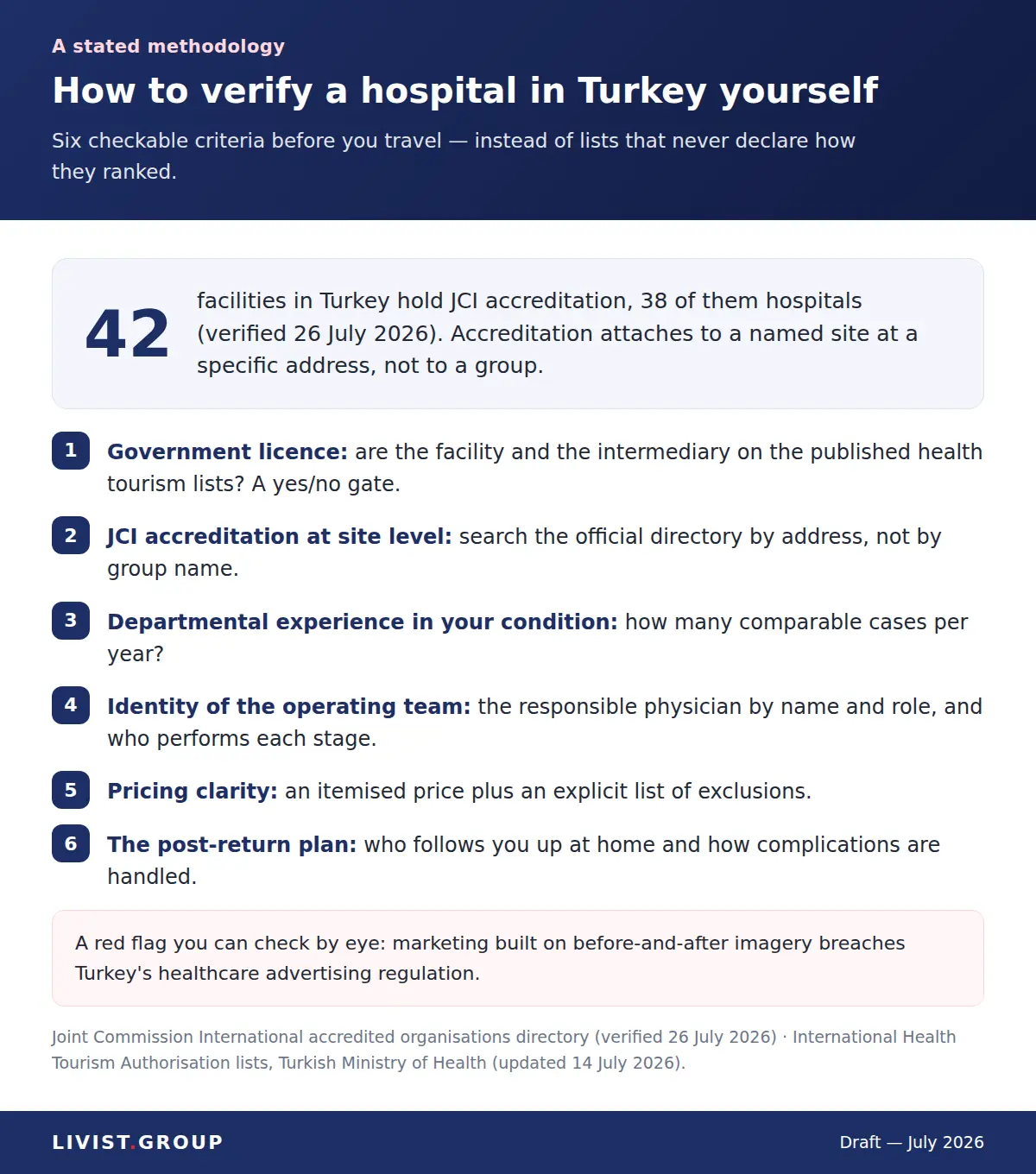
Criteria for verifying a hospital in Turkey · Livist Group
Source: health tourism data published via USHAŞ, the state international health services company, drawing on TÜİK.
This is useful to you as a patient: fewer patients with flat revenue means a higher price per case and sharper competition for your booking — which explains the volume of advertising following you around. Read it as negotiating context, not as evidence of quality.
Our methodology: six checkable criteria
We state them openly, because a ranking without a declared method is an advertisement:
- Government licence (yes/no). Is the facility on the Ministry's health tourism lists? A pass/fail gate, not a scoring point.
- JCI accreditation at site level. Search by address in the official directory, not by group name.
- Departmental experience in your specific condition. A hospital excellent in cardiology is not automatically excellent in hair restoration. Ask for annual volume of comparable cases.
- Identity of the operating team. The responsible physician by name and role, and who performs each stage — see our FUE vs DHI article on why this matters more than technique.
- Pricing clarity and exclusions. An itemised price and an explicit list of what it excludes.
- The post-return plan. Who follows up in your country, and how complications are handled.
Three red flags you can check by eye
1. Before-and-after advertising
Turkey's healthcare advertising regulation prohibits before-and-after imagery in the promotion of health services and restricts promotion to licensed professionals. A facility whose social accounts are built on such images is visibly in breach of a published rule. That makes it an unusually efficient signal: it takes one minute to check, and someone relaxed about a rule you can see invites a question about the rules you cannot.
2. Absence from the official lists
No licence, no conversation — and this applies to the intermediary contacting you, not only the hospital.
3. Undisclosed commission
Here is a striking asymmetry: Turkish regulation is strict on licensing and strict on advertising, but we found no provision requiring an intermediary to disclose the commission it earns from a hospital. The person recommending your "best hospital" may be paid a percentage by that hospital, entirely lawfully, without any obligation to tell you.
A list built on commission is not ordered by who treats you best. It is ordered by who pays the recommender most.
The question that resolves it: "Do you receive a commission from this hospital, and how much?" Ask it every time. You are entitled to the answer even where nobody is obliged to volunteer it.
State hospitals: the question nobody answers
A substantial share of search interest concerns state hospitals — and there is essentially no first-page content covering them. The reason is structural rather than clinical: state hospitals pay no referral commissions, so nobody has an incentive to write about them.
In practice, the Turkish system includes university hospitals and large "city hospitals" (Şehir Hastanesi) with substantial capability, many of which treat international patients within the official framework. The honest comparison is not "public bad, private good" but a specific department against its counterpart — factoring in language support, waiting times and hospitality services. Ask your adviser to put the public option on the table; if they refuse, ask why.
The uncomfortable part: what if something goes wrong?
No intermediary raises this, so we will. The official medical tourism page of the US Embassy in Ankara warns that a patient's legal options in cases of malpractice are "very limited in Türkiye".
That does not make treatment in Turkey unsafe — over a million international patients are treated each year, most with good outcomes. It means prevention outweighs remedy: verification before you fly deserves more of your time than you think, because correction after you return is hard. See also our guide to health insurance in Turkey on what cover does and does not extend to elective treatment abroad.
Checklist before booking
- Is the facility on the Ministry's health tourism licence lists?
- Is the specific site where you will be treated listed in the JCI directory by address?
- How many comparable cases does that department perform annually?
- Who is the responsible physician by name, and who performs each stage?
- What is excluded from the price?
- Who follows up after you return, and how?
- Is the intermediary licensed, and does it take a commission from this facility?
- Does the facility advertise with before-and-after imagery?
Why Livist
We give you the criteria before the names. We verify licensing and site-level accreditation, insist on itemised pricing with exclusions, put the public-hospital option on the table where it makes sense, and build a follow-up plan for after you return. When we do recommend, we tell you the basis for it.
Request a documented comparison of your treatment options — Livist MedicalFrequently asked questions
Answers to the most common questions about this topic

Hair Transplant Turkey: What Decides Your Result — and How to Check a Clinic’s Licence
A neutral 2026 guide with official sources: how the procedure works, who actually performs it, and how to verify your clinic and agency on Turkey’s public Ministry of Health licence lists before you pay.

Medical Visa Turkey 2026: Rules, Documents and Permits
The medical visa turkey guide from official sources: who is already exempt, why the e-Visa will not cover treatment, and the treatment permit.

Lasik in Turkey 2026: The Official Price Floor Per Technique
Lasik in turkey priced against the Turkish Health Ministry's binding floor for each technique, so you can spot the quote that sits below the legal minimum.