Mandatory Health Insurance for a Turkey Residence Permit (2026): What the Regulation Guarantees vs. What Brokers Sell You
The legal basis, the minimum coverage floor in force since 1 April 2025, the capped broker commission, the four official exemptions, and the 2026 permit fees — every figure attributed to its source and retrieval date.

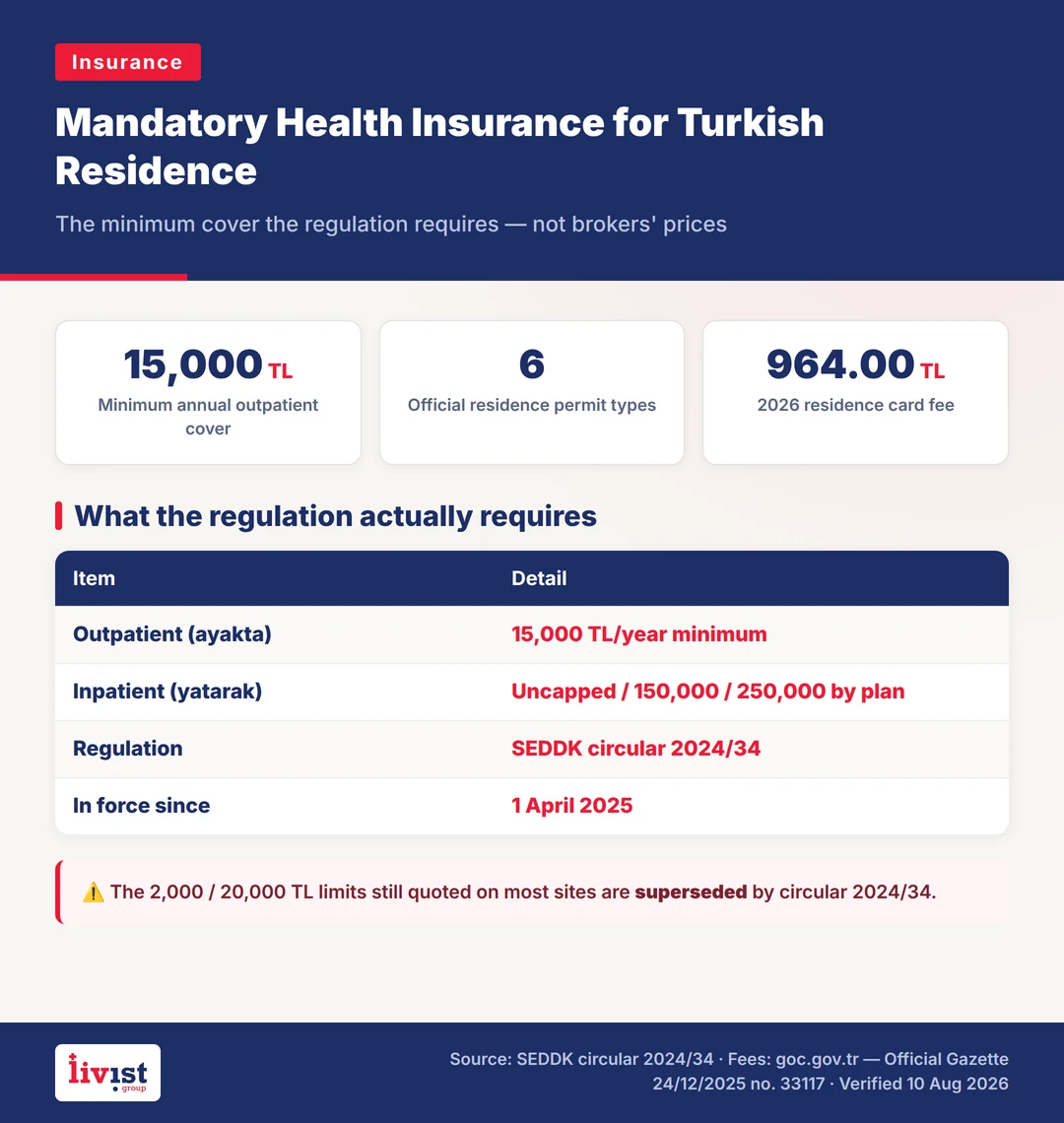
Yes — valid health insurance is a condition for a Turkish residence permit. The policy must be issued by a Turkey-licensed insurer and cover the full requested permit period. Turkey's regulator sets no premium tariff; it sets a coverage floor. Circular SEDDK 2024/34, effective 1 April 2025, mandates 15,000 TL a year for outpatient care and uncapped inpatient care at contracted providers.
| Indicator | Value | Source and date |
|---|---|---|
| Outpatient minimum | 15,000 TL per year | SEDDK Circular 2024/34 (25/12/2024), effective 01/04/2025 |
| Inpatient minimum | Uncapped at contracted providers · 150,000 TL non-contracted · 250,000 TL at Annex-1 hospitals | SEDDK Circular 2024/34 |
| Agency commission cap | 25% of premium (30% on renewals) | SEDDK Circular 2024/34, Art. 2 |
| Residence card fee 2026 | 964.00 TL | Official Gazette 24/12/2025 no. 33117 · goc.gov.tr, retrieved 10/08/2026 |
| Daily permit *harç* | 348.10 TL per day | Official Gazette 31/12/2025 no. 33124 · goc.gov.tr, retrieved 10/08/2026 |
| Were 2026 fees raised? | No | Presidency of Migration Management statement, 30/04/2026 |
| Official permit types | 6 | Law 6458 Art. 30 · goc.gov.tr |
Every page ranking for this query is selling something. Almost none of them cite the rule they are selling against. This guide does the opposite: it publishes the regulation, the coverage floor, the capped commission and the official exemptions, so you can measure any quote you receive before you pay for it.
The requirement is not a broker invention. Health insurance is a statutory condition for a Turkish residence permit under Law No. 6458 on Foreigners and International Protection — Article 35 for family permits, Article 43/1-ç for long-term permits — and it is regulated in detail by the Insurance and Private Pension Regulation and Supervision Agency (SEDDK) through Circular 2016/16 as amended by Circular 2024/34.
Below: what the regulator actually mandates, why no price table exists, the four published exemptions, where you will still pay out of pocket, and where insurance sits in the full 2026 permit bill. The wider topic hub is our guide to health insurance in Turkey for foreigners.
Is health insurance actually mandatory for a Turkish residence permit?
Yes. Valid health insurance is a legal condition for a residence permit in Turkey under Law No. 6458, and proof is uploaded inside the e-ikamet application. The policy must be issued by an insurer licensed in Turkey and must cover the full requested permit period, meeting a minimum coverage floor that the regulator imposes on every insurer without exception.
Where the rule actually sits
- Law 6458, Article 35: family permits require insurance "covering all family members."
- Law 6458, Article 43/1-ç: long-term permits require "holding valid health insurance."
- SEDDK Circular 2016/16, as amended by 2024/34: imposes the insurance requirement on "residence permits to be obtained within the scope of Law No. 6458" and fixes its minimum limits.
A correction worth making loudly: a number of pages — including well-linked ones — cite Article 15 of Law 6458 as the source of the residence-permit insurance requirement. Article 15 is titled "Foreigners to whom a visa shall not be issued." It governs visa refusal, not permit issuance. An article citing the wrong article never opened the statute.
The four official exemptions — quoted from the government site
The Presidency of Migration Management publishes cases in which valid health insurance is not required. Most commercial pages mention none of them. The official English wording, as retrieved on 10/08/2026:
— en.goc.gov.tr — Residence Permit Types
The four published cases are:
- Applicants who document that their treatment costs are paid — the permit is then issued for a duration matching the treatment.
- Applicants whose accommodation, subsistence and health expenses are covered by public institutions during treatment, following an assessment of means.
- Accompanying persons within the defined period.
- Applicants who have requested to become insured under General Health Insurance (GSS) — no separate private policy is demanded. But the same page adds a hard deadline: those who fail to apply within three months of registration and thereby lose GSS eligibility are required to buy private insurance.
Note what is absent from that list: no age-65 exemption and no minors' exemption. More on that below.
What does it cost? There is no official tariff — and that is the finding
You will not find an age-band price table here, and not for lack of searching. No Turkish regulation prices foreigners' residence policies or links premiums to age — not SEDDK's circulars, not the Treasury. The regulator fixes the minimum coverage; pricing is left to competition between insurers. Every "official 2026 price list by age" circulating online is a commercial offer presented as a tariff.
What is verifiable is what you are buying:
| Treatment type | Contracted providers | Non-contracted providers | Annex-1 public hospitals | Source |
|---|---|---|---|---|
| Outpatient (Ayakta) | 15,000 TL — you pay 20% | 15,000 TL — you pay 40% | 15,000 TL — you pay 20% | SEDDK Circular 2024/34 |
| Inpatient (Yatarak) | Uncapped — you pay 0% | 150,000 TL — you pay 20% | 250,000 TL — you pay 0% | SEDDK Circular 2024/34 |
If you are comparing older articles: the widely repeated limits of "2,000 TL outpatient / 20,000 TL inpatient" are the pre-amendment figures of Circular 2016/16 and have been void since 1 April 2025. Any page publishing them today is working from dead numbers.
"Annex-1" is not a footnote. The 2024/34 amendment introduced a list of 20 public hospitals — across Ankara, Antalya, Bursa, Gaziantep, Istanbul, İzmir, Kocaeli, Mersin and Muğla — where the insured receives 250,000 TL of inpatient cover with zero co-payment. Which hospital you walk into changes your coverage materially.
Want a neutral read of the offer in front of you before you pay? Send the quote to the Livist team for a clause-by-clause review.
Why do two quotes differ by 3× for the same applicant?
Age is rarely the real variable. These are:
- Coverage tier. A policy written exactly at the regulatory floor and a policy that exceeds it on ceilings and provider network are different products. The price follows the product, not the birth year.
- Agency commission — and it is capped by regulation. Circular 2024/34 sets a maximum agency commission of 25% of the policy premium, rising to 30% on renewal policies. That cap is a yardstick: a large gap between two quotes for identical limits means either a different product or a margin approaching the ceiling.
- Policy duration. The policy must cover the entire requested permit period. A "cheaper" quote covering a shorter term is not cheaper.
- Payment terms. Since 1 April 2025 the circular requires premiums to be paid up front ("peşin"); the earlier text expressly permitted instalments. An instalment offer is an arrangement outside the current text.
On "80% off" advertising: the question is never the discount percentage, it is a discount off which coverage tier. Ask for the limits and co-payment table in writing before you ask for the price. A broker who will not put those in writing is selling you an unknown.
The over-65 and minors "exemptions": no published basis
Both appear repeatedly on broker pages — sometimes as absolute exemptions, sometimes conditional on holding social security in the country of origin. The sources contradict each other, which is itself a signal.
We reviewed the full text of Law 6458, the full text of SEDDK Circulars 2016/16 and 2024/34, and the Presidency of Migration Management's permit-type pages in both Turkish and English. Age 65 does not appear. Age 18 does not appear. "State school" does not appear. The officially published exemptions are the four listed above and nothing else.
Practical consequence: do not build your file on an undocumented exemption. If a provincial migration directorate tells you verbally that one applies, ask for the written basis. Turkey's bilateral social security agreements are a genuine mechanism that can change your insurance position, but their effect is determined by the specific agreement covering your nationality — not by a general rule you read online.
Where you still pay out of pocket
The mandatory policy is a floor, not comprehensive cover. The table above alone produces three direct exposures:
- Co-payment. A 10,000 TL outpatient bill at a contracted provider costs you 2,000 TL (20%). The same bill at a non-contracted provider costs you 4,000 TL (40%).
- The outpatient ceiling. 15,000 TL a year disappears quickly across consultations, laboratory work and imaging. Everything past it is yours.
- Network status. Contracted vs non-contracted doubles your co-payment and imposes a cap on inpatient care. Ask for the provider list before purchase, not after.
One right most policyholders do not know they have: Circular 2024/34 states that health services provided for sudden illnesses and conditions cannot be excluded from cover. If an insurer declines a sudden-onset case by pointing at an exclusions annex, there is a regulatory text on your side.
Every other exclusion — pregnancy and childbirth, dental, cosmetic, pre-existing conditions, waiting periods — is contractual, not regulatory. It varies between policies and the regulator does not standardise it. That makes the exclusions annex more important than the price page. In our client files, the two clauses that surprise buyers most often are maternity and the contracted-hospital network.
Step by step: buying the policy before your appointment
- Fix the permit duration first, then buy a policy that covers all of it — never the reverse.
- Get three quotes from Turkey-licensed insurers and compare them on limits and co-payments before comparing prices.
- Verify the licence. A policy from an insurer not licensed in Turkey "shall not be processed" under Circular 2016/16 — unless you are applying from outside Turkey.
- Take delivery electronically. The circular requires policies to be issued online and in real time, and linked to the Insurance Information Centre so that the migration authority can verify validity instantly. A paper or delayed policy is not usable.
- Match the name to your passport character for character, then upload it in e-ikamet. A single-character mismatch is among the most common causes of a returned file — see our walkthrough of the e-ikamet application steps.
What happens if your coverage lapses mid-permit?
It does not go unnoticed. Circular 2024/34 obliges the insurer to notify the Presidency of Migration Management within five working days when a policy terminates for any reason. The "cancel it once the card arrives" plan is not a silent one.
Conversely, the rules recognise three legitimate grounds for terminating a policy with a pro-rata daily refund (Circular 2016/16, Article 3):
- Submitting a new policy covering the permit period.
- Cancellation of the residence permit.
- Proving that you have entered General Health Insurance (GSS) cover.
That third ground matters financially: a resident who moves to the state system recovers the unused portion of the private premium. Whoever sold you the policy rarely mentions it. If you are renewing a short-term permit year after year, also read our guide to renewing a tourist residence permit.
After year one: when SGK enters the picture
The private policy is a first-year product. After one uninterrupted year of residence in Turkey without formal employment, Law No. 5510 opens a different door: voluntary registration in General Health Insurance (GSS) on request — a flat monthly contribution unrelated to your age or medical history, priced on a completely different logic from the private market.
Is it actually cheaper? The answer is arithmetic, and it is not the one most people assume. It sits in our separate guide: SGK and social security for foreigners in Turkey — eligibility, the monthly premium, and the five-year math.
Where insurance sits in the full 2026 permit bill
| Item | 2026 amount | Source and retrieval date |
|---|---|---|
| Residence card fee | 964.00 TL | Directorate General of Public Accounts communiqué — Official Gazette 24/12/2025 no. 33117 · goc.gov.tr, retrieved 10/08/2026 |
| Permit harç, per day up to one month | 348.10 TL | Fees Law communiqué — Official Gazette 31/12/2025 no. 33124 · goc.gov.tr, retrieved 10/08/2026 |
| First-month band (per permit) | Not less than 653.70 TL, not more than 3,359.90 TL | Same source |
| Each month after the first | 2,232.30 TL | Same source |
| Private insurance premium | Set by the market — no official tariff | No pricing regulation at SEDDK or the Treasury |
An important qualifier: the official page states these amounts apply to nationals of countries not belonging to any country group, citing Serbia, Fiji, Norway and the Northern Mariana Islands as examples; other nationalities fall under separate group schedules. Ten jurisdictions are exempt from the harç on reciprocity grounds — including Syria and Palestine — but the 964.00 TL card fee carries no exemption for any nationality, in the site's own words.
Two recurring errors worth correcting: Turkey has six official residence permit types (short-term, family, student, long-term, humanitarian, victim of human trafficking) — see the six residence permit types in Turkey. And a long-term permit requires eight uninterrupted years of lawful residence; it has nothing to do with the length of your insurance policy.
If you would rather have the whole file handled — policy selection, upload, appointment and follow-up to card collection — see Livist Group's residence and insurance services.
This content is informational and is not legal or insurance advice. Conditions, fees and coverage limits are determined by what the official sources publish on the date of your application. All figures above were retrieved from their official sources on 10/08/2026.
Frequently asked questions
Answers to the most common questions about this topic
SGK Cost for Foreigners in Turkey 2026: The Monthly GSS Premium, With the Statute That Sets It
7,927.20 TL a month for a resident foreigner in 2026 — and the whole formula: twice the gross minimum wage (33,030) at 12%, under Articles 60(1)(d) and 80 of Law 5510. Plus the condition most pages leave out: you are not eligible for GSS at all until one full year of residence is complete.

Health Insurance in Turkey 2026: Real Prices by Age
A residence-permit policy costs about $30–$113 a year by age at the official TCMB rate of 04/09/2026 — plus the coverage floor immigration actually requires.

Health Insurance in Turkey for Foreigners 2026: Rules, Types, SGK vs Private
Health insurance in Turkey is not really a product you shop for. It is a consequence of your legal status — your residency decides which policies are even available to you. This guide maps the whole system.