Which Turkey Residence Permit Suits You? 2026 Decision Guide
Which Turkey residence permit fits you: work, study, family, property or the new $150K investor permit, the easiest route, and 2026 official fees.

The right Turkey residence permit follows your reason for staying: a job contract leads to a work permit, university admission to a student permit, a family tie to a family permit, and a $200,000 home to a property permit. Since 18 November 2026, non-working foreigners also have an investor route: $150,000 for three years.
| Item | Value | Source |
|---|---|---|
| Official permit types | 6 | Law 6458 — Art. 30 · goc.gov.tr |
| Investor permit (new) | $150,000 = 3 yrs · $200,000 = 5 yrs | Decision 11994 · Official Gazette 33434 (18.11.2026) |
| Property permit threshold | $200,000 (residential only) | Amendment 16.10.2023 |
| Long-term residence | 8 continuous years | Law 6458 — Art. 42–45 |
| Residence card fee 2026 | 964.00 TL | goc.gov.tr — from 01.01.2026 |
Choosing which Turkey residence permit fits you is not a question about categories — it is a question about why you are staying. Turkey issues six official residence permit types, and your reason for being here decides your type before anything else does. This guide skips the category list and starts where the decision actually happens: four situations, one comparison table, and the conditions each route carries into year three.
The distinction matters. Applicants routinely pick whichever permit looked simplest to obtain, then find two years later that those years built nothing — no path to long-term status, no footing if circumstances change. Choosing on eligibility rather than convenience is the highest-value decision in this process.
Which Turkey residence permit fits your situation
| Your situation | Likely route | Who files the application | What usually decides approval |
|---|---|---|---|
| Employment contract with a Turkish company | Work permit (serves in place of a residence permit) | Your employer | Validity of the contract and employer compliance |
| Enrolment at a Turkish university | Student residence permit | You, usually via the university | Enrolment certificate and insurance |
| Spouse or family already resident here | Family residence permit | Your sponsor in Turkey | Proven relationship and shared address |
| Property ownership or investment | Short-term permit (property-based) | You, as owner | Property type, value and address |
| None of the above | Short-term "tourist" permit | You | Address, insurance and entry record |
Use the table to find your lane; the sections below explain what each costs you in flexibility.
What most guides get wrong about Turkey residence permits
There are six official types, not twenty-eight. Turkish law defines six: short-term, family, student, long-term, humanitarian, and the permit for victims of human trafficking. Everything else circulating online — "real estate residence permit", "tourist residence permit", "remote work residence" — is a reason falling under one of those six, most often under short-term. An agency selling you a permit type that does not exist in law is selling you a sub-reason at the price of a category.
A work permit is not one of the six — but it is widely reported to remove the need for a separate residence permit. It is issued by a different authority, and the accepted practice is that a valid one stands in place of a residence permit while it runs — confirm the extent of that with the issuing authority. If you hold a genuine employment contract, ask where that leaves you before paying for a short-term route.
Your address can invalidate an otherwise perfect file. Since 1 July 2022 Turkey closes neighbourhoods to new foreign registration once the foreign share of residents passes a set threshold. The official list published by the Directorate General of Migration Management covers 1,169 neighbourhoods across 63 provinces, and the threshold is 20%, reduced from 25%. Signing a lease before checking the list is the most avoidable rejection in the entire system.
Turkey work permit route
With a contract from a company registered in Turkey, your employer files — not you. You supply your passport, photographs and qualifications; the company handles the filing with the labour authority.
What that arrangement means in practice:
- The permit is tied to that employer. Changing jobs is a new process, not an amendment.
- If the contract ends, your legal footing ends with it. Have a fallback route identified before you need it.
- Lawful employed years are the strongest possible base for long-term status later, because they produce continuous, documented, socially-insured residence.
- Your insurance position changes entirely once you are registered with the social security system — see SGK insurance for foreigners in Turkey.
Choose this route if: you have a real contract and intend to stay for years. It offers the strongest legal position available without any capital outlay.
Turkey student residence permit route
University admission is the key that opens this route. A student permit is tied to the duration of your programme and renewed alongside your enrolment; most universities run the process collectively for international students.
Three practical points:
- The enrolment certificate is the backbone of the file. Any break in enrolment reflects immediately on the permit.
- Health insurance is mandatory, and the policy must meet defined criteria — buying the cheapest one before checking them is a common, expensive mistake. See mandatory health insurance for a Turkish residence permit.
- How student years count toward long-term residence is not as straightforward as people assume — a special rule governs it, and its wording should come from the migration authority itself. Do not build a decade-long plan on the assumption that each academic year counts as a full year.
Choose this route if: study is genuinely your reason for being here. Using enrolment purely as an immigration cover carries administrative risk that outweighs the tuition saved.
Turkey family residence permit and marriage
A family residence permit is granted on the basis of a sponsor lawfully present in Turkey — a Turkish citizen or a foreign national holding a valid permit. Spouses and minor children are the principal beneficiaries.
What is assessed here differs from every other route. The file is judged on the reality of the family relationship and the shared household, not on capital. Expect to evidence the relationship formally, share a registered address, demonstrate income sufficient for dependants, and hold insurance covering everyone in the application.
If your spouse is a Turkish citizen, a separate citizenship route exists through marriage, conditional on a minimum period of marriage and on genuine cohabitation. The qualifying periods and the conditions attached to them should be confirmed with the authority responsible for nationality matters, not with an agency. Keep the two apart: a family permit is permission to remain, not an automatic grant of nationality.
Choose this route if: the family tie already exists. It is among the most stable routes precisely because it does not depend on an employer or an enrolment.
Turkey property residence permit ($200,000)
This is where the most costly confusion in the market sits:
| Objective | Financial threshold | Property type | Outcome |
|---|---|---|---|
| Property-based residence | USD 200,000 | Residential (konut) only | Renewable short-term residence permit |
| Citizenship by property | A higher official threshold | Per official conditions | Naturalisation, with a three-year no-sale undertaking |
The USD 200,000 residence threshold has applied since 16 October 2023 — it is not a 2026 change, despite how some pages frame it — and the property must be residential. Shops and land do not serve this purpose. Citizenship by property is a different mechanism entirely, set at a higher threshold whose current figure should come from the official source when you apply, since it is subject to revision. It also requires an official valuation report, title deed registration and a commitment not to sell for three years.
Full detail sits in the real estate residence permit guide and Turkish citizenship through property.
One practical warning: a property inside a closed neighbourhood can give you ownership without giving you address registration. Check the neighbourhood before you buy, not after.
Turkey investor residence permit 2026: $150K and $200K without property
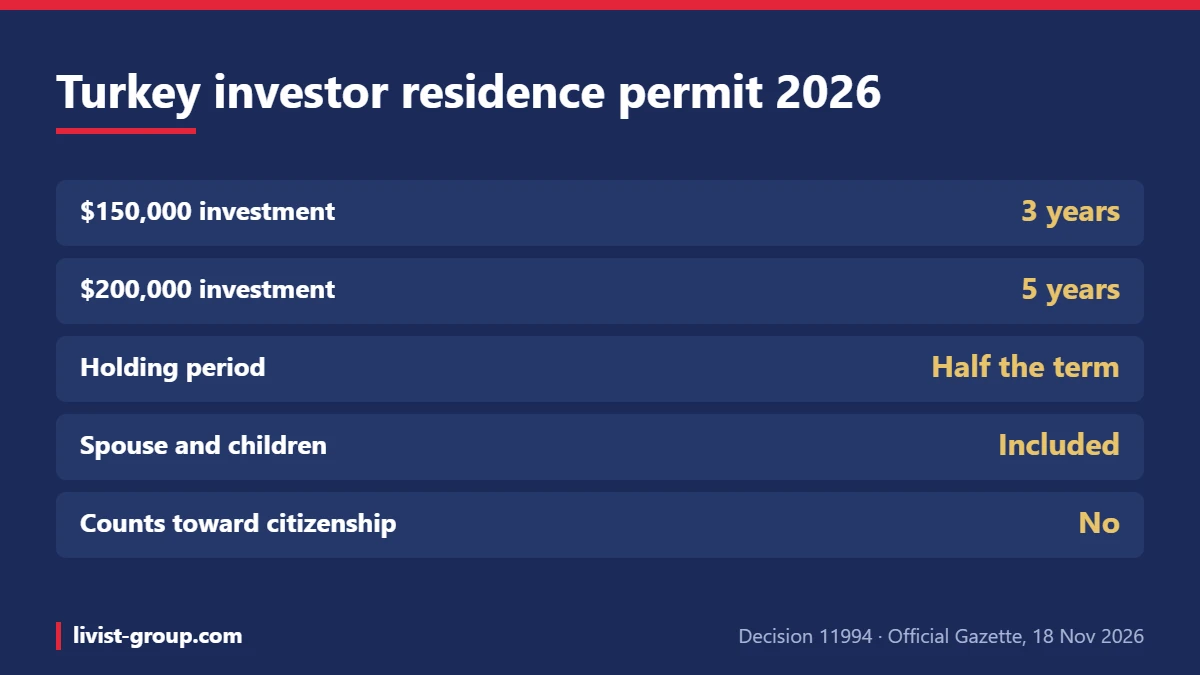
Under Presidential Decision No. 11994, published in the Official Gazette on 18 November 2026, a foreigner who does not work in Turkey can obtain a 3-year residence permit for an investment of at least $150,000, or 5 years for at least $200,000. The legal basis is Article 31 of Law No. 6458.
| Item | Detail |
|---|---|
| $150,000 | 3-year permit — investment held at least 1.5 years |
| $200,000 | 5-year permit — investment held at least 2.5 years |
| Eligible instruments | Bank deposits · government debt instruments · real estate or venture capital fund shares · private pension (BES) contributions |
| Family | Spouse and minor or dependent children |
| Citizenship | Does not count — outside Article 12 of Citizenship Law 5901 |
| Direct property purchase | Not listed in the decision text |
"En az 150.000 ABD Doları veya karşılığı döviz tutarı — 3 yıl · En az 200.000 ABD Doları — 5 yıl" — Decision 11994 schedule, Official Gazette, 18 Nov 2026.
The practical difference from the property route: no property and no neighbourhood restriction tied to ownership, and a longer term from day one — but the money stays locked for half the term. Details in our Turkey investor residence permit guide.
Turkey tourist (short-term) residence permit and its ceiling
The short-term permit for tourism purposes is the default for anyone the other four routes do not cover. It is entirely legitimate — and it should be understood for what it is: a bridge, not a plan.
- Renewal is not automatic. Each application is assessed on its own merits, and refusals happen without prior warning. See renewing a tourist residence permit in Turkey.
- Address sensitivity is at its highest here, because this route is the one most exposed to the closed-neighbourhood rule.
- It accumulates little. Years spent on this route leave you roughly where you started, while years on the work or family routes build a documented record.
What is the easiest way to get residency in Turkey?
The easiest way to get residency in Turkey is the short-term (tourist) residence permit: apply on e-İkamet before your visa or visa-free stay ends, with an address in a neighbourhood open to foreigners and health insurance — but it is the weakest at renewal. For those with capital, the steadier routes are the property permit ($200,000 home) or the new investor permit ($150,000 for three years).
| Permit | Ease of starting | Long-term stability |
|---|---|---|
| Short-term (tourist) | Easiest | Weakest — renewal not automatic |
| Property | Needs a $200,000 residential property | Medium — tied to ownership and address |
| Investor | Needs $150,000 or $200,000 | 3 or 5 years from the first grant |
Before signing a lease, check the address against closed neighborhoods in Turkey.
Turkey long-term residence permit: what counts toward eight years
Long-term residence is the closest thing Turkey offers to permanent status, and the statutory requirement is eight continuous years of lawful residence. Two words in that sentence carry all the weight:
- Continuous — absences and gaps between permits matter. A lapse of status is not merely paperwork; it can reset your position.
- Lawful — time spent in Turkey without valid status does not count, no matter how long it lasted.
Two people can spend the same eight years here and arrive somewhere completely different: one with an unbroken employment record, the other with a two-month gap in year four.
Further conditions attach to long-term status, and student years are treated under a special counting rule. Put both to the migration authority directly before you count on them, rather than inferring them from any online summary — including this one.
Turkey residence permit comparison table
| Route | Core requirement | Who files | Stability | Value toward long-term status |
|---|---|---|---|---|
| Work | Contract with a registered company | Employer | High while the contract holds | Strong — continuous lawful residence |
| Study | Valid admission and enrolment | Student / university | Moderate — tied to enrolment | Special counting rule applies — confirm officially |
| Family | Family tie to a resident or citizen | Sponsor | High | Strong |
| Property | Residential property at USD 200,000 | Owner | Moderate — tied to ownership and address | Depends on continued ownership |
| Short-term | Accepted reason to reside | Applicant | Low | Weakest |
Maximum durations per grant and per renewal are deliberately not stated here, because they vary by permit type and by the reason for the application, and move with administrative updates. Take the duration that applies to your case from the migration authority before you file — not from a table in an article.
Four questions to choose your Turkey residence permit
- Do you hold a contract with a company registered in Turkey? Yes → work permit route; stop here.
- Do you hold a valid university admission? Yes → student permit.
- Do you have a spouse, parent or child who is a Turkish citizen or lawful resident? Yes → family permit, usually the most stable option available to you.
- Do you own — or can you acquire — residential property at USD 200,000? Yes → property route. No → short-term permit, with a plan to move onto one of the four within a year.
Turkey residence permit fees 2026, and the rumour that wasn't true
Fees in force since 1 January 2026, as published by the migration authority:
| Item | 2026 amount |
|---|---|
| Residence permit card fee | TRY 964.00 |
| Daily harç charge | TRY 348.10 |
| First month — minimum | TRY 653.70 |
| First month — maximum | TRY 3,359.90 |
| Each subsequent month | TRY 2,232.30 |
Two corrections worth carrying with you. TRY 3,359.90 is a ceiling, not a flat fee — a widespread error online. And the TRY 810 / TRY 292.70 figures still circulating belong to 2025.
"The Directorate General of Migration Management officially denied, on 30 April 2026, reports of an increase in residence permit fees for 2026. The applicable fees are those published in the Official Gazette and in force since 1 January 2026." — goc.gov.tr, statement of 30 April 2026
Budget separately for what official tables omit: insurance, certified translation, and in some files a bank account to evidence means — see opening a bank account in Turkey as a foreigner.
Get your Turkey residence permit with Livist Group
Once the route is chosen, execution decides the outcome: an address that clears the neighbourhood rule, a policy that meets the insurance criteria, a complete document set. Almost every rejection reason above is detectable before filing — which is what the LIVIST Services team does: review your circumstances, confirm which permit genuinely fits, and prepare the file through to card collection.
Working with a single group also means the items that most often stall residence files — insurance, housing, property, banking — are handled under one roof. With more than eight years inside Turkey and over 60,000 clients served, the aim is a decision that holds up in year three, not just in week one.
For the wider regulatory picture, see the Turkey residence and visa guide 2026.
Frequently asked questions
Answers to the most common questions about this topic

Turkey Investor Residence Permit 2026: $150K and $200K Rules
New presidential decision: 3-year permit for USD 150,000, 5-year for USD 200,000 in deposits, bonds, funds or pensions. Covers family, no citizenship.

Retire in Turkey 2026: Residence, Costs, Healthcare and Best Places
How to retire in Turkey without a retirement visa: residence permit routes, the property myth, monthly costs, health insurance, UK pensions and tax, and the best places to retire.

Student Residence Permit Turkey 2026: Requirements, Fee, Renewal
Official rules for the student residence permit in Turkey: who qualifies, required documents, the TRY 964 card fee, e-İkamet application, renewal, work rights and changing university.