SGK Cost for Foreigners in Turkey 2026: The Monthly GSS Premium, With the Statute That Sets It
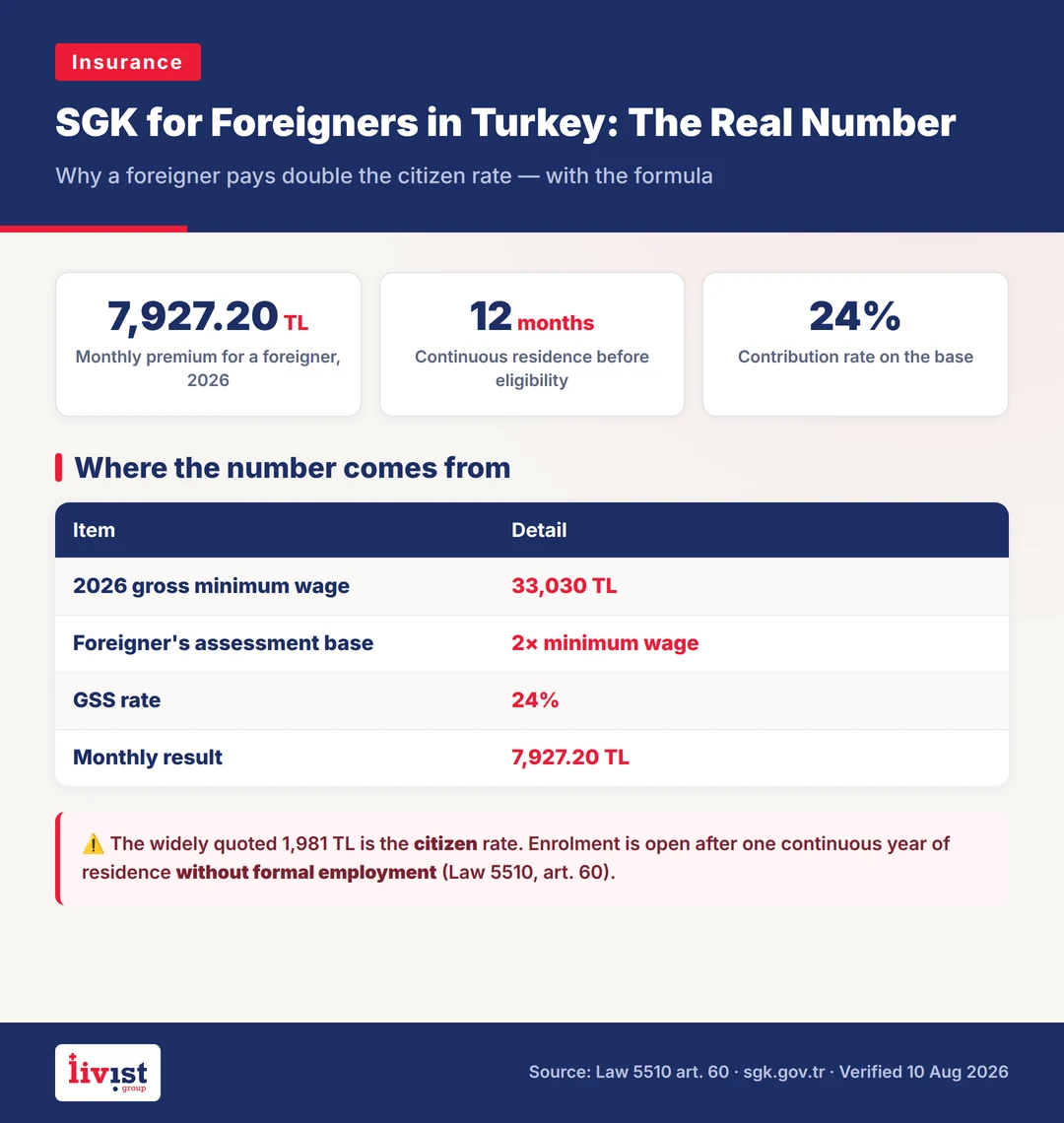
7,927.20 TL a month for a resident foreigner in 2026 — and the whole formula: twice the gross minimum wage (33,030) at 12%, under Articles 60(1)(d) and 80 of Law 5510. Plus the condition most pages leave out: you are not eligible for GSS at all until one full year of residence is complete.

A foreigner who has resided in Turkey for one uninterrupted year without formal employment may request registration in General Health Insurance (GSS). The 2026 premium is 7,927.20 TL per month, because a foreigner's income is deemed to be twice the gross minimum wage (33,030 TL) and charged at 12% — that is 24% of the minimum wage, four times what a Turkish citizen pays.
| Indicator | Value | Source and date |
|---|---|---|
| Monthly GSS premium, foreigner, 2026 | 7,927.20 TL | Muratpaşa District Governorate + Sinop University, retrieved 09/08/2026 |
| Equivalent annual cost | 95,126.40 TL | Direct calculation: 7,927.20 × 12 |
| Assessment base | Twice the gross minimum wage: 2 × 33,030 = 66,060 TL, charged at 12% | Ministry of Labour and Social Security, 2026 minimum wage |
| Turkish citizen premium (Art. 60/g) | 1,981.80 TL per month | sgk.gov.tr, retrieved 09/08/2026 |
| Eligibility for foreigners | One uninterrupted year of residence, on request | sgk.gov.tr, definition of GSS insured persons |
| Income test (*gelir testi*) | Not available to foreigners | Muratpaşa District Governorate, retrieved 09/08/2026 |
| 2026 minimum wage | 33,030.00 TL gross · 28,075.50 TL net | csgb.gov.tr, in force 01/01–31/12/2026 |
Two of the highest-authority pages on this topic contradict each other. A major Turkish university tells international students that to qualify for SGK "you must be legally employed in Turkey." Two insurers ranking beside it state that a foreigner can register voluntarily after a year of residence under Law No. 5510. Nothing on the first results page resolves it.
The second unresolved question is the price. The top "people also ask" query for this topic is what SGK costs per month for foreigners — and the figures circulating online differ by a factor of four, because most of them quote the Turkish citizen's premium.
This guide settles both against official sources, then runs the five-year arithmetic. It picks up where a private residence-permit policy leaves off — for that first-year product see our separate guide to mandatory health insurance for a Turkish residence permit, and our wider health insurance in Turkey hub.
SGK vs GSS vs private insurance: what each one actually is
SGK is Turkey's Social Security Institution. GSS is the general health insurance branch inside it. Foreigners enter GSS through one of three routes: formal employment, voluntary registration after one uninterrupted year of residence under Law No. 5510, or as a registered dependent. The mandatory private policy is a separate commercial product, required by the migration authority — not by SGK.
| Entity / product | What it is | When it concerns you |
|---|---|---|
| SGK | The state institution administering pensions, social security and health insurance | The body you register with — not the product itself |
| GSS | The general health insurance branch inside SGK — a registration with a monthly contribution, not a purchase | After one year of residence, on formal hiring, or as a dependent |
| Mandatory private policy | A commercial policy from a licensed insurer, above a regulatory coverage floor | Before your permit application and at every renewal unless you are inside GSS |
Most guides use "SGK" and "GSS" interchangeably. They are not synonyms, and that conflation is the origin of most of the errors you will read on this subject.
Do you have to be employed to get SGK? Settling a live contradiction
| Source | Type | Claim |
|---|---|---|
| International students page of a major Turkish university | Academic institution | "To be eligible for insurance from the SGK, you must be legally employed in Turkey" |
| Two insurers ranking on the same results page | Commercial institutional position | Voluntary registration is possible after one year of residence under Law No. 5510 |
| Social Security Institution (SGK) | Official source | Persons deemed insured under GSS include "foreign nationals who have resided in our country for one uninterrupted year and who make an application" |
Bottom line: the insurers are right and the university's sentence is inaccurate as a general statement. The system runs two separate tracks, and merging them produces the contradiction:
- Track one — SGK through employment (4/a): begins immediately on formal hiring, with no residence-duration condition, and the employer handles the contribution.
- Track two — voluntary GSS: available on application after one uninterrupted year of residence with no employment at all.
"You must be employed" is true of track one only. The university page addresses students in a specific employment context, which plausibly explains the absolute phrasing — this is a scope error, not a fabrication.
Confidence: high — grounded in the Social Security Institution's own definition of who counts as insured under GSS. Individual cases are decided at your provincial SGK directorate.
How much does SGK/GSS cost per month in 2026?
Here is the full chain of legal authority, because a figure without its source is an opinion rather than a fact — and the first source is the statute itself, not an agency page:
| Link in the chain | What it says | Effect on your calculation |
|---|---|---|
| Law 5510, Article 60(1)(d) | “Subject also to the principle of reciprocity, foreign nationals who hold a residence permit and who are not insured under the legislation of a foreign country” are counted as general health insurance holders | This is your clause — not 4/a, not 4/b |
| Law 5510, Article 80 | For those subject to general health insurance alone, in determining the monthly earnings base: “for the persons listed in Article 60(1)(d), twice the lower limit of the daily earnings base determined under Article 82, taken over thirty days” | Your base = twice the gross minimum wage |
| Law 5510, Article 82 | The lower limit of the daily earnings base is one thirtieth of the minimum wage | Thirty days = one full gross minimum wage |
| General health insurance contribution rate | 12% of the base | × 12% |
| 2026 minimum wage — Ministry of Labour and Social Security | 33,030.00 TL gross (28,075.50 TL net) for 01.01.2026–31.12.2026 | 2 × 33,030 × 12% = 7,927.20 TL |
Minimum-wage source: the “asgari-ücret-2026” sheet published on csgb.gov.tr, read 7 September 2026. Statutory text: Law 5510 as published on a Turkish government domain, read the same day.
— Law No. 5510 on Social Insurance and Universal Health Insurance, Article 60, first paragraph, subparagraph (d)
The one-year rule: when does a foreigner become eligible for SGK at all?
Before any of the arithmetic there is a door that opens on one condition only. Law 5510 states expressly that no general health insurance premium is collected from foreign nationals, and they are not counted as general health insurance holders, until their residence in Türkiye has completed one year. Your first year in Turkey is therefore not a choice between GSS and a private policy: the private policy is the only lawful option in it, and the five-year comparison below starts from year two, not year one.
7,927.20 TL per month. Here is the full derivation, because the number moves with the minimum wage every year while the formula does not:
- 2026 minimum wage: 33,030.00 TL gross per month, in force 01/01–31/12/2026.
- A foreigner's income under GSS is deemed to be twice the gross minimum wage: 2 × 33,030 = 66,060 TL.
- The contribution rate of 12% applies to that base: 66,060 × 12% = 7,927.20 TL — equal to 24% of the gross minimum wage.
| Case | Assessment base | Monthly | Annual | Source and retrieval date |
|---|---|---|---|---|
| Foreign resident (GSS) | 2 × gross minimum wage, at 12% | 7,927.20 TL | 95,126.40 TL | Muratpaşa District Governorate + Sinop University, 09/08/2026 |
| Turkish citizen under Art. 60/g | 1⁄2 × gross minimum wage, at 12% | 1,981.80 TL | 23,781.60 TL | sgk.gov.tr, 09/08/2026 |
The most-repeated wrong number in this topic: many guides state that a foreigner pays 1,981.80 TL. That is off by a factor of four. It is the Turkish citizen's premium, assessed on half the minimum wage, while a foreigner is assessed on twice it. Budgeting on 1,981.80 TL means discovering a 5,945.40 TL monthly gap at the first assessment.
Article 60 of Law 5510 and the SGK “retroactive debt”: what is actually true
A recurring claim in English-language guides is that a foreigner who fails to register after a year accumulates backdated contributions and is later hit with a large debt. As told, that does not apply to foreigners, and the distinction is material:
- Registration after the residence year is application-based — SGK's wording is explicit: foreign residents "who make an application." Cover runs from the date of the request.
- Consequently no contributions accrue for the residence period preceding your application. Someone who never applied is not in debt; they are simply uncovered.
- Liability begins after registration: the contribution falls due monthly, and arrears from that point are treated as institutional debt. How late-payment interest is computed on such arrears should be confirmed with your provincial SGK directorate — To be verified before publication.
Confidence: medium to high. SGK's own phrasing is decisive on the "upon application" point. We did not quote the text of Article 60 verbatim because the consolidated statutory text could not be opened, so we attribute no direct quotation to it.
There is, however, a real deadline. The Presidency of Migration Management states that applicants who have requested GSS insured status are not asked for an additional private policy, and that those who fail to apply within three months of registration, thereby losing GSS eligibility, are required to obtain private health insurance. Delay does not create a debt — it can close the state door and send you back to the private market. The residents most exposed are those who renew a short-term permit year after year without ever contacting social security; see our guide to renewing a tourist residence permit, and to the six residence permit types in Turkey that determine how your residence year is counted.
Unsure where you stand? Livist can check your status with the institution before you plan around a guess.
Gelir testi (income test): why it will not lower a foreigner’s GSS premium
The income test is a well-known feature of the Turkish system: it allows the GSS contribution to be reduced, or paid by the state, when household income per capita falls below a threshold. It is absent from every expat guide — and the reason is that it does not apply to foreigners.
The official wording is unambiguous: the right to apply for an income test is granted to Turkish citizens deemed insured under Article 60/g, and foreign nationals residing in Turkey have no right to apply for the income test.
Direct consequence: there is no lawful route to reduce the 7,927.20 TL premium by proving low income, and the state cannot assume it on your behalf. A foreigner pays the full band whatever they earn. Any offer to lower your contribution through "income documentation" has no basis.
SGK vs private: what is actually covered
| Item | Mandatory private policy | State GSS |
|---|---|---|
| Outpatient ceiling | 15,000 TL a year with 20–40% co-payment (SEDDK Circular 2024/34) | Services at public and contracted providers under SGK's health implementation rules |
| Inpatient care | Uncapped at contracted providers · 150,000 TL non-contracted · 250,000 TL at Annex-1 hospitals | Within the institution's covered services |
| Dependents | A separate policy per person | Dependents can be registered on the same file |
| Age and medical history | Pricing factors set by each insurer | No effect — the premium is fixed by formula |
| Dental, maternity, chronic conditions | Contractual clauses that vary by policy and are not standardised by the regulator | Determined by SGK's health implementation rules — To be verified before publication |
The structural difference is simple: private cover prices you, by age and medical history; GSS prices everyone by one formula. Which is better therefore depends entirely on who you are. Full private limits are set out in our mandatory residence insurance guide.
The five-year math: SGK/GSS against a private policy
Assumptions: 2026 rates held constant · one adult, no dependents · state premium derived from the formula above.
| Year | Cumulative GSS cost | Note |
|---|---|---|
| Year 1 | 95,126.40 TL | Not available before one year of residence is complete |
| Year 2 | 190,252.80 TL | The first year you can realistically be inside GSS |
| Year 3 | 285,379.20 TL | — |
| Year 4 | 380,505.60 TL | — |
| Year 5 | 475,632.00 TL | At 2026 rates only |
Why there is no private-insurance column here. No Turkish regulation prices private policies for foreigners: neither SEDDK nor the Treasury sets or bands these premiums, and the regulator fixes only the minimum coverage. Every "2026 price by age" table in circulation originates with a seller. We will not publish an unsourced number simply to complete a table.
The rule you actually need is one figure: the break-even point is 95,126.40 TL per year. If the annual premium on the private quote in front of you is below that, private is cheaper on price alone; if it is above it, GSS is cheaper. Run it with your own quote, not with a number from an article.
Price is not the whole comparison. GSS is a continuing registration that does not re-rate you as you age or after a diagnosis, while a private policy is re-priced at every renewal. And a resident who moves into GSS may terminate the private policy and recover the unused premium on a pro-rata daily basis — one of three grounds for termination set out in SEDDK Circular 2016/16.
Step by step: registering via your SGK directorate and e-Devlet
- Confirm the uninterrupted residence year is complete before applying. The most common mistake is applying early: the request is refused and the applicant concludes they are permanently ineligible.
- Prepare the documents: foreigner ID number (yabancı kimlik no), a valid residence card, and proof of your registered address.
- File the request at your provincial SGK directorate. Registration is application-based; nothing starts automatically when the year elapses.
- Track it on e-Devlet, the government portal where you check registration status and the contribution due.
- Pay monthly and register dependents on the same file where applicable.
Why Livist: 60,000+ clients, eight years in the Turkish market, and one group covering residence, insurance, social security and translation. SGK is a government service, not something we sell — our role here is procedural: status checks, document preparation and follow-up. If you want your file followed from the first private policy through to state registration, see Livist Group's residence and insurance services.
This content is informational and is not legal or financial advice. Eligibility and contributions are determined by the rules in force at the Social Security Institution on the date of your application, and individual cases are assessed at your provincial SGK directorate. All figures above were retrieved from their official sources on 09–10/08/2026.
Arrange your SGK registration with Livist Group insurance and residence services
Everything above is written so you can decide on your own, and that is the point of it. If you would rather have the execution handled: we check your permit type and start date to establish whether the one-year threshold is even met, calculate your premium with the formula above against the current year’s minimum wage, compare it with a like-for-like private policy quoted for your age, then walk you through registration at the competent SGK directorate and the addition of your dependants.
What we need from you in one message: your permit type, the start date of your first valid residence in Turkey, your age, and how many dependants you have — and you get the calculation and the comparison before you pay anything.
Frequently asked questions
Answers to the most common questions about this topic
Mandatory Health Insurance for a Turkey Residence Permit (2026): What the Regulation Guarantees vs. What Brokers Sell You
The legal basis, the minimum coverage floor in force since 1 April 2025, the capped broker commission, the four official exemptions, and the 2026 permit fees — every figure attributed to its source and retrieval date.

Health Insurance in Turkey 2026: Real Prices by Age
A residence-permit policy costs about $30–$113 a year by age at the official TCMB rate of 04/09/2026 — plus the coverage floor immigration actually requires.

Health Insurance in Turkey for Foreigners 2026: Rules, Types, SGK vs Private
Health insurance in Turkey is not really a product you shop for. It is a consequence of your legal status — your residency decides which policies are even available to you. This guide maps the whole system.