
Turkey Real Estate 2026: Four Markets, Not One — and What Actually Drives Yield
Breaking the Turkish property market down by buyer and driver, with the Article 35 restrictions, the mandatory TKGM valuation report, and the costs budgets usually miss.

Turkish property is not one market but four with different logic: central Istanbul, its outskirts and new projects, the coast, and inland cities. Foreign ownership falls under Article 35 of Land Registry Law 2644, with a mandatory valuation report in the format regulated by the General Directorate of Land Registry and Cadastre.
| Item | Summary |
|---|---|
| Market structure | Four separate markets, not one |
| Legal framework | Article 35, Land Registry Law No. 2644 |
| Restrictions | Security zones · individual area cap · district percentage cap |
| Valuation | Mandatory report in the TKGM-regulated format |
| Yield drivers | Transit proximity · demand type · supply conditions |
| Short-term letting | Regulated by Law 7464 — permit and unanimous consent |
"Turkey real estate" is not one market. It is several separate markets running on different logic, and treating them as one is how buyers end up in the wrong place at the wrong price. This guide takes the market apart rather than praising it.
Four markets, not one
| Market | Who buys | What drives it |
|---|---|---|
| Central Istanbul | Income investors and citizenship buyers | Land scarcity · transport · urban renewal |
| Outer Istanbul and new projects | Lower-budget buyers | Infrastructure promises not yet delivered |
| The coast (Antalya and around) | Seasonal and retirement buyers | Seasonality · regulated tourism letting |
| Inland and emerging cities | Local residents | Domestic demand, not foreign |
A yield from one market does not transfer to another. Reading a figure about Antalya and buying in Istanbul means buying on information that does not apply to you.
What restricts a foreign buyer
Foreign ownership is governed by Land Registry Law No. 2644, Article 35: no acquisition in military and security zones, a ceiling on the total area one foreign individual may own, and a ceiling on the proportion of an administrative district held by foreigners. These are verified officially after the application is filed — that is, after you have paid a deposit if you did not ask early.
Foreign transactions also require a valuation report in a format regulated by the General Directorate of Land Registry and Cadastre (TKGM), which published its circular and template. That report is your only source of a number that does not come from the seller.
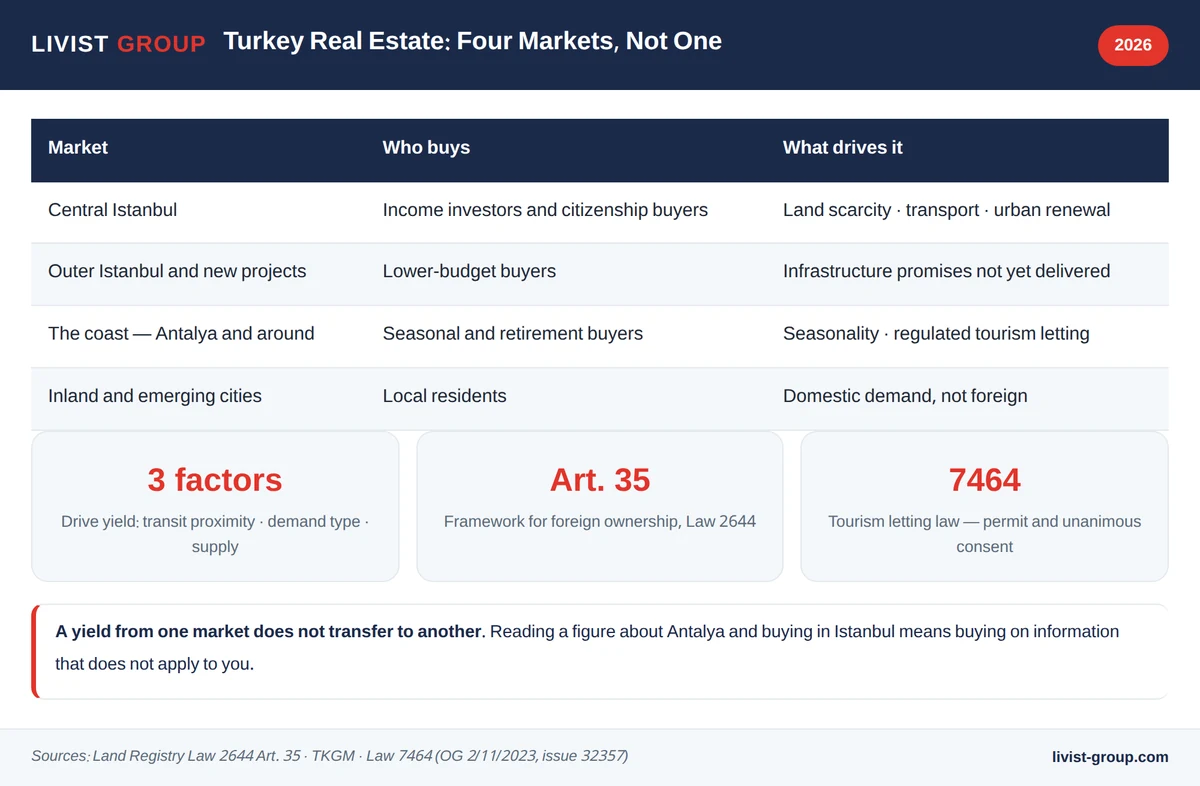
Livist infographic — data from the official sources listed at the end of this article.
Completed versus under construction
- Completed: you see what you buy, income starts immediately, the price is higher.
- Under construction: lower price and staged payments, against delivery and specification risk. The one rule that governs it: the developer's delivery record, not the brochure — ask which projects they have actually handed over, and go and see them.
What actually produces yield
Not the city and not the compound's name, but three things: real proximity to a transit line (not "near the highway"), the type of demand in the neighbourhood (students, families, short-stay visitors), and supply conditions — a district receiving thousands of units in the same year depresses rents however attractive it looks.
If your plan is short-term letting, note that this is a regulated activity requiring an official permit and unanimous consent of the building's owners — see apartments for rent in Istanbul before building any yield model on it.
Costs people leave out of the budget
- Transfer duty, revolving fund charges, sworn translator and valuation fees.
- Monthly complex management charges (aidat) — recurring, not one-off.
- Compulsory earthquake insurance, utilities and meter transfers.
- Annual property taxes, and capital gains tax on sale within the statutory period.
Five warning signs
- A guaranteed yield printed in an advertisement — yields are not guaranteed.
- Pressure to sign "before tomorrow's price rise".
- Refusal to show the title register or the valuation report.
- Payment requested to a personal account rather than the registered owner's.
- Talking about citizenship before talking about the property.
Where Livist fits
We do not hold a portfolio to sell you. We start from your purpose, then the register, the zone and the valuation, and show you what fits that purpose even when it costs less. See also buying property in Turkey step by step, the best investment areas in Istanbul, safe title deed steps, the official valuation, and citizenship through real estate.
Sources
- Turkish Land Registry Law No. 2644, Article 35 — restrictions on foreign acquisition.
- General Directorate of Land Registry and Cadastre (TKGM) — valuation report circular and template on tkgm.gov.tr.
- Law No. 7464 — Official Gazette 2/11/2023, issue 32357 — regulation of tourism-purpose residential letting.
Frequently asked questions
Answers to the most common questions about this topic

Where to Live in Istanbul 2026: Neighbourhoods for Expats
Where to live in Istanbul comes down to two questions: which neighbourhood suits you, and which one will register your residence address at all.

Property Tax in Turkey 2026: Rates, Dates and Exemptions
Property tax in Turkey from Law 1319: the annual rates, the metropolitan doubling, the two instalments and compulsory earthquake cover.
Turkish Citizenship by Investment 2026: All Seven Routes, and Who Attests Each Amount
The full official list from the Investment Office — thresholds, three-year lock-ins and the ministry or regulator that must certify each one — plus how to check a title deed yourself before anyone’s paperwork.