
Buying Property in Turkey: Nine Steps in the Right Order and Where Deals Go Wrong
An execution sequence from registry check to post-deed, with the Article 35 restrictions of Land Registry Law 2644 and the mandatory valuation report regulated by TKGM.

Buying property in Turkey as a foreigner starts with fixing the purpose, then checking the title register and the zone, followed by a mandatory valuation report from a licensed appraiser, a preliminary contract with a refund clause, bank payment, filing at the land registry, fees and the transfer appointment with a sworn translator, and finally the post-deed steps.
| Step | What happens |
|---|---|
| 1 · Purpose | Residence, income, permit or citizenship — sets the property type |
| 2 · Register | Deed type, registered owner, mortgages and annotations |
| 3 · Valuation | Mandatory report in the TKGM-regulated format |
| 4 · Contract | Deposit with a written refund clause |
| 5 · Payment | Bank transfer to the registered owner |
| 6 · Land registry | Filing plus administrative and security checks |
| 7 · Appointment | Sworn translator mandatory for non-Turkish speakers |
| 8 · After the deed | Meters, insurance, management, tax position |
This is not a "everything you need to know" article. It is the execution sequence for buying property in Turkey: what happens at each step, who is responsible, and where the mistakes that void or delay a deal actually occur.
Before step one: what actually restricts a foreign buyer
Foreign ownership of Turkish property is governed by Land Registry Law No. 2644, Article 35. The substantive restrictions to know before paying a deposit:
- Security zones: acquisition is not permitted inside military and security zones. This is checked officially after the application is filed, not before.
- Area ceiling: a national cap on the total area one foreign individual may own.
- District percentage ceiling: a cap on the proportion of a single administrative district that foreigners may hold.
In practice, ask before any payment: is this property outside restricted zones, and has the district reached its ceiling? — and take the answer from the land registry directorate, not the seller.
Step 1: fix the purpose before the property
Residence? Rental income? A property residence permit? Citizenship? Each imposes different conditions on the type, price and record of the property. Buying first and then looking for a purpose that fits is the most expensive error in this market.
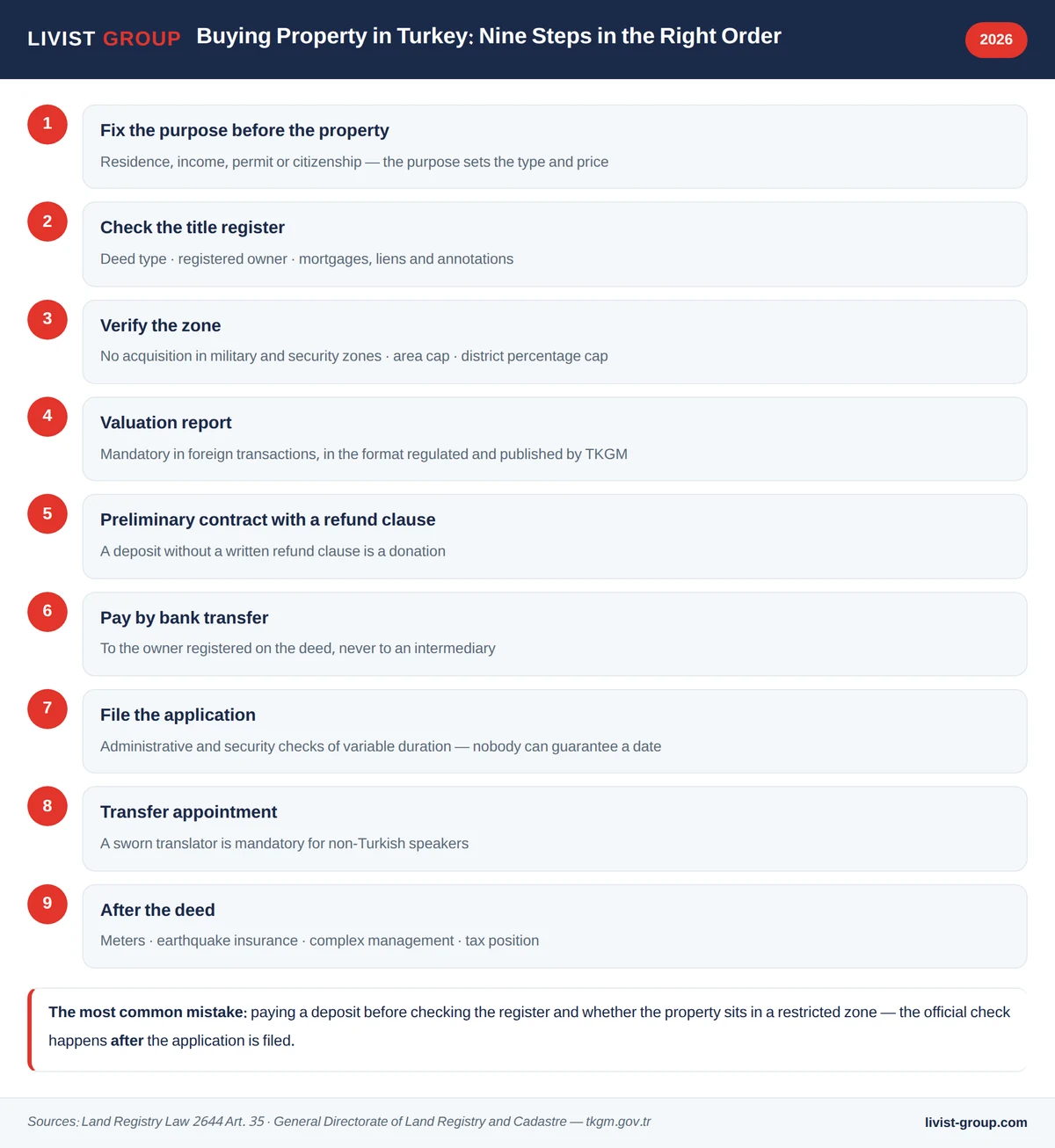
Livist infographic — data from the official sources listed at the end of this article.
Step 2: check the record before the viewing
Request a copy of the title deed and check the deed type (land or independent unit), the registered owner's name, and whether any mortgage, lien or annotation sits on it. A beautiful property with an encumbered record is a legal problem regardless of the photographs.
Step 3: the valuation report — mandatory, not optional
Foreign acquisitions require a real estate valuation report prepared by a licensed appraiser. The General Directorate of Land Registry and Cadastre (TKGM) has regulated its format and published the circular and report template officially.
The buyer's real benefit: a figure independent of the seller's. If the assessed value comes in well below the asking price, you have either a negotiating position or a warning.
Step 4: the preliminary contract and deposit
Do not pay a deposit without a written contract stating the property as described in the register, the full price, the payment schedule, and a refund clause if the application is refused for reasons outside your control — a restricted zone, for example. A deposit with no refund clause is a donation.
Step 5: pay through banking channels
Pay by documented bank transfer to the owner registered on the deed, not to an intermediary. Cash with no banking trail removes your proof and complicates any later procedure that depends on tracing the source of funds.
Step 6: filing at the land registry directorate
The application is filed and the property is checked administratively and for security clearance. The duration varies and nobody can guarantee it — be wary of anyone promising a specific date.
Step 7: fees and taxes
Transfer duty is calculated on the declared value and paid to the treasury before the appointment, alongside revolving fund charges, sworn translator costs and the valuation fee. Ask for a written breakdown of every line before the appointment; surprises here come from omitted items, not wrong percentages.
Step 8: the transfer appointment
Both parties or their attorneys under a formal power of attorney attend, and a sworn translator must be present if the buyer does not speak Turkish — this is not waivable. The transaction is signed and the deed is issued in your name.
Step 9: after the deed
The deal does not end at the deed: transferring electricity, water and gas meters, compulsory earthquake insurance, joining the complex's management, and settling your tax position. Buyers who stop at the deed discover the rest late.
Seven recurring mistakes
- Paying a deposit before checking the registry record and the zone.
- Accepting the seller's estimate instead of a licensed valuation report.
- Paying an intermediary's account rather than the registered owner's.
- Granting an open-ended power of attorney to an unverified party.
- Budgeting without the fees and the post-deed steps.
- Buying for citizenship without first confirming its official conditions.
- Relying on informal interpretation instead of a sworn translator at the appointment.
Where Livist fits
We work on sequence, not persuasion: registry and zone check first, then an independent valuation, then a contract with clear refund terms, then the deed, then what follows. If an obstacle appears at any step we stop the transaction rather than push it forward. See also safe title deed registration steps, the official property valuation, Turkish citizenship through real estate, the real estate residence permit, and the best investment areas in Istanbul.
Sources
- Turkish Land Registry Law No. 2644, Article 35 — the framework for foreign acquisition, geographic restrictions and area and percentage ceilings.
- General Directorate of Land Registry and Cadastre (TKGM) — circular and template for the real estate valuation report used in foreign acquisition transactions, published on tkgm.gov.tr.
Frequently asked questions
Answers to the most common questions about this topic

Where to Live in Istanbul 2026: Neighbourhoods for Expats
Where to live in Istanbul comes down to two questions: which neighbourhood suits you, and which one will register your residence address at all.

Property Tax in Turkey 2026: Rates, Dates and Exemptions
Property tax in Turkey from Law 1319: the annual rates, the metropolitan doubling, the two instalments and compulsory earthquake cover.

Turkish Citizenship by Investment 2026: All Seven Routes, and Who Attests Each Amount
The full official list from the Investment Office — thresholds, three-year lock-ins and the ministry or regulator that must certify each one — plus how to check a title deed yourself before anyone’s paperwork.