
Health Insurance in Turkey 2026: Real Prices by Age
A residence-permit policy costs about $30–$113 a year by age at the official TCMB rate of 04/09/2026 — plus the coverage floor immigration actually requires.

A private residence-permit policy in Turkey costs about 1,447 TL (~$30) a year in the 17–25 band, rising to about 5,458 TL (~$113) in the 56–64 band. Insurance is mandatory to apply for or renew a residence permit, and the cheapest legal policy is enough provided it meets the coverage floor in SEDDK circular 2024/34: at least 15,000 TL a year of outpatient cover with the insurer paying 80%. Figures are converted at the Central Bank of the Republic of Türkiye rate of 1 USD = 48.3195 TRY, dated 04/09/2026.
| Indicator | Value |
|---|---|
| Cheapest age band (17–25), 1 year | ~1,447 TL (~$30) |
| Mid band (36–45), 1 year | ~2,236 TL (~$46) |
| Oldest priced band (56–64), 1 year | ~5,458 TL (~$113) |
| Minimum outpatient cover — SEDDK circular 2024/34 | 15,000 TL a year, insurer pays 80% |
| Legally required? | Yes — Law 6458, Article 15 |
Written and reviewed by Sara Murat, Livist Group. Lira figures carry the date of the list they come from and the Central Bank rate used to convert them; ask for a current quote before you buy.
How much does health insurance cost in Turkey in 2026?
Every dollar figure on this page is converted at the official Central Bank of the Republic of Türkiye rate — 1 USD = 48.3195 TRY, bulletin dated 04/09/2026 — not at a rate copied from an older article.
Why health insurance prices in Turkey contradict each other
Search for what health insurance costs in Turkey and you will find figures ranging from 370 TL to 18,000 TL for what looks like the same product. The spread is not a pricing disagreement. It is three recurring mistakes:
- Lira figures with no date. A great many pages still publish 2019 or 2021 premiums untouched. The lira changed by multiples; the number on the page did not.
- Two different products treated as one. A compliance policy exists to satisfy the immigration directorate so your permit gets stamped. Medical cover is a policy you buy because you intend to use private hospitals. Turkish law only requires the first.
- One-year prices confused with two-year prices. Much of the high end circulating online is a two-year premium presented as an annual one.
Conflating them is how people either overpay by thousands or get their file rejected. Price them separately, and read every lira figure with its date attached.
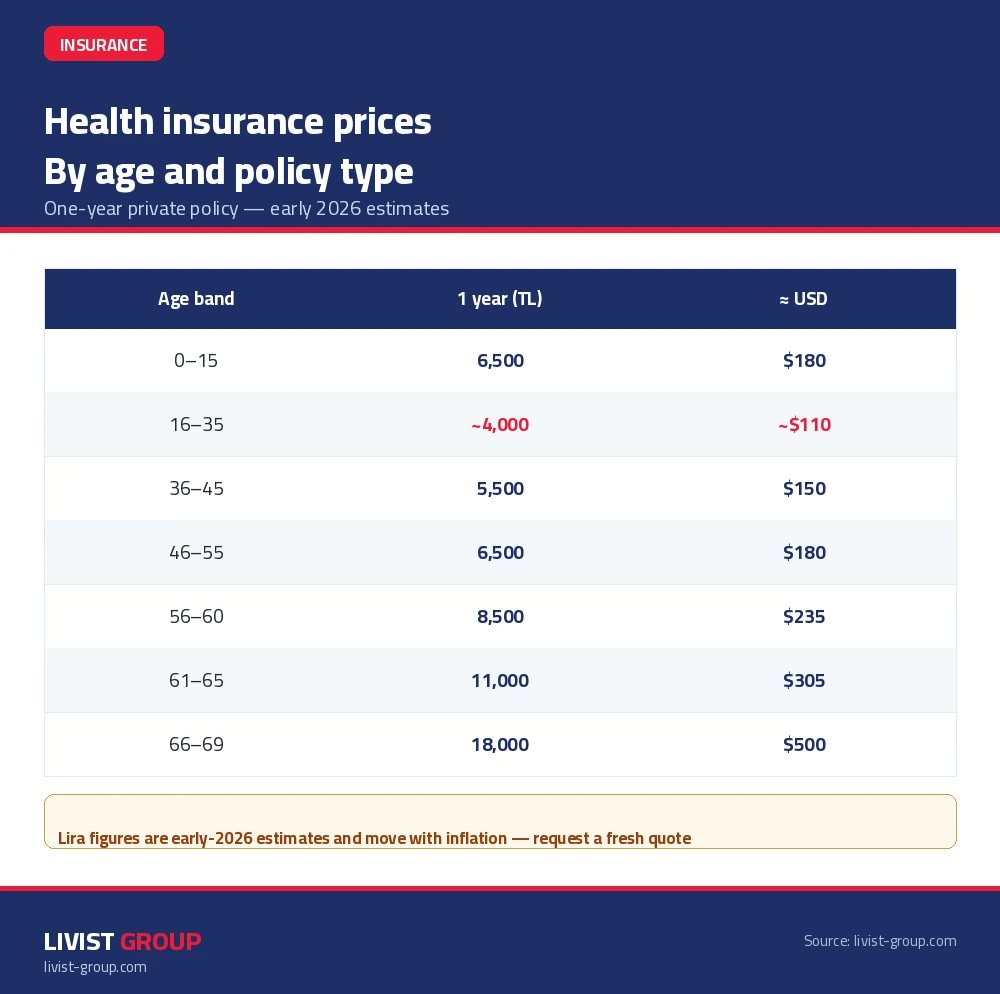
Health insurance in Turkey priced by age: the residence-permit policy
This is the number that matters for your residence permit file. Age is the dominant variable — not city, not insurer, not your medical history. The table below is built from the published price list of a licensed Turkish insurance broker (enuygun sigorta), dated 01/09/2025, adjusted by the 31.51% annual inflation reported by the Turkish Statistical Institute for August 2026.
| Age band | Published list, 09/2025 (TL) | Inflation-adjusted (TL) | Approx. USD |
|---|---|---|---|
| 0–16 | 2,840 | ~3,735 | ~$77 |
| 17–25 | 1,100 | ~1,447 | ~$30 |
| 26–30 | 1,200 | ~1,578 | ~$33 |
| 31–35 | 1,300 | ~1,710 | ~$35 |
| 36–45 | 1,700 | ~2,236 | ~$46 |
| 46–50 | 2,950 | ~3,880 | ~$80 |
| 51–55 | 3,150 | ~4,143 | ~$86 |
| 56–64 | 4,150 | ~5,458 | ~$113 |
| 65–70 | 3,150 | ~4,143 | ~$86 |
Three things worth noticing. First, the curve is not linear — it is nearly flat through your mid-forties, then bends sharply upward after 46. Second, the youngest band is not the cheapest: children aged 0–16 price higher than adults aged 17–25. Third, the 65–70 band appears lower than 56–64, and that is not a typo — it is a restricted product, so ask what its limits are before celebrating the price.
Two-year policies cost roughly double in absolute terms, but they lock your premium against a year of lira inflation and match the duration of many permits. If your permit will run two years, price both and compare.
The minimum coverage floor that makes health insurance in Turkey acceptable for a residence permit
This is where files are rejected, and almost no guide states it. A policy is not accepted because it is insurance; it is accepted because it meets floors written into circular 2024/34 of the Insurance and Private Pension Regulation and Supervision Agency (SEDDK), issued 25/12/2024 and in force from 01/04/2025.
| Treatment type | Contracted institutions | Non-contracted institutions |
|---|---|---|
| Outpatient (ayakta) | Annual limit 15,000 TL · insurer pays 80%, you pay 20% | Same annual limit · your share rises to 40% |
| Inpatient (yatarak) | No limit · no cost-sharing from you | Up to 150,000 TL a year · your share 20% |
"The health insurance taken out for visa and residence permit applications must provide the annual minimum coverage limits set out below."
— Insurance and Private Pension Regulation and Supervision Agency (SEDDK), circular on health insurance for visa and residence permit applications, no. 2024/34, 25/12/2024The practical move: ask your broker to state in writing that the policy complies with circular 2024/34. One sentence saves you an entire rejection.
Compliance policy versus real medical cover in Turkey
| Item | Residence-permit policy (mandatory) | Real medical cover |
|---|---|---|
| Annual price | 1,447–5,458 TL ($30–$113) by age | Quoted individually by age, network and limits — a different market entirely |
| Outpatient | 15,000 TL a year, insurer pays 80% | Higher limits and lower cost-sharing |
| Inpatient | No limit at contracted hospitals | Wider private hospital network and choice of doctor |
| Purpose | Getting the permit stamped | Actually using the healthcare |
The honest question to ask yourself: how often do you expect to see a doctor? If the answer is "once a year, maybe," the compliance policy plus paying cash for the occasional consultation is usually cheaper than a comprehensive premium. If you have a family, a chronic condition, or you simply want the certainty, the maths changes.
The cheap health insurance trap in Turkey
The cheapest compliant policy is genuinely sufficient for your permit — as long as it meets the coverage floor above. This is the single point where saving money backfires.
Policies exist that undercut that floor. They are cheaper. They are also rejected at the immigration directorate, which means a delayed file, a re-submission, and a second premium paid on top of the first. The saving evaporates and the delay costs you more than the policy did.
So the rule is not "buy cheap" or "buy expensive." It is: find the floor, buy the cheapest thing above it, and verify the floor before you pay — not after.
Types of health insurance in Turkey, and which one applies in your first year
Most English-language guides list the insurance types side by side as if you were choosing between them today. You are not. The choice is sequenced by time.
Private residence-permit insurance
An annual policy that meets immigration requirements. In your first year in Turkey this is not really a choice — it is the only route, because the public system is not open to you yet.
SGK (the public system)
Turkey's social security scheme becomes available to you after one year of residence, paid as a monthly premium rather than an annual lump sum. Broader cover, public hospital network.
TSS (complementary insurance)
Sits on top of SGK and widens your options at private hospitals. It only makes sense once you have SGK — it is a top-up, not a standalone product.
Student insurance
A discounted policy for international students, usually priced within the 17–25 band. If you are enrolled, check this before anything else; it is the cheapest legitimate route to a compliant file.
Read that as a timeline rather than a menu. Year one: private, cheapest compliant policy. Year two onwards: the SGK question opens up, and if you go that way, TSS becomes the interesting add-on.
Waiting periods on health insurance in Turkey
Buying a policy does not mean you are covered tomorrow. Turkish policies typically apply waiting periods of around six months for outpatient treatment and nine months for inpatient (overnight) treatment. Emergencies are covered immediately.
The practical consequence: a policy bought to solve a problem you already have will not solve it. If you are planning a procedure, the clock starts at purchase, not at need. And if you switch insurers mid-stream, check whether your waiting periods reset — that detail alone can justify staying with a slightly pricier incumbent.
Renewing your health insurance in Turkey with your residence permit
Your policy must cover the full duration of the permit you are applying for, so renew well before your current permit expires rather than in the same week. A policy that runs out one month before your permit does is a rejection waiting to happen.
The full permit process, timing and document list is in our guide to the Turkish residence permit. If you are still in the visitor stage and not yet applying for residence, travel insurance for Turkey is the relevant product instead — it is not interchangeable with a residence-permit policy.
Get the cheapest compliant health insurance in Turkey with Livist Group
Livist Group does not sell you the most expensive policy. We identify the cheapest one your specific file will actually clear, check it against circular 2024/34 before you pay rather than after, and tell you plainly when the basic tier is all you need.
Ask Livist Group for a compliant policy at the right price →
Frequently asked questions
Answers to the most common questions about this topic

SGK Cost for Foreigners in Turkey 2026: The Monthly GSS Premium, With the Statute That Sets It
7,927.20 TL a month for a resident foreigner in 2026 — and the whole formula: twice the gross minimum wage (33,030) at 12%, under Articles 60(1)(d) and 80 of Law 5510. Plus the condition most pages leave out: you are not eligible for GSS at all until one full year of residence is complete.
Mandatory Health Insurance for a Turkey Residence Permit (2026): What the Regulation Guarantees vs. What Brokers Sell You
The legal basis, the minimum coverage floor in force since 1 April 2025, the capped broker commission, the four official exemptions, and the 2026 permit fees — every figure attributed to its source and retrieval date.

Health Insurance in Turkey for Foreigners 2026: Rules, Types, SGK vs Private
Health insurance in Turkey is not really a product you shop for. It is a consequence of your legal status — your residency decides which policies are even available to you. This guide maps the whole system.