
Health Insurance in Turkey for Foreigners 2026: Rules, Types, SGK vs Private
Health insurance in Turkey is not really a product you shop for. It is a consequence of your legal status — your residency decides which policies are even available to you. This guide maps the whole system.

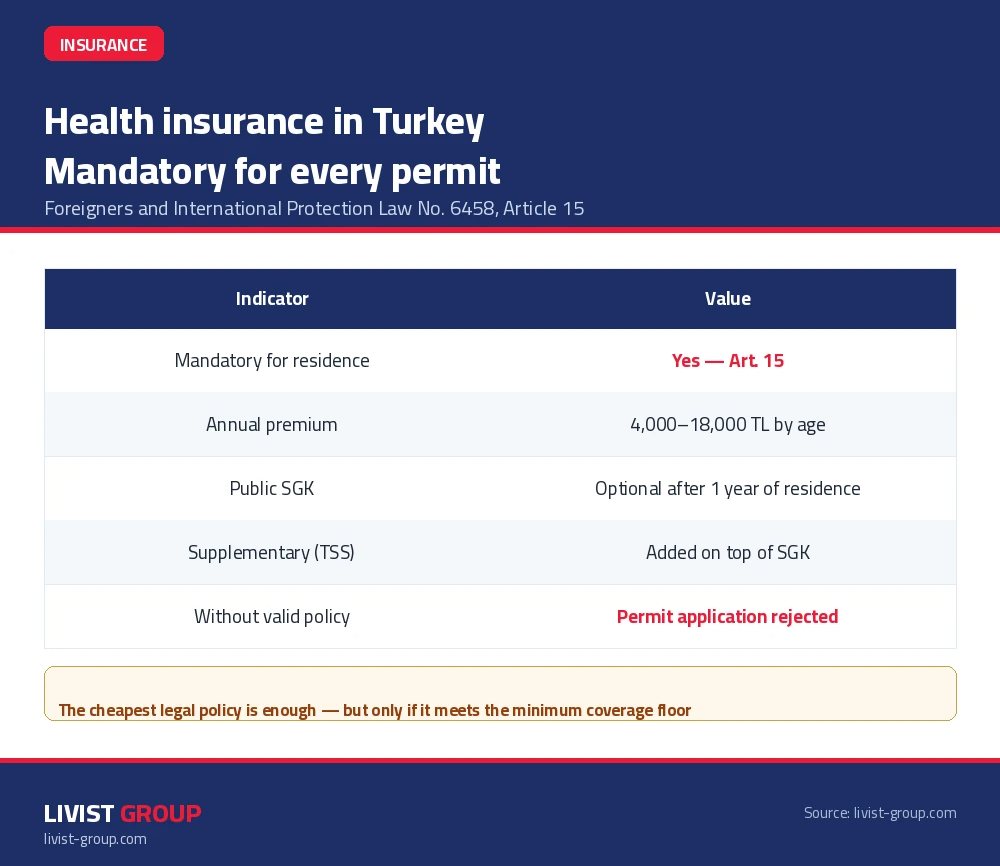
Private health insurance is mandatory for every foreigner applying for or renewing a Turkish residence permit; without a valid policy the file is rejected under Law 6458, Article 15. Premiums run roughly 4,000–18,000 TL a year by age. After one year of continuous residence, the public SGK system becomes an optional alternative.
| Indicator | Value |
|---|---|
| Legally required for residence? | Yes — Law 6458, Article 15 |
| Annual private premium range | ~4,000–18,000 TL, by age |
| SGK eligibility | After one year of continuous residence |
| SGK monthly premium | ~24% of the minimum wage |
| Policy types | Private residence, SGK, TSS (top-up), travel |
Reviewed by the Livist team. Lira figures are early-2026 estimates and move quickly with inflation; ask for a current quote before you buy. This guide is information, not legal advice.
Do foreigners need health insurance in Turkey?
Insurance follows your status, not your preference
Most English-language guides present Turkish health insurance as a menu: here is SGK, here is private, here is complementary cover, pick the one that suits you. That framing quietly misleads people, because on the day most foreigners first need insurance, the menu has exactly one item on it.
The system works on eligibility, not preference. Your residency status determines which products you can legally buy, and that status changes over time. In your first year you are not choosing between SGK and private insurance — the public system simply is not open to you yet. A year later, the same person faces a genuine choice they could not have made twelve months earlier.
The right question is not "which insurance is best in Turkey?" It is "which insurance am I currently eligible for, and what opens up next?"
Read the rest of this guide with that sequence in mind. It explains why advice from a five-year expat is often useless to someone who landed last month: they are describing a different rung of the same ladder.
The four things called "health insurance" in Turkey
Four distinct products share the name. Confusing them is the single most common and most expensive mistake foreigners make here.
1. Private residence-permit insurance
The most common by far: an annual policy that meets the minimum coverage level required for a residence permit file. It treats hospitals within the insurer's contracted network. For almost everyone, this is the starting point — and in year one, the only point.
2. SGK — the public social security system
Turkey's state health scheme. Available to foreigners voluntarily, and only after one year of continuous residence. Broader coverage than a basic private policy, paid as a monthly premium rather than an annual lump sum.
3. TSS — complementary insurance
Complementary health insurance sits on top of SGK and widens your options at contracted private hospitals. It is a top-up, not a standalone product: without SGK underneath it, TSS does nothing for you and satisfies no legal requirement.
4. Travel insurance
Short-term cover for a visit or a visa application. It is not a substitute for residence-permit insurance and will not be accepted for one. More on that distinction below.
What the law actually requires
When you apply for or renew a residence permit, the migration directorate asks for a valid private policy that satisfies two conditions. First, it must meet the minimum coverage floor set by the authorities. Second — the condition people overlook — it must cover the full duration of the permit you are requesting, not merely the day you apply.
That second condition causes more rejections than any pricing decision. A policy that lapses a month before your permit does is not a small administrative wrinkle; it is a file that does not clear. If your permit runs two years, your cover must run two years. Renew your policy comfortably ahead of your permit, not in the same week. The full document list and application timing live in our guide to the Turkish residence permit.
What it costs: the shape of the curve
Age is the dominant variable in Turkish insurance pricing — more than city, insurer, or medical history. These are estimates for a one-year policy, early 2026:
| Age band | One year (TL) | Approx. USD |
|---|---|---|
| 0–15 | ~6,500 | ~$180 |
| 16–35 | ~4,000 | ~$110 |
| 36–45 | ~5,500 | ~$150 |
| 46–55 | ~6,500 | ~$180 |
| 56–60 | ~8,500 | ~$235 |
| 61–65 | ~11,000 | ~$305 |
| 66–69 | ~18,000 | ~$500 |
The headline to take from this table is structural, not arithmetic: the cost is broadly flat through your forties and then climbs steeply past 55. For a couple in their thirties, insurance is a rounding error in the cost of moving to Turkey. For a retiree in their late sixties, it is a real line in the annual budget and worth planning around before you commit to the move.
We keep the detailed pricing analysis — policy tiers, two-year policies, student rates, and where the cheap-policy trap lies — in our companion guide to health insurance costs in Turkey 2026. This guide stays on the rules.
SGK vs private insurance: the real comparison
Once you pass the one-year mark, the comparison finally becomes live. Broadly:
| Dimension | Private (residence policy) | SGK (public) |
|---|---|---|
| Who can get it | Anyone, immediately | Only after one year of continuous residence |
| Mandatory? | Yes, for the permit file | No — voluntary |
| How you pay | Annual premium, paid up front | Monthly premium (~24% of the minimum wage) |
| Speed to obtain | Fast — often same day | Slower, registration-based |
| Breadth of cover | Narrower; basic policies are thin by design | Broader, including conditions private policies typically exclude |
| Best suited to | Year one; short stays; younger applicants | Long-term residents and families |
The honest summary: private insurance is cheaper for your first year and faster to arrange; SGK covers considerably more. Neither is simply better. They answer different questions — one gets your file stamped, the other gets you treated.
One trap worth naming. Because SGK's monthly premium is pegged to the minimum wage, it is not a fixed cost you can pencil in for five years; it moves when the wage moves. And once you are on SGK, TSS becomes the interesting addition — it buys back the private-hospital access that made private insurance attractive in the first place, usually for less than a full private policy.
Visa insurance is not residence insurance
These are two different products and they are not interchangeable. If you are coming for a holiday or applying for a visa, what you need is travel insurance with emergency medical cover — often up to €30,000 — at a modest price. It is short-term by design and does nothing for a residence file.
If you are applying for residency, you need a Turkish residence-permit policy, and travel cover will not be accepted in its place. People arrive holding the wrong one surprisingly often. The details of the short-term product are in our guide to travel insurance for Turkey.
A related point for European readers: EHIC and GHIC cards do not work in Turkey. EU citizens arrange cover on exactly the same terms as everyone else.
Who is exempt
The requirement is close to universal, but not entirely. Two groups are commonly exempt: children under 18 enrolled in Turkish public schools, and some applicants over 65, depending on the terms of the social security agreement between Turkey and their home country.
Both exemptions are worth checking rather than assuming — for a family, the children's exemption alone changes the annual bill meaningfully, and the over-65 case turns entirely on nationality.
How to get a policy
- Decide the policy type and duration — usually a private residence policy matching your full permit period.
- Prepare your passport copy and your foreigner ID number, if you already have one.
- Choose a licensed insurer whose policy the migration directorate accepts.
- Pay the premium and receive the electronic policy document for your file.
Step three is where cost-cutting turns into delay. Cheaper policies exist that fall below the required coverage floor: they are rejected, the file stalls, and you pay a second premium on top of the first. Verify the floor before you pay, not after.
Approved insurers
Familiar names include Allianz, Axa, Anadolu and Mapfre, among others. Brand matters far less than compliance: what counts is that the policy is accepted by the migration directorate and meets the minimum coverage requirement.
Why Livist
We help you choose the policy that your specific residence file will actually clear, and we connect your insurance to your residency or medical treatment under one group — so the paperwork and the healthcare are not two disconnected problems.
Frequently asked questions
Answers to the most common questions about this topic

SGK Cost for Foreigners in Turkey 2026: The Monthly GSS Premium, With the Statute That Sets It
7,927.20 TL a month for a resident foreigner in 2026 — and the whole formula: twice the gross minimum wage (33,030) at 12%, under Articles 60(1)(d) and 80 of Law 5510. Plus the condition most pages leave out: you are not eligible for GSS at all until one full year of residence is complete.
Mandatory Health Insurance for a Turkey Residence Permit (2026): What the Regulation Guarantees vs. What Brokers Sell You
The legal basis, the minimum coverage floor in force since 1 April 2025, the capped broker commission, the four official exemptions, and the 2026 permit fees — every figure attributed to its source and retrieval date.

Health Insurance in Turkey 2026: Real Prices by Age
A residence-permit policy costs about $30–$113 a year by age at the official TCMB rate of 04/09/2026 — plus the coverage floor immigration actually requires.