Rhinoplasty in Turkey 2026: Cost, Floor Price and Recovery
How much is rhinoplasty in Turkey? Typically $2,000 to $7,500. Costs by type, the Health Ministry floor price, revision rates and week by week recovery.

Rhinoplasty in Turkey typically costs $2,000 to $7,500, depending on technique, complexity and the surgeon. Primary surgery usually runs $2,000 to $5,500 and revision $4,500 to $8,500 or more, above the official floor price in the Health Ministry tariff. Recovery runs week by week, and revision rates are published below.
| Item | Detail |
|---|---|
| What it is | Surgery to change the shape or size of the nose, sometimes to improve breathing. It takes one and a half to three hours and usually needs one or two nights in hospital (NHS). |
| Official floor price | Turkey's Health Ministry tariff makes 31,275 TL a binding minimum for the simplest form of the operation for an international patient, in public and private facilities alike. |
| Recovery | Splint seven days · up to two weeks off work · bruising settles by three weeks · strenuous exercise after four to six weeks · swelling can take up to six months to go (NHS). |
| Flying home | Do not fly for seven to ten days after facial cosmetic procedures (NHS). |
| Revision rate | 6.40% with synthetic implants versus 2.25% with autologous rib cartilage, in two published meta-analyses. |
| Licensing | Verified on the Health Ministry's own lists, and TÜSKA accreditation is mandatory by 31 December 2026. |
Note: this page is informational only and is not a substitute for medical advice. Do not use it to diagnose a condition or choose a treatment. Any surgical decision belongs with a doctor who has examined you.
Rhinoplasty in Turkey: on this page
- What rhinoplasty in Turkey actually involves
- Open, closed, and what laser rhinoplasty really means
- Ethnic rhinoplasty in Turkey
- How long rhinoplasty takes and how long you stay
- Preparing for rhinoplasty: two consultations, not one
- Rhinoplasty recovery week by week
- After the rhinoplasty splint comes off
- Rhinoplasty complication and revision rates in the published evidence
- Rhinoplasty in Turkey: how much it costs by type
- Nose surgery istanbul price and the official floor
- Turkey rhinoplasty package: what the number includes
- All-inclusive rhinoplasty turkey offers and the invoice
- Is it safe to get a nose job in turkey? Licensing and the 2027 deadline
- Best rhinoplasty in turkey: what can actually be verified
- Rhinoplasty in turkey reviews: how to read them
- Is it safe to get rhinoplasty in Turkey? What GOV.UK says
- Nose job Turkey cost in pounds, and flying home
- Rhinoplasty in Turkey in summary
- Sources for this rhinoplasty guide
- Book your rhinoplasty consultation in Turkey with Livist Group
What rhinoplasty in Turkey actually involves
People search for rhinoplasty in Turkey with one question ahead of all others: is it safe. So this page starts where the official record starts, not where the marketing does.
Rhinoplasty is an operation to change the shape or size of the nose. It is carried out for appearance, to improve breathing, or both. It is usually done under general anaesthetic, and depending on the case the surgeon may reduce the nose by removing cartilage and bone, augment it using cartilage taken from the ear or bone from the hip, elbow or skull (a graft), or reshape it by breaking the nasal bone and rearranging the cartilage. That description is the NHS's.
The NHS also says two things that no clinic brochure will lead with: rhinoplasty is a complex operation, and the results cannot be guaranteed. Everything below is written on that basis.
Open, closed, and what laser rhinoplasty really means
The difference between the two standard techniques is where the incision goes, not which device is used:
| Technique | Incision | Consequence |
|---|---|---|
| Open | A cut across the skin between the nostrils | Wider view for the surgeon, small external scar |
| Closed | Tiny cuts inside the nostrils | Leaves no visible scars, but is not always possible or available |
Source: NHS.
And "laser rhinoplasty"? It is a marketing term more than a surgical category. Nothing in the NHS description of nose reshaping replaces the incision and the reshaping of bone and cartilage with a laser. What is sold under that name is usually either an energy-assisted instrument used inside conventional surgery, or a non-surgical surface treatment that does not change the structure of the nose at all.
One question settles it: will the nasal bone be cut or repositioned and the cartilage rearranged? If yes, it is surgery, with the risks and the recovery of surgery, whatever the device is called.
Ethnic rhinoplasty in Turkey
"Ethnic rhinoplasty" is not a separate regulated procedure. It is a description of surgical intent: reshaping a nose while preserving the features that make it consistent with the rest of the face, rather than moving it toward a single aesthetic template.
Two practical points follow from the evidence already on this page rather than from the label.
Cartilage requirements change the risk column. Cases that need the nose built up rather than reduced are the cases that need a graft, and grafts are exactly where the published complication figures diverge — see the revision data. If augmentation is part of your plan, the material used is a question for the consent form, not a technical detail.
The tariff already distinguishes these cases. Turkey's official price list prices rhinoplasty without a graft, rhinoplasty with a graft, and rhinoplasty with autologous graft as three different procedures with three different codes — see the price table. A single quoted figure given before an examination is pricing a procedure that has not been decided yet.
How long rhinoplasty takes and how long you stay
All figures in this table are the NHS's, read live on 4 September 2026:
| Item | Duration |
|---|---|
| The operation | 1.5 to 3 hours |
| Hospital stay | 1 or 2 nights |
| Splint on the nose | 7 days, held with tape |
| Difficulty breathing through the nose | About a week |
A dressing is placed on the nose after the operation with a splint taped over it, and painkillers are given for pain and discomfort. Breathing through your mouth for about a week is expected, not a complication.
Preparing for rhinoplasty: two consultations, not one
1. Two consultations, with a gap. The NHS is explicit: you should have two consultations with the surgeon who will treat you before any surgery, giving you a cooling-off period, which is normally two weeks in the UK.
2. Four things you must understand before you agree. The surgeon should make sure you understand what the procedure involves, the limitations of the procedure, what alternatives exist, and the risks and complications. They should be able to show before and after pictures of their own work.
3. Questions to put to the surgeon. The NHS list: their training and qualifications · which professional organisations they belong to · how long they have practised · how many nose reshaping operations they have performed · how many of their operations have had complications · what follow-up to expect if things go wrong · their patient satisfaction rates · and whether they speak a language you understand.
4. Two rules that do not bend when you travel. From the NHS guidance on cosmetic surgery abroad: do not pay for a hospital you have never seen, and do not pay to see a surgeon you have not met. Make sure the consultation is with the surgeon, not only with sales staff.
5. Insurance does less than you think. The NHS notes that travel insurance does not normally cover things going wrong in surgery. Check what insurance the clinic or surgeon holds and whether it covers you, and how you would get home in an emergency and at what cost. Our guide to travel insurance for Turkey covers what these policies typically exclude.
Rhinoplasty recovery week by week
This is the canonical recovery table on this page. Every figure is the NHS's.
| Stage | What happens |
|---|---|
| First days | Dressing and splint · mouth breathing · light nosebleeds · prop your head up on pillows when resting to reduce swelling |
| About a week | Stitches removed unless dissolvable, and the splint may come off |
| Up to two weeks | You may need up to two weeks off work |
| At three weeks | Bruises, swelling and redness may have faded · you may be able to swim |
| Four to six weeks | You should be able to resume strenuous exercise |
| Up to six months | Swelling completely gone · the full effect may take several months |
Common and expected after the operation, per the NHS: breathing difficulty requiring mouth breathing for a week or so · a stiff and numb nose · soreness, swelling and bruising around the eyes lasting up to three weeks · light nosebleeds for the first few days.
When can you fly? This is the question that decides how long you stay. The NHS recommends not flying for seven to ten days after facial cosmetic procedures, and gives the reason plainly: air travel and major surgery both increase the risk of a blood clot, which can be life threatening. Your return date is set by that number, not by ticket prices.
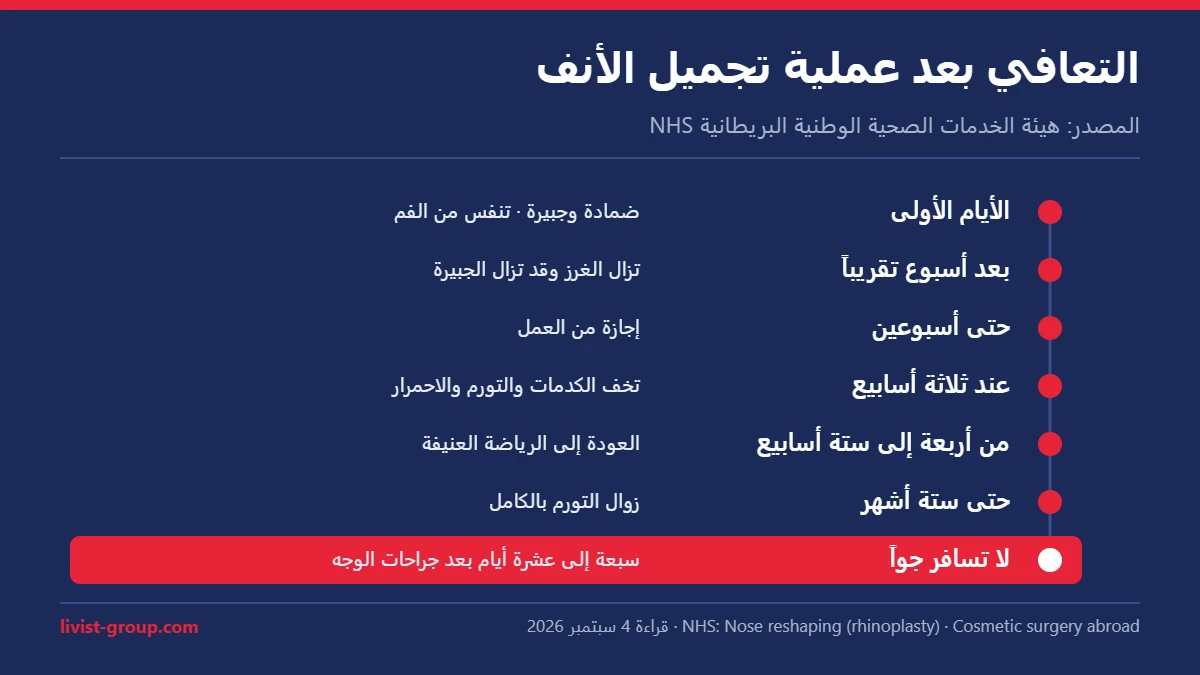
Recovery milestones as published by the UK National Health Service: the splint comes off after a week, swelling can take up to six months to settle.
After the rhinoplasty splint comes off
The NHS instructions for this stage are short and strict:
- Do not blow your nose and do not remove any crusts until your appointment to have the splint removed.
- Sneeze through your mouth to avoid pressure on your nose.
- Avoid hot baths and avoid getting the splint wet.
- Prop your head up on pillows for a couple of days when resting.
- No strenuous exercise or contact sports for four to six weeks.
If you have severe pain or any unexpected symptoms, contact the clinic where you had the operation as soon as possible. Which is precisely the instruction that is hardest to follow from another country — and why the NHS treats aftercare as part of the decision to travel rather than an afterthought. Before you book, establish where follow-up appointments will be, what happens if you need more surgery, how easily you can travel back, and how much that will cost.
Rhinoplasty complication and revision rates in the published evidence
What can go wrong with the nose itself (NHS): permanent breathing difficulty · damage to the cartilage wall between the nostrils · an altered sense of smell · heavy nosebleeds.
What can go wrong in any operation (NHS): excessive bleeding · a blood clot in a vein · infection · an allergic reaction to the anaesthetic. Your surgeon should explain how likely each of these is and how it would be treated.
The rhinoplasty number nobody quotes: revision rate
"Success rate" is not a measurable quantity and you will not find one here. The measurable quantity is how often a second operation is needed, and it is published. This is the canonical complication table on this page:
| Measure | Synthetic (polymer) implant | Autologous rib cartilage |
|---|---|---|
| Evidence base | 27 studies · 3,803 cases | 20 studies · 1,648 patients |
| Revision rate | 6.40% | 2.25% |
| 95% CI for revision | 3.84 – 9.57 | 0.96 – 3.90 |
| Infection | 1.91% | 1.45% |
| Most common other finding | Deviation 0.72% · irregularity 0.70% | Warping 3.05% · resorption 1.20% |
Sources: the first meta-analysis was published in Maxillofacial Plastic and Reconstructive Surgery in 2022 and covers polymer-based alloplastic materials in nasal dorsal augmentation. The second was published in Aesthetic Plastic Surgery in 2023 and covers autologous costal cartilage.
⚠️ Read the table honestly. The two studies define "overall complications" differently — the second also counts donor-site complications at the ribs — so their overall figures are not directly comparable. What is directly comparable is the revision rate and infection, measured the same way in both. The second study also reported that donor-site morbidity raises the overall complication rate for rib-cartilage rhinoplasty, and that the pneumothorax rate was zero.
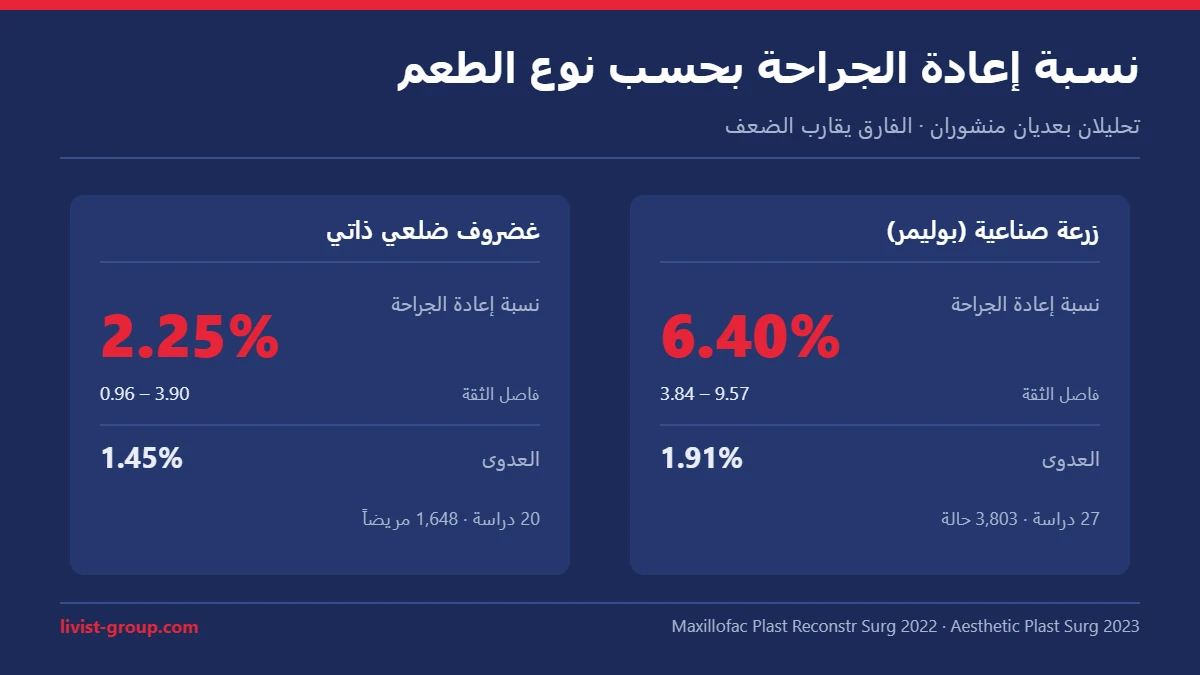
Synthetic implant versus autologous rib cartilage — the difference in revision and infection rates is what belongs in the conversation before the price.
One piece of rhinoplasty context a travelling patient should not skip
The UK Foreign, Commonwealth and Development Office states in its Turkey travel advice that it is aware of 7 British nationals having died in Turkey in 2025 following medical procedures, and that others have had complications requiring further treatment or surgery.
That is a count, not a rate. It covers all medical, surgical and dental procedures, it is not specific to rhinoplasty, and it cannot be turned into a percentage because the denominator is not published. We include it because it comes from a government source and bears on the same decision, and we state its limits because presenting it without them would mislead.
The FCDO's most useful instruction in the same place: do your own research, because private companies have a financial interest in booking your treatment and their literature should not be your only source of information.
Rhinoplasty in Turkey: how much it costs by type
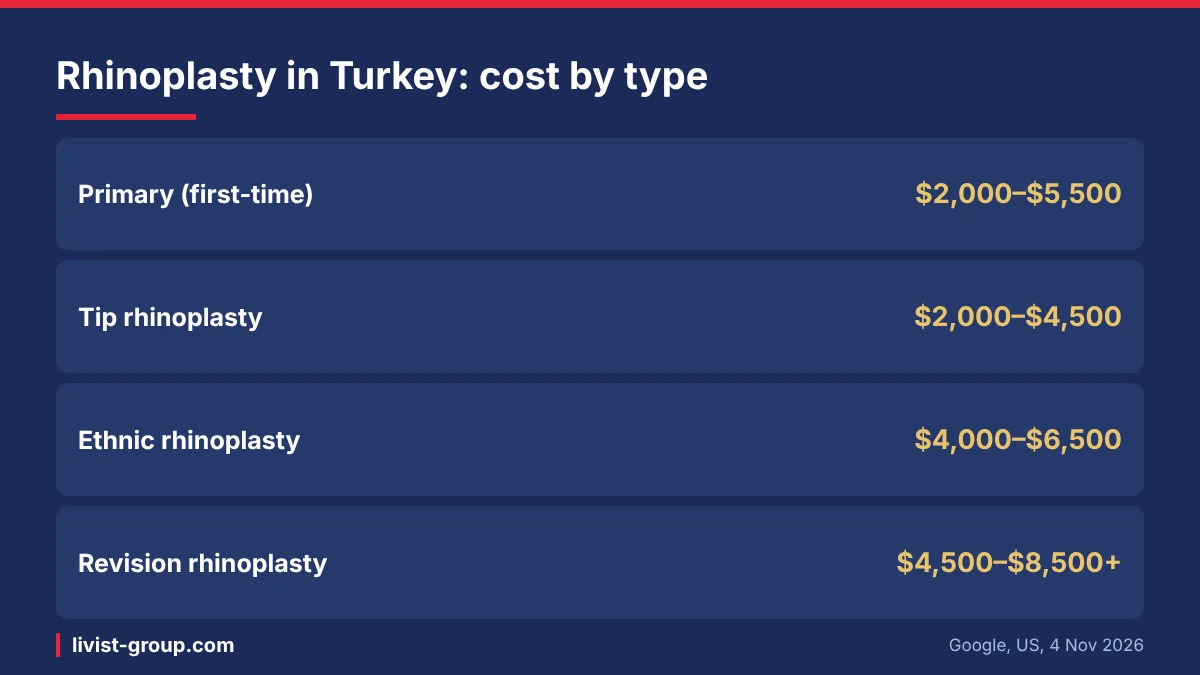
Rhinoplasty in Turkey typically costs $2,000 to $7,500, depending on technique, complexity and the surgeon.
| Rhinoplasty type | Typical price in Turkey |
|---|---|
| Primary (first-time) | $2,000–$5,500 |
| Tip rhinoplasty | $2,000–$4,500 |
| Ethnic rhinoplasty | $4,000–$6,500 |
| Revision rhinoplasty | $4,500–$8,500+ |
Market ranges read from Google on 4 November 2026. The official floor below is the legal minimum, not a market price.
Nose surgery istanbul price and the official floor
Most pages answer this with a marketing range and no source. There is a better answer, and it has legal force.
Turkey's Ministry of Health publishes a Health Services Price Tariff (EK-2), brought into force by an administrative decision dated 16 February 2026 and effective from 23 February 2026. The rules governing it (EK-1, article 12(a), as amended on 16 February 2026) state that the prices in that tariff are the floor price (TABAN) for health services provided to people covered by the International Health Tourism Regulation, at all public and private health service providers.
In plain terms: this is not an average price. It is the level below which a price may not legally go.
Update note: the Turkish Ministry of Health page lists an amendment to the tariff dated 28 July 2026. The figures in the table below come from the version in force from 23 February 2026, so confirm the current figure with your provider.
The official rhinoplasty price table
Source: Health Services Price Tariff (EK-2), Turkish Ministry of Health, in force from 23 February 2026.
Conversion: official buying rate of the Central Bank of the Republic of Türkiye, bulletin 2026/165 dated 3 September 2026.
| Procedure | Code | Turkish lira | USD | GBP |
|---|---|---|---|---|
| Uncomplicated rhinoplasty, no graft | SP601600 | 31,275 | 649 | 481 |
| Septorhinoplasty | SP601630 | 40,050 | 831 | 616 |
| Open rhinoplasty with total septal reconstruction | SP601290 | 69,000 | 1,431 | 1,062 |
| Complicated rhinoplasty with graft | SP601610 | 70,275 | 1,457 | 1,082 |
| Complicated rhinoplasty with autologous graft | SP601615 | 90,000 | 1,866 | 1,385 |
| Nasal valve surgery, bilateral | SP601540 | 17,550 | 364 | 270 |
| Nasal fracture repair | SP601500 | 1,920 | 40 | 30 |
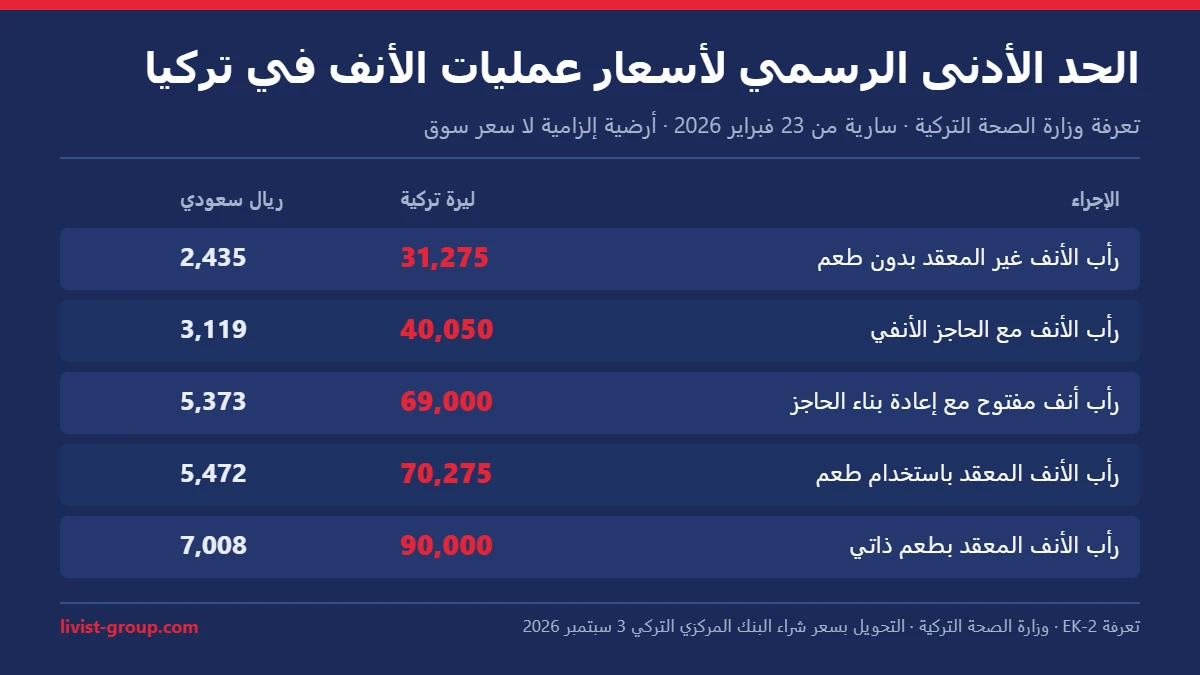
The official floor price from the Turkish Ministry of Health tariff — any offer below it is a question to ask, not a discount to accept.
How to use it. Commercial offers sit well above these numbers, and that is not a breach. A price below the floor is. What the table gives you is not a target but a reference line you can hold an offer against — and a demonstration that the tariff itself treats "rhinoplasty" as several different operations. A single number quoted before an examination is pricing a procedure nobody has chosen yet. For the wider picture across procedures, see our guide to cosmetic surgery costs in Turkey.
Turkey rhinoplasty package: what the number includes
A turkey rhinoplasty package is not an informal marketing idea. Turkish regulation defines it. Article 12(e) of the tariff rules allows health facilities to set health-tourism package prices whose content may include travel (return air ticket), accommodation, guidance and a city tour, alongside the prices of the procedures listed in the tariff.
That definition is the checklist. When an offer is described as a package, ask which of those four items are in it and what each of the missing ones costs separately. Our guide to what a medical package in Turkey includes sets out the same list in more detail.
The only rhinoplasty price comparison two official sources support
| Reference | Figure | What kind of number it is |
|---|---|---|
| Turkish Health Ministry tariff | 31,275 TL, about £481, for the simplest form of the operation | A binding minimum for an international patient |
| NHS published cost in the UK | £4,000 to £7,000 | A published market range |
A methodological warning: do not divide a floor price by a market price and call the result a saving. The Turkish figure is what may not be gone below; the British figure is what is actually paid. A fair comparison needs a written Turkish quote in your hand next to the published UK range.
The NHS adds a line that comparisons usually omit: also factor in the cost of any consultations, further surgery or follow-up care you may need. If a second operation would happen in another country, its cost includes a flight, accommodation and time all over again — and up to two weeks off work, plus seven to ten days when you cannot fly. Those are budget lines, not just calendar lines.
All-inclusive rhinoplasty turkey offers and the invoice
An all-inclusive rhinoplasty turkey offer is only as good as the invoice behind it, and Turkish regulation gives you four things to check.
- The currency of record is the lira. Article g.4 of the tariff rules requires invoices for health-tourism services to be issued and collected in Turkish lira. Payment may be taken in foreign currency for the amount equivalent to the lira figure shown on the invoice, converted at the Central Bank of the Republic of Türkiye buying rate of that day. Any dollar price you are quoted is a translation of a lira figure, and the exchange rate on the day you pay is a real variable.
- The conversion rate is not the clinic's choice. For reference, bulletin 2026/165 dated 3 September 2026 gave a buying rate of 48.2238 for the US dollar and 64.9761 for the pound sterling.
- An itemised invoice is your right, in writing. Article 12(f) obliges the health facility to provide a detailed breakdown of the health service charge attached to the invoice, and states that the patient or their insurer is entitled to request that detail.
- Translation, consultancy and support are separate lines. The same article allows facilities and companies to charge for interpreting, consultancy and support services outside the health service itself, provided the amount is shown separately on the invoice. A single all-in figure with no breakdown is an incomplete invoice, not a generous offer.
Is it safe to get a nose job in turkey? Licensing and the 2027 deadline
The honest answer is that "Turkey" is not the unit that safety attaches to. The facility is. And unlike almost everything else in this decision, the facility's status is a matter of public record.
First, licensing is verifiable. The Turkish Ministry of Health publishes two official lists: authorised health facilities permitted to treat international health-tourism patients, and authorised intermediary organisations. Both were updated on 20 August 2026. The UK FCDO refers British nationals to the Turkish Ministry's own list of approved providers, and adds that it gives no endorsement of the competence or suitability of any practitioner or facility. Even the government issuing the warning points you at the licence register, because it is the one thing that can be checked objectively.
Second, a deadline that changes what you should ask. Under the International Health Tourism and Tourist Health Regulation published in the Turkish Official Gazette on 26 April 2025 (no. 32882), and per the Health Tourism Department's announcement of 13 May 2026:
| Type of facility | Requirement | Deadline |
|---|---|---|
| Hospital · laboratory · medical centre · dialysis centre holding a health tourism authorisation certificate | TÜSKA accreditation | 31 December 2026 |
| Other facilities (private practice, polyclinic, institution) | Certificate from the Provincial Health Directorate | 31 December 2026 |
The announcement states the consequence directly: facilities that have not completed accreditation or certification by the end of that period will not be able to continue admitting international patients or providing services within the scope of health tourism.
What to do with that. If your surgery is in 2026, ask the facility where it stands in the process. If it is in 2027, the question is not optional: ask about accreditation, not about the older certificate, because your follow-up may fall after the deadline. Our guide to choosing hospitals and clinics in Turkey covers what else is checkable, and pre-operative health checks covers what happens before the operating theatre.
Third, the logistics around the surgery. Entry rules are set out in our Turkey e-visa requirements guide, and the first journey after facial surgery is not a detail — see Istanbul airport transfer.
Where Livist Group sits in this: we are a coordination and services company, not a health facility. We do not perform procedures and we do not provide medical services directly; work is carried out with contracted health institutions holding health tourism authorisation. Every clinical decision stays between you and the doctor who examines you.
Best rhinoplasty in turkey: what can actually be verified
"Best" is not a verifiable claim, and any page ranking the top ten surgeons is publishing a commercial ranking, not a clinical one.
Top 10 rhinoplasty surgeon in turkey: why no such list exists
A search for that phrase returns exactly what it promises — rankings. None of them is issued by a regulator, a medical association, or the Health Ministry. The only list with official standing is the Ministry's register of authorised facilities, and it is a licence list, not a quality ranking: appearing on it is necessary, not sufficient. Four things, though, are verifiable — and three come straight from the NHS:
| What can be checked | How |
|---|---|
| The facility's licence | The Turkish Ministry of Health list of authorised facilities, updated 20 August 2026 |
| The intermediary's licence | The Ministry's separate list of authorised intermediary organisations |
| The surgeon's volume, as a number | Ask: how many nose reshaping operations have you performed, and how many had complications? (NHS) |
| Professional membership | Most associations publish searchable registers (NHS) |
The NHS adds the point that matters most when surgery happens abroad: standards and qualifications abroad may differ from your own country, and it can be difficult to establish whether a surgeon is fully trained in the procedure you want. Its advice is to find out how surgeons and clinics are regulated in your chosen country, and how those standards are enforced — which is exactly what the licensing section above answers, and why it comes before this one.
Rhinoplasty in turkey reviews: how to read them
Reviews and forum threads are the second most-read source in this decision, after price pages. They are worth reading, for a narrower set of questions than people use them for.
What reviews are genuinely good for:
- What the first seven days felt like — mouth breathing, sleeping propped up, the bruising around the eyes. Lived detail no official source writes down.
- How the logistics ran — appointments, interpreting, follow-up, how fast someone answered when the patient was worried.
- What happened when something went wrong. The most valuable accounts, and the rarest on marketing pages.
What they cannot measure, however many you read:
- Risk. Ten good outcomes are not a success rate. The published revision rates on this page (6.40% versus 2.25% depending on graft material) cannot be inferred from comments.
- Price. What someone else paid was for their procedure, and the tariff shows how far apart two rhinoplasties can sit.
- The surgeon. Satisfaction is not a proxy for qualification, and qualification is checkable — see the section above.
The reading rule: use reviews to learn how it will feel, and official sources to learn how likely something is. Confusing the two is the most common route to a rushed decision. If you are weighing several procedures at once, our guides to hair transplants in Turkey and dental implants and veneers follow the same method: official figure first, then experience.
Is it safe to get rhinoplasty in Turkey? What GOV.UK says
It also advises discussing plans with your doctor first and notes that private companies have a financial interest in booking your treatment. The Ministry of Health publishes its approved providers; see the licensing section above.
Nose job Turkey cost in pounds, and flying home
A nose job in Turkey typically costs £2,370 to £4,000, against £5,000 to £8,000 or more in the UK, according to Google's UK results on 4 November 2026. Many packages cover the surgery, anaesthesia, pre-op tests and a 4-star hotel, so check what yours includes.
Rhinoplasty in Turkey in summary
Rhinoplasty is a complex operation whose results cannot be guaranteed — the NHS's words, not ours. If you are considering rhinoplasty in Turkey, four numbers carry this page:
- 31,275 TL is the official floor price for the simplest form of the operation for an international patient, in public and private facilities alike, under the tariff in force since 23 February 2026. An offer below it is not compliant.
- Seven to ten days with no flying after facial surgery, and up to two weeks off work. That, not the ticket price, sets the length of your stay.
- 6.40% versus 2.25% revision rates depending on graft material — a question for the consent form, asked by name.
- 31 December 2026 is the deadline for TÜSKA accreditation, after which an unaccredited facility may not admit international patients.
And the rule that comes before all four: two consultations with the surgeon, an itemised invoice, and a facility you can find on the Ministry's list.
Closing note: this page is informational and does not replace medical advice, and must not be used to diagnose or to choose treatment. Speak to your own doctor before any surgical decision.
If you are combining procedures in one trip, recovery and pricing for breast surgery are in breast augmentation Turkey.
Sources for this rhinoplasty guide
Every figure on this page comes from one of the following, all opened and read on 4 September 2026:
- NHS — Nose reshaping (rhinoplasty) — description, duration, hospital stay, recovery, side effects and complications, UK cost, surgeon-selection questions.
- NHS — Cosmetic surgery abroad — two consultations, cooling-off period, limits of travel insurance, aftercare planning, and the no-flying window after facial procedures.
- T.C. Sağlık Bakanlığı — Health Services Price Tariff (EK-2) — procedure codes and prices, in force from 23 February 2026 under a decision dated 16 February 2026.
- T.C. Sağlık Bakanlığı — Price Tariff Principles (EK-1), article 12 — floor-price status, invoicing in lira, the right to an itemised invoice, separation of translation and consultancy charges, and the definition of a package.
- Health Tourism Department announcement, 13 May 2026 — TÜSKA accreditation deadline of 31 December 2026, under the Official Gazette regulation of 26 April 2025 (no. 32882).
- Health Tourism Department announcement, 20 August 2026 — updated lists of authorised facilities and authorised intermediaries.
- GOV.UK — Foreign travel advice: Turkey (Health) — 7 British nationals died in Turkey in 2025 following medical procedures, and medical tourism guidance.
- Maxillofacial Plastic and Reconstructive Surgery (2022) — meta-analysis of 27 studies and 3,803 cases: complications and revision rate for alloplastic implant materials.
- Aesthetic Plastic Surgery (2023) — meta-analysis of 20 studies and 1,648 patients: complications and revision rate for autologous costal cartilage.
- Central Bank of the Republic of Türkiye — exchange rate bulletin 2026/165 dated 3 September 2026, the reference named in article g.4 for currency conversion.
Book your rhinoplasty consultation in Turkey with Livist Group
We arrange a consultation with a contracted facility on the Turkish Ministry of Health list for international health tourism, and you receive a written plan before any payment.
Rhinoplasty in Turkey: frequently asked questions
Answers to the most common questions about this topic
Hair Transplant Turkey 2026: Cost, Clinics, Risks & Recovery
Hair transplant Turkey: $2,000–5,000 per search results. What decides the result, how to check a clinic licence, and the honest recovery timeline.
BBL Turkey 2026: Cost, All-Inclusive Packages, Safety and Recovery
How much a BBL in Turkey costs in 2026, what all-inclusive packages cover, the official minimum price, BAAPS safety rules, recovery time and how to check a surgeon.
Knee Replacement Turkey 2026: Cost, Total vs Partial, Recovery
Knee replacement in Turkey costs in 2026 for one or both knees, partial and robotic surgery, what packages include, the official minimum fee, NHS recovery timeline and risks.