
turkish citizenship by marriage: Article 16 in full
turkish citizenship by marriage from the text of Law 5901 rather than from agency summaries: the three-year rule, the three statutory conditions, the death and annulment exceptions, and the official document list.

turkish citizenship by marriage is never automatic; Article 16 of Law 5901 requires a subsisting marriage to a Turkish citizen of at least three years, plus three conditions written into the statute.
| Item | Value |
|---|---|
| Legal basis | Law No. 5901, Article 16 |
| Required marriage duration | at least three years, subsisting |
| Additional statutory conditions | three |
| Ordinary route for comparison | Article 11 — five years of residence |
| If the Turkish spouse dies | the family-unity condition falls away |
| Competent authority | Directorate of Civil Registration and Nationality |
Most of what is published about turkish citizenship by marriage is written by service firms competing for the same keyword, and almost none of it quotes a single line of the law that governs it. This article does the opposite: it starts from the Turkish text of the article that regulates turkish citizenship by marriage, then explains what follows from it.
⚠️ Note: this article is informational and reproduces official texts as they stand; it is not legal advice. The competent authority on citizenship applications is Türkiye's Directorate General of Civil Registration and Nationality, and any individual case should be put to it or to a licensed lawyer in Türkiye.
What the law says about turkish citizenship by marriage
The basis is Article 16 of Turkish Citizenship Law No. 5901. Its first paragraph reads:
"Bir Türk vatandaşı ile evlenme doğrudan Türk vatandaşlığını kazandırmaz. Ancak bir Türk vatandaşı ile en az üç yıldan beri evli olan ve evliliği devam eden yabancılar Türk vatandaşlığını kazanmak üzere başvuruda bulunabilir."
In translation: marriage to a Turkish citizen does not directly confer Turkish citizenship. However, foreigners who have been married to a Turkish citizen for at least three years and whose marriage subsists may apply to acquire Turkish citizenship.
That sentence alone disposes of the largest misconception on the subject: marriage does not grant citizenship; it opens the door to applying, after three years. An application filed before the three years are complete does not meet the durational requirement.
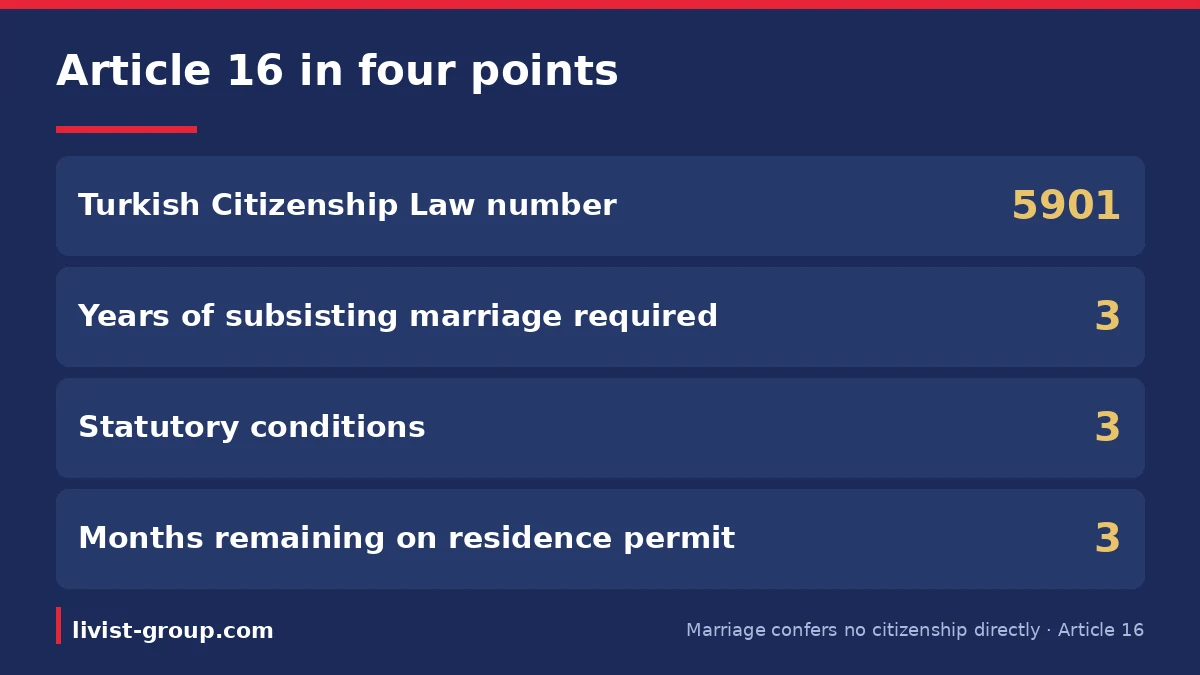
The four governing figures in Article 16 of Turkish Citizenship Law No. 5901.
Do you get citizenship if you marry a Turkish citizen?
No — not by the marriage itself, and the statute says so in its opening words. What marriage does is create eligibility to apply once the marriage has subsisted for three years and the three statutory conditions are met. Until then no application route exists on this basis, whatever an intermediary may suggest.
How long after marriage can I get my citizenship?
The statutory waiting period before you may apply is three years of subsisting marriage. That is the only duration written into Article 16.
What the law does not fix is how long the authority takes to decide once you have applied. We publish no processing time in months, because the directorate publishes no binding schedule of decision periods, and any figure you read elsewhere is an estimate without an official source. Our rule is explicit: a number with no dated official source is deleted, not estimated.
The three conditions for turkish citizenship by marriage
Beyond the durational requirement, Article 16 sets three conditions, lettered (a), (b) and (c). This is the canonical table of this article:
| Letter | Turkish text | Meaning |
|---|---|---|
| (a) | Aile birliği içinde yaşama | Living in family unity — the spouses must actually live as a family, not merely hold a certificate |
| (b) | Evlilik birliği ile bağdaşmayacak bir faaliyette bulunmama | Not engaging in activity incompatible with the marital union |
| (c) | Millî güvenlik ve kamu düzeni bakımından engel teşkil edecek bir hali bulunmama | Having no circumstance constituting an impediment on grounds of national security and public order |
Condition (a) is the one that decides most cases in practice, because it means a marriage of convenience does not pass: the law is not satisfied by a subsisting contract, it requires actual family life.
Death of the Turkish spouse and turkish citizenship by marriage
Article 16 contains an express exception:
"Başvurudan sonra Türk vatandaşı eşin ölümü nedeniyle evliliğin sona ermesi halinde birinci fıkranın (a) bendindeki şart aranmaz."
That is: if the marriage ends after the application because of the death of the Turkish spouse, the condition in paragraph (a) is not required — the family-unity condition. The logic is plain: a condition rendered impossible by death is not held against the applicant.
Note the limit: the exception is tied to death after the application was filed, not to any other ending of the marriage.
Annulment and turkish citizenship by marriage
A third rule covers someone who acquired citizenship and whose marriage is then annulled:
"Evlenme ile Türk vatandaşlığını kazanan yabancılar evlenmenin butlanına karar verilmesi halinde evlenmede iyiniyetli iseler Türk vatandaşlığını muhafaza ederler."
That is: foreigners who acquired Turkish citizenship through marriage retain it where annulment is ordered, if they were in good faith at the time of the marriage. Good faith is the test: someone who married without knowing the ground of nullity is not punished by loss of citizenship.
Documents required for turkish citizenship by marriage
The document list as provincial civil registration directorates publish it:
- The application form for this route (Vat-6), issued at the directorate.
- A notarised copy of the Turkish translation of the passport or equivalent document showing the applicant's nationality.
- A notarised Turkish translation of the birth certificate issued by the competent authorities of the applicant's country, showing all identity data in a form suitable for registration.
- A copy of the most recent residence permit, with at least three months remaining.
- One biometric photograph of each spouse.
- A receipt for the service fee paid at the finance directorate's till.
- The Turkish spouse's civil registry record and the marriage notification.
- A certified copy of any final court judgment, where one exists.
We do not publish the service fee amount, even though the official page displays a figure: the page states no year of effect, and service fees are revised annually. Publishing an undated figure is worse than omitting it, because readers will read it as a 2026 amount. Ask the directorate for the fee in force on the day you apply.
The practical point in item 4: a valid residence permit is a working precondition, so anyone whose permit has lapsed or has under three months left should renew first. See the Türkiye residence permit and e-ikamet application steps.
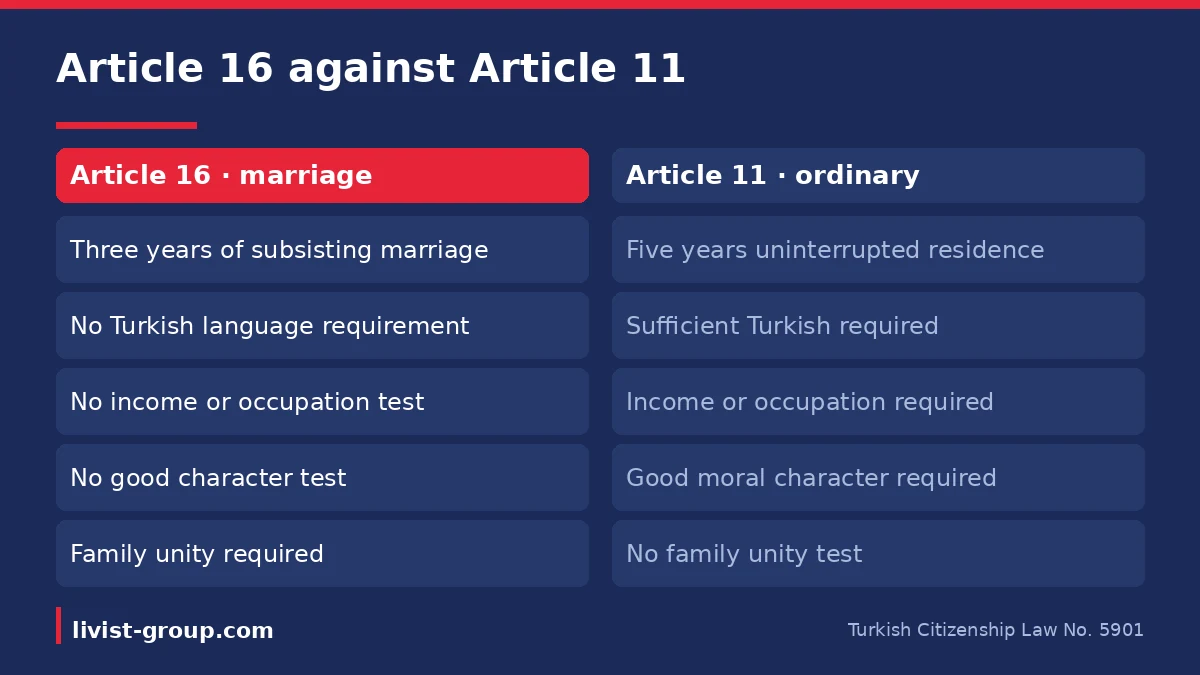
A comparison of conditions between Article 16 and the ordinary naturalisation route in Article 11 of the same law.
What is the easiest way to get Turkish citizenship?
There is no official "easiest" route, but the statute lets you compare two of them directly. Article 11 governs ordinary naturalisation, and set beside Article 16 it shows exactly how much the marriage route removes:
| Requirement | Article 16 — marriage | Article 11 — ordinary route |
|---|---|---|
| Duration | Three years of subsisting marriage | Five years of uninterrupted residence in Türkiye |
| Turkish language | Not required by the text | Required: "yeteri kadar Türkçe konuşabilmek" |
| Income or occupation | Not required by the text | Required: income or a profession supporting the applicant and dependants |
| Public health | Not required by the text | Required: no disease posing a danger to public health |
| Good moral character | Not required by the text | Required: "iyi ahlak sahibi olmak" |
| National security | Required | Required |
The conclusion is that the marriage route carries fewer conditions, not that it is easier to execute. It drops language, income, health and character requirements, but adds one that does not exist in the ordinary route — proving actual family unity — and that is the condition on which most refusals turn.
Which country gives fastest citizenship by marriage?
We will not rank countries, because no authority publishes a comparative table of marriage-based naturalisation periods, and any ranking you find is compiled commercially and changes without notice. What is verifiable is each country's own statute. For Türkiye, that number is written in Article 16 and it is three years of subsisting marriage before an application may be filed.
If a comparison matters to your decision, read each country's own citizenship law rather than a league table, because the durational rule is only one variable — the family-unity test in Article 16 has no equivalent in many other systems.
turkish citizenship by marriage versus the investment route
These are two entirely separate routes with different legal bases, and conflating them is common:
- The marriage route rests on Article 16. Its criterion is time and family relationship, and no sum of money is involved.
- The investment route rests on a different basis. Its criterion is a numeric investment threshold set by decision and amended periodically, with no residence or marriage duration attached.
Someone who meets the three-year rule needs no investment, and someone taking the investment route needs no marriage. Full detail in Turkish citizenship by investment and Turkish citizenship through real estate.
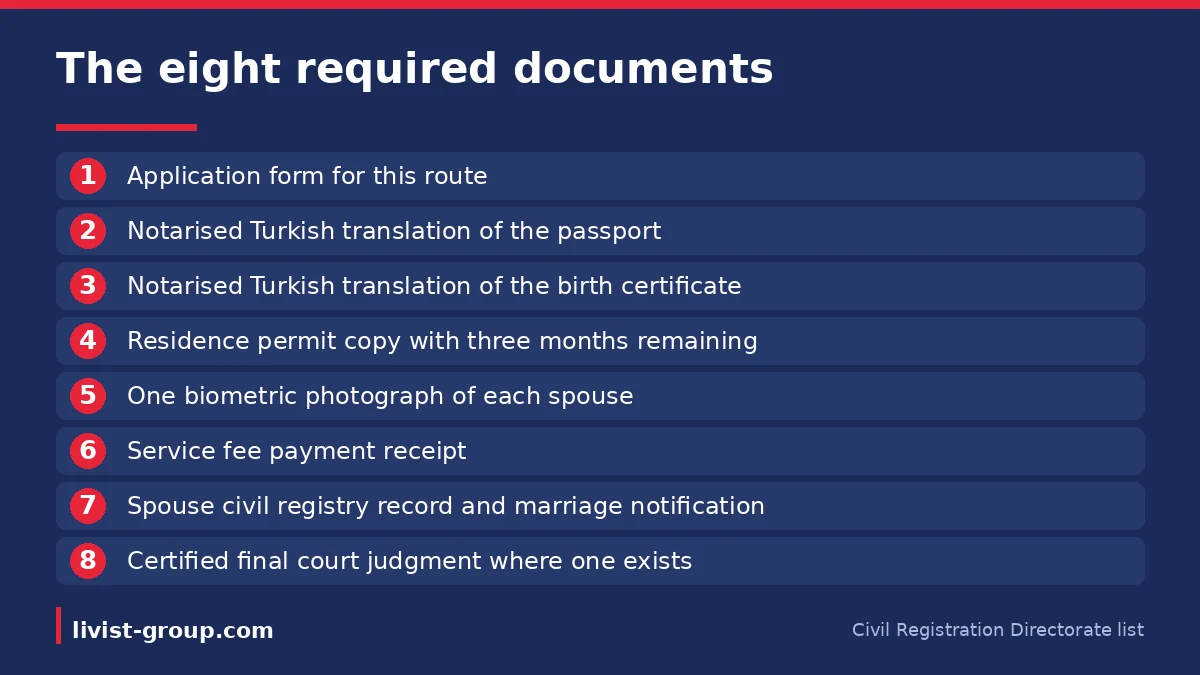
The eight documents required for the marriage route as Turkish civil registration directorates publish them.
Dual nationality and turkish citizenship by marriage
Türkiye permits dual nationality, and the citizenship law does not require renouncing your original nationality as a condition of acquisition — unlike many states. The other half of the equation is not in Türkiye's hands: some countries automatically withdraw their nationality from a citizen who acquires another, and that is governed by your own country's law. Check with your own authority before applying.
Does a Turkish passport enter Europe?
Not without a visa. Türkiye is a member of neither the European Union nor the Schengen area, and a Turkish passport holder applies for a Schengen visa like anyone else. We have a full guide to that: Schengen visa from Türkiye.
We publish no global passport ranking and no visa-free country count, because those figures come from private commercial indices rather than any government, and change several times a year. What is official and dependable is each country's published visa policy.
Whichever route you take, the cost of actually living there is built on the statutory minimum wage and the inflation rate, set out in the cost of living in Turkiye.
Permanent residence compared with turkish citizenship by marriage
Permanent residence and citizenship are different things, and confusing them costs time. Permanent residence is a long-term residence status: it does not make you a citizen and does not give you a Turkish passport. Citizenship makes you a citizen with full rights. Someone married to a Turkish citizen may have both routes available and chooses by need. See types of residence permits in Türkiye and which residence permit suits you.
Common mistakes in turkish citizenship by marriage
- Assuming marriage confers citizenship automatically — the text says the opposite in its first sentence.
- Applying before three years are complete — the application does not meet the durational rule.
- Underestimating the family-unity condition — it is where most refusals land.
- Applying with under three months left on the residence permit — the official list requires it expressly.
- Confusing the marriage route with the investment route — different legal bases, different criteria.
- Assuming a Turkish passport enters Europe visa-free.
Prepare your file with Livist Group
In summary, turkish citizenship by marriage is a clearly drawn route in the text of Article 16: three years of subsisting marriage, three statutory conditions, a defined document list, and two exceptions for death and annulment. Livist Group prepares the residence, documentation and certified translations this route rests on. Talk to us at livist-services.com.
Sources
- Turkish Citizenship Law No. 5901 — Article 16 (acquisition through marriage) and Article 11 (conditions for the ordinary route), official Turkish text. Read live 20 September 2026.
- Türkiye Directorate General of Civil Registration and Nationality — page on acquiring Turkish citizenship and the conditions of the marriage route. Read live 20 September 2026.
- Edirne Provincial Civil Registration Directorate — required document list for the marriage route. Read live 20 September 2026.
Frequently asked questions
Answers to the most common questions about this topic

Universities in Turkey 2026: Rankings, Fees, Admission
Universities in Turkey by official figures: 128 state and 75 foundation universities, QS 2027 ranks, tuition under Decision 11625, and scholarships.

Driving Licence Exchange Turkey 2026: The Six-Month Rule
Driving licence exchange turkey rules: six months for foreigners and two years for citizens from the date of entry, plus documents and fees.

Company Formation in Turkey for Foreigners 2026 Guide
Company formation in turkey for foreigners: minimum capital after the 2024 decision, the MERSIS steps and the 2026 corporate tax rates.