Schengen Visa from Turkey for Foreigners: 2026 Eligibility, Documents and Real Costs
If you hold a Turkish residence permit but not a Turkish passport, you can apply from Turkey. Here is the jurisdiction rule, the extra evidence you will be asked for, the EUR 90 official fee, the 2025 refusal rate of every Schengen consulate in Turkey, and why the Cascade rule does not extend to you.

A practical guide for non-Turkish nationals living in Turkey who want to apply for a Schengen visa from Turkey. It covers the legal-residence rule in Article 6 of the Visa Code, which consulate takes your file, the documents added to a foreign resident's list, the official consular fee, and the limits of the Cascade rule.
| Item | Verified figure | Source | Reference date |
|---|---|---|---|
| Consular fee — adult | €90 | EEAS · EU Visa Code (Regulation 810/2009), Art. 16(1) | In force since 11/06/2024 |
| Consular fee — child aged 6 to under 12 | €45 | Same source, Art. 16(2) | In force since 11/06/2024 |
| Consular fee — child under 6 | Free | Same source, Art. 16(4) | In force since 11/06/2024 |
| Jurisdiction rule for applicants | Consulate of the Member State in whose jurisdiction the applicant **legally resides** | EU Visa Code, Art. 6(1) | Consolidated text, 2024 |
| Legally present but not resident | May be examined if the applicant justifies applying at that consulate | EU Visa Code, Art. 6(2) | Consolidated text, 2024 |
| Schengen applications lodged at consulates in Turkey (all nationalities) | 1,268,376 | European Commission — official visa statistics file, "Totals - third country" sheet | 2025 |
| Applications not issued | 183,196 | Same source | 2025 |
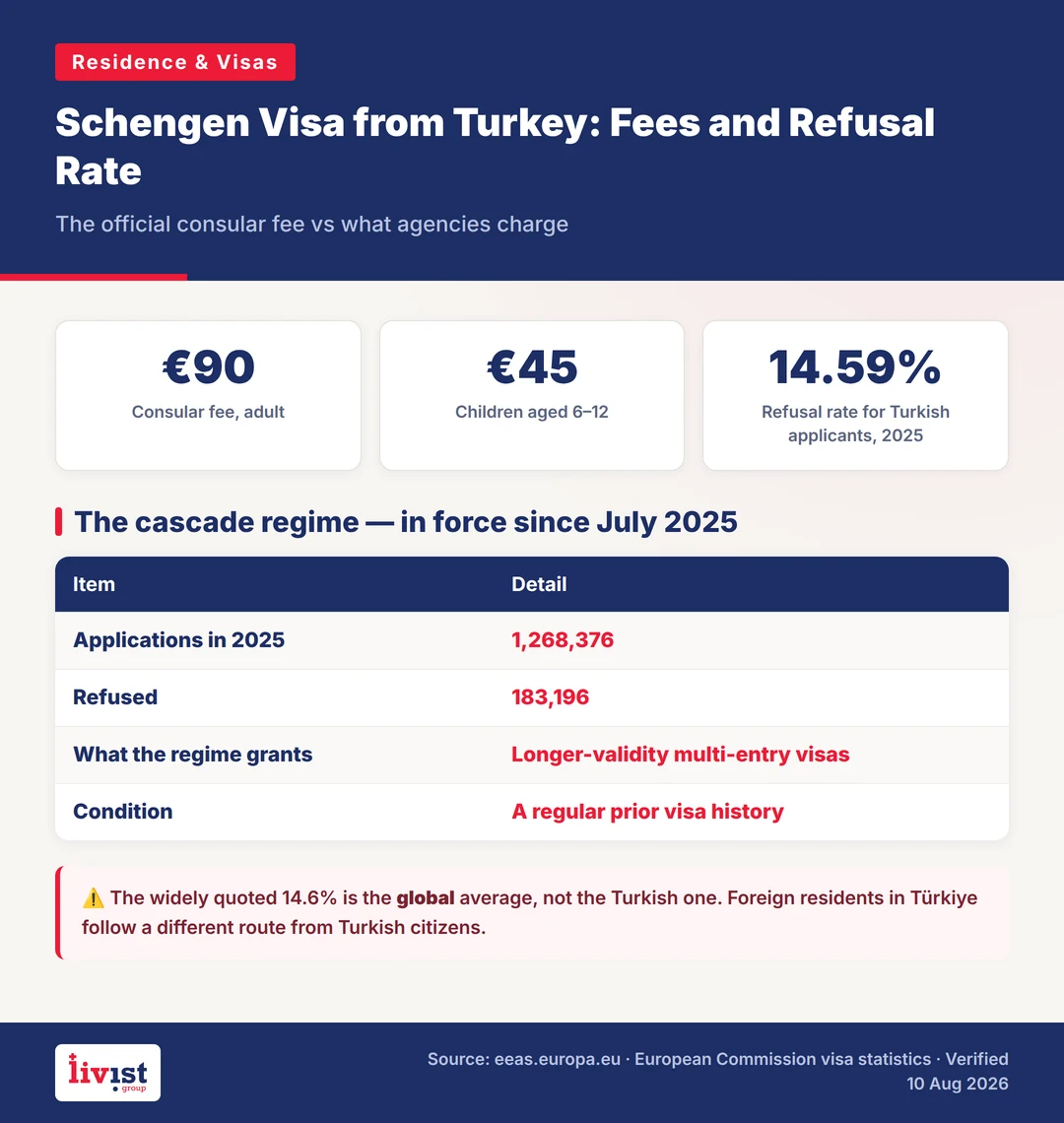
| Not-issued rate — all applications lodged at consulates in Turkey | **14.59%** | Same source (calculated from raw data) | 2025 |
| Not-issued rate — all applications lodged at consulates in Turkey | 14.54% (170,129 of 1,173,917) | Same source | 2024 |
| Global not-issued rate — for contrast only | 14.6% | European Commission, Schengen statistics release | 2025 |
| Multiple-entry share of visas issued at consulates in Turkey | 68.71% | Same source | 2025 |
| Cascade rule | Commission Decision C(2025) 4694, restricted to **Turkish nationals** | European Commission | Adopted 15/07/2025 · announced and applicable from 29/07/2025 |
| Visa application centre service fees (VFS Global / iDATA) | Vary by country and centre | The authorised centre's own platform | Published per centre by the authorised provider — EEAS, page updated 18/07/2025 |
Direct answer: A foreign national living in Turkey on a valid residence permit can apply for a Schengen visa from Turkey, because the EU Visa Code assigns applications by legal residence rather than by nationality. You apply to the consulate of your main destination through its authorised application centre in Turkey. The consular fee is €90 for adults and €45 for children aged 6 to under 12.
Almost everything written in English about applying from Turkey is written for Turkish citizens. That leaves the largest group of readers unserved: Syrians, Iranians, Russians, Pakistanis, Indians, Arabs and Europeans who live in Turkey on an ikamet and hold a non-Turkish passport. Your file is not the same file. The legal basis for accepting it is different, the evidence you are asked to produce is different, and the one piece of good news Turkish applicants received in July 2025 — the Cascade rule — does not extend to you. This guide covers eligibility, jurisdiction, documents, real cost, refusal odds and the limits of the Cascade rule, each with its source named in the sentence.
Can a non-Turkish resident apply for a Schengen visa from Turkey?
Yes — and it is the default rule, not an exception. Article 6(1) of the EU Visa Code (Regulation 810/2009) states that an application shall be examined and decided on by the consulate of the competent Member State in whose jurisdiction the applicant legally resides. The passport you hold does not decide where you apply; the place where you lawfully live does.
The legal-residence rule for a Schengen visa from Turkey
- A valid Turkish residence permit covering the application period, ideally with validity extending past your planned return date. If you are unsure which permit type you hold, see types of residence permits in Turkey; if you are still in the application stage, see the e-ikamet application steps.
- Lodging the application inside Turkey, at the consulate or authorised centre serving your city of residence.
- Evidence that your life is anchored in Turkey, not only in your country of origin.
Legally present but not resident: can you still get a Schengen visa from Turkey?
Article 6(2) allows a consulate to examine an application from someone who is legally present but not residing in its jurisdiction, provided the applicant justifies why they are applying there. In practice this is a discretionary door, not an entitlement: a tourist passing through Turkey on a short-stay entry is expected to apply from their country of residence, and a weak justification is itself a refusal ground. If your residence permit application is still pending, wait for the card before booking a visa appointment.
Why third-country nationals applying for a Schengen visa from Turkey are assessed differently
The core assessment in any short-stay application is the risk that you will not leave the Schengen area. For a Turkish citizen applying from Turkey, the anchor is obvious. For a foreign resident, the consulate is weighing two countries at once: will you return to Turkey, and is your right to return to Turkey secure for the whole period? That single question explains every extra document in the next section.
Which consulate takes your Schengen visa application in Turkey?
Authorised visa application centres for a Schengen visa from Turkey
These are the only external service providers authorised by the Schengen states in Turkey. The list below is published by the EU Delegation to Turkiye (EEAS), page updated 18/07/2025.
| Authorised centre | Schengen states it accepts applications for |
|---|---|
| iDATA | Germany, Italy |
| VFS Global | Belgium, Bulgaria, Czechia, Denmark, Estonia, France, Croatia, Latvia, Lithuania, Luxembourg, Malta, Netherlands, Austria, Poland, Slovenia, Finland, Sweden, Iceland, Norway, Switzerland |
| AS-Visa | Hungary |
| BLS | Spain, Slovakia |
| Kosmos Visa Services | Greece |
| No external provider | Romania (own national visa portal) and Portugal (embassy website) |
EEAS states this plainly: you do not need a travel agency or any other actor aside from the authorised external service providers listed above. Any intermediary that promises better access is charging you for something it cannot deliver.
Main-destination rule: apply to the country where you will spend the longest period. Tiebreaker: if the stays are equal, apply to the country of first entry into the Schengen area. Then there is the operational layer: most Member States in Turkey outsource intake and biometrics to external service providers such as VFS Global or iDATA. Those centres accept files, collect fingerprints and photographs and return passports; they do not decide anything. The decision belongs to the consulate alone, and no centre can accelerate it.
Geographic jurisdiction inside Turkey varies by Member State — some consulates serve the whole western half of the country from Istanbul, others split Ankara and Izmir. Check the destination country's own page before booking, because filing at the wrong centre gets a file rejected on form before it is ever read on merit.
Documents for a Schengen visa from Turkey: the common file and the foreign-resident add-ons
| Document | Turkish citizen | Foreign resident in Turkey |
|---|---|---|
| Valid passport with blank pages | ✓ | ✓ |
| Signed harmonised application form | ✓ | ✓ |
| Biometric-format photographs | ✓ | ✓ |
| Travel medical insurance valid across the Schengen area for the whole trip | ✓ | ✓ |
| Proof of funds, flight and accommodation bookings | ✓ | ✓ |
| Proof of occupation (employment letter, company registration, student enrolment) | ✓ | ✓ |
| Valid Turkish residence permit card | — | + mandatory |
| Evidence of ties to Turkey: lease, employment contract, enrolment | — | + effectively mandatory |
| Remaining permit validity extending beyond your return date | — | + requested by most consulates |
Minimum insurance cover is set by each consulate's own published list, so use that list rather than any intermediary's summary; for how the policies differ, see our guide to travel insurance for Turkey in 2026. If your permit expires within a few months of your travel dates, deal with the residence permit renewal first — a permit that lapses mid-trip undermines the strongest argument in your file.
How to apply for a Schengen visa from Turkey step by step in 2026
- Fix your main destination and visa type — a short-stay type C visa, filed with the country where you will spend the most nights.
- Book the appointment on the correct official platform for that Member State. Never pay a third party to "secure" an appointment slot.
- Complete the harmonised application form and sign it yourself. Any mismatch between the form and your documents is a routine refusal ground.
- Assemble both document columns from the table above — the common file, then your foreign-resident add-ons.
- Attend for biometrics; fingerprints and a photograph are taken in person, with limited exemptions for applicants whose biometrics are still on file.
- Pay the consular fee and the service charge separately — €90 adult, €45 for children 6 to under 12, plus the centre's own fee.
- Track and collect using the centre's reference number, and avoid non-refundable bookings until a decision is issued.
How much does a Schengen visa from Turkey cost in 2026?
| Item | Amount | Source |
|---|---|---|
| Consular fee — adult | €90 | EEAS · Visa Code Art. 16(1), in force since 11/06/2024 |
| Consular fee — child 6 to under 12 | €45 | Same source, Art. 16(2) |
| Consular fee — child under 6 | Free | Same source, Art. 16(4) |
| Application centre service fee | Varies by country and centre | Published by each authorised centre on its own platform (EEAS) |
| Travel medical insurance | Depends on duration, age and cover | Insurance market · published by each authorised centre on its own platform (EEAS) |
| Full agency package | A multiple of the consular fee | Market offers — the difference is a service charge, not a state fee |
Some categories are exempt from the fee by law, including pupils, students, postgraduate students and accompanying teachers travelling for study or educational training. Nationals of countries covered by visa facilitation agreements pay €35, and Cape Verde nationals €67.50. The Commission reviews the fee every three years; the next review is expected around 2027.
You can complete every step above yourself, and the €90 consular fee is identical whoever submits the file. If you would rather have the foreign-resident evidence checked before you burn a non-refundable appointment, you can have your Schengen file reviewed by the Livist Services team.
The Cascade rule for Schengen visas in Turkey: what it gives and who it leaves out
The Cascade rule is not news — the Commission published it and news agencies covered it in July 2025. What is genuinely missing in English is how to read it against your own record, and one honest statement about its scope. The instrument is Commission Decision C(2025) 4694, adopted 15/07/2025 and applicable from its announcement on 29/07/2025. The ladder has four rungs, not three; most summaries drop the first one.
| Your previous record | Validity you may be granted |
|---|---|
| A previous visa used lawfully, applying within one year of its expiry | Multiple-entry visa valid 6 months |
| A 6-month visa used lawfully, applying within two years of its expiry | Multiple-entry visa valid 1 year |
| A 1-year visa used lawfully, applying within two years of its expiry | Multiple-entry visa valid 3 years |
| A 3-year visa used lawfully, applying within two years of its expiry | Multiple-entry visa valid 5 years |
— European Commission, Commission Implementing Decision C(2025) 4694 final, 15 July 2025, recital (4)
That single recital is the whole answer, and it is why this page exists. Article 1 of the same decision limits the facilitated tiers to Turkish nationals residing in Türkiye and applying in Türkiye, and excludes Turkish truck drivers applying in a professional capacity. If you are a foreign resident in Turkey, you still apply from Turkey under Article 6(1) of the Visa Code, but your multiple-entry validity is assessed under the general provisions of Article 24(2), not under the Turkish cascade. Knowing this before your second application is worth more than an optimistic reading of it.
The Schengen visa Cascade ladder in Turkey: exact validity steps under C(2025) 4694
| Visa validity issued | Condition in Article 2 of the decision |
|---|---|
| Six months | Applied within one year from the expiry of a lawfully used previous visa |
| One year | Applied within two years from the expiry of a lawfully used previous visa that was valid for six months |
| Three years | Applied within two years from the expiry of a lawfully used previous visa that was valid for one year |
| Five years | Applied within two years from the expiry of a lawfully used previous visa that was valid for three years |
In every step the visa can never outlast the passport: where the validity would exceed that of the travel document, it is shortened accordingly.
Cumulative conditions for the Turkish cascade are: residence in Türkiye, application from Türkiye, a bona fide travel record, satisfaction of entry conditions, and a visa validity that does not exceed passport validity. Truck drivers applying in their professional capacity are expressly excluded. And you never request a tier: you lodge an ordinary application, and the consulate measures your history against the ladder.
Schengen visa refusal rates in Turkey: the official 2025 numbers
Which Schengen consulate in Turkey refuses the fewest applications?
Direct answer: in 2025 the lowest refusal rate on applications lodged in Turkey was Portugal at 3.5%, and the highest was Lithuania at 35.5%. Greece handled the largest volume — 310,920 applications at a 10.8% refusal rate. The figures below are calculated from the European Commission consulate-level statistics file for 2025, released 28/05/2026, and cover every application lodged at a Schengen consulate in Turkey, whatever the applicant’s nationality — yours included, not only Turkish passport holders.
| Schengen country (consulates in Turkey) | Applications 2025 | Refused | Refusal rate | Multiple-entry share |
|---|---|---|---|---|
| Portugal | 3,921 | 136 | 3.5% | 62% |
| Slovakia | 3,003 | 196 | 6.5% | 74% |
| Romania | 25,716 | 1,891 | 7.4% | 70% |
| Spain | 55,853 | 3,881 | 7.4% | 25% |
| Luxembourg | 3,412 | 293 | 8.8% | 90% |
| Netherlands | 110,441 | 9,925 | 9.0% | 59% |
| Switzerland | 23,072 | 2,258 | 9.8% | 78% |
| Bulgaria | 82,033 | 8,240 | 10.1% | 70% |
| Greece | 310,920 | 33,420 | 10.8% | 72% |
| Latvia | 1,828 | 232 | 12.8% | 45% |
| Austria | 15,142 | 1,911 | 12.8% | 70% |
| Italy | 79,470 | 11,734 | 14.8% | 67% |
| France | 143,379 | 21,837 | 15.5% | 48% |
| Belgium | 14,393 | 2,292 | 16.1% | 69% |
| Czech Republic | 24,042 | 4,234 | 17.6% | 46% |
| Slovenia | 5,890 | 1,030 | 17.6% | 100% |
| Hungary | 35,605 | 6,457 | 18.3% | 77% |
| Denmark | 44,253 | 8,491 | 21.0% | 85% |
| Germany | 217,627 | 46,008 | 21.2% | 94% |
| Finland | 5,824 | 1,234 | 22.0% | 42% |
| Norway | 15,532 | 3,833 | 24.7% | 84% |
| Croatia | 3,663 | 880 | 24.9% | 65% |
| Sweden | 21,661 | 5,742 | 26.7% | 52% |
| Poland | 7,341 | 2,148 | 29.3% | 59% |
| Estonia | 2,995 | 915 | 30.6% | 51% |
| Malta | 8,068 | 2,811 | 34.9% | 45% |
| Lithuania | 3,292 | 1,167 | 35.5% | 54% |
| All consulates in Turkey | 1,268,376 | 183,196 | 14.59% | 68.71% |
Read this as a planning input, not a shortcut: you must still apply to the country that is your main destination. Where two destinations are genuinely equivalent for your trip, the table tells you which file will be examined more strictly.
A widely repeated figure needs correcting: 14.6% is the global not-issued rate for 2025 across all nationalities, not Turkey's rate. Turkey's own figure for 2025 is 14.59%, calculated from the European Commission's official statistics file: 183,196 applications not issued out of 1,268,376 lodged. The two numbers are close by coincidence, and conflating them is common.
| Reference | Applications | Not issued | Rate |
|---|---|---|---|
| All applications lodged in Turkey — 2025 | 1,268,376 | 183,196 | 14.59% |
| All applications lodged in Turkey — 2024 | 1,173,917 | 170,129 | 14.54% |
| Worldwide — 2025 (context only) | More than 12 million | — | 14.6% |
Read that denominator carefully, because most Arabic and English guides get it wrong. The European Commission compiles these figures by the country where the consulate is located, not by the applicant’s passport — the column heading in the Commission’s own file reads “Country where the consulate is located”. So 14.59% is the refusal rate for every short-stay file lodged in Turkey in 2025: Turkish citizens and foreign residents alike, yours among them. No published official rate isolates third-country nationals applying from Turkey, and anyone quoting one is estimating. For scale: Turkey is the world’s second-largest source of Schengen applications after China, and 68.71% of the visas issued there in 2025 were multiple-entry.
Schengen visa refusal grounds that hit foreign residents in Turkey specifically
- Ties evidenced in the wrong country — proving a strong life in your country of origin while proving nothing in Turkey.
- Residence permit expiring during or shortly after the trip, which undermines your return route.
- Funds that appear days before submission without a traceable origin.
- Insurance that does not cover the full stay or is not accepted by that consulate.
- Inconsistencies between the form, the bookings and the employment or enrolment evidence.
Most refusals are file errors that are visible before submission and invisible afterwards, and the consular fee is not refunded on refusal. If you want a second pair of eyes, book a pre-appointment file review with Livist Services.
When to book your Schengen visa appointment in Turkey: the official deadlines
Direct answer: an application for a Schengen visa from Turkey must be lodged no later than 15 calendar days before the start of the intended visit, and you may begin planning it up to six months in advance. Both deadlines come from the EU Visa Code and are published by the EU Delegation to Turkiye, so they do not move with the season.
What does change weekly is the appointment queue. Waiting times at the authorised centres shift per consulate, per visa category, and again whenever a new batch of slots opens, so no fixed number is printed here — any number would be wrong within weeks. Open the authorised centre platform for your destination, look at the earliest slot that actually exists today, and build your travel dates on what you saw. If the earliest real slot leaves you fewer than 15 days before departure, move the trip rather than the file.
Apply for your Schengen visa from Turkey with Livist Group residence and visa services
We publish the €90 consular fee before we mention our own service, because you deserve to know which part of any quoted price is a government charge and which part is labour. What you pay us covers file preparation for your specific permit type and destination consulate, evidence-of-ties review, and follow-up through to passport collection. One clear next step: send us your residence permit type, your main destination and your intended travel dates, and we will return a document list matched to that consulate — with an honest note on what you can comfortably do yourself.
Frequently asked questions
Answers to the most common questions about this topic

Universities in Turkey 2026: Rankings, Fees, Admission
Universities in Turkey by official figures: 128 state and 75 foundation universities, QS 2027 ranks, tuition under Decision 11625, and scholarships.

Driving Licence Exchange Turkey 2026: The Six-Month Rule
Driving licence exchange turkey rules: six months for foreigners and two years for citizens from the date of entry, plus documents and fees.

Company Formation in Turkey for Foreigners 2026 Guide
Company formation in turkey for foreigners: minimum capital after the 2024 decision, the MERSIS steps and the 2026 corporate tax rates.