Liposuction and Tummy Tuck in Turkey: Cost, Safety, Recovery
Liposuction and tummy tuck in Turkey: $3,800–$6,800 in search results vs a 44,850-lira official floor, how safe it is, compression garment weeks and recovery.

Liposuction with a tummy tuck in Turkey is quoted at $3,800 to $6,800 in search results, against an official floor of 44,850 lira (about $917). Combining them raises major complications from 3.1% for a tummy tuck alone to 3.8%; the NHS says to expect a compression garment for six weeks and four to six weeks off work.
| Item | Detail |
|---|---|
| The two operations | Liposuction contours defined fat pads · a tummy tuck removes lax skin and repairs separated muscle |
| Risk of combining | Major complications rise from 3.1% for a tummy tuck alone to 3.8% when combined |
| With a third contouring procedure | Up to 10.4% — from an analysis of 25,478 abdominoplasties |
| Compression garment | Six weeks |
| Time off work | Four to six weeks · swelling can take up to six months to settle |
| Official floor price | 44,850 lira for the combined session — Turkish Ministry of Health tariff, code S101710 |
Liposuction and tummy tuck in Turkey: on this page
- Liposuction and tummy tuck in Turkey: two operations, two different problems
- Can you get a tummy tuck and liposuction at the same time?
- Is it safe to have liposuction in Turkey? What the UK government publishes
- Liposuction and tummy tuck complication rates: the number before the price
- Where tummy tuck and liposuction complications actually are
- How painful are liposuction and a tummy tuck, and what do the first days feel like?
- Tummy tuck compression garment: how long to wear it
- Tummy tuck and liposuction recovery timeline, from an official source
- When you can fly after a tummy tuck or liposuction
- In which situations is liposuction performed?
- What happens 10 years after liposuction?
- Is Turkey the right country for liposuction — or the wrong question?
- Verifying a Turkish liposuction or tummy tuck facility before you pay
- Eight things to verify before booking liposuction in Turkey
- Liposuction and tummy tuck cost in Turkey: the official floor first
- Why Livist Group for liposuction and a tummy tuck
- Liposuction and tummy tuck in Turkey in summary
- Plan liposuction and a tummy tuck in Turkey with Livist Group
Liposuction sculpts specific fat deposits; a tummy tuck removes loose skin and realigns separated abdominal muscles. Combining them in one session means one anaesthetic and one trip, but it raises the major complication rate from 3.1% to 3.8%. Full recovery from a tummy tuck takes about six weeks.
Liposuction and tummy tuck in Turkey: two operations, two different problems
Confusing these is the single most common reason patients end up disappointed with a technically successful surgery.
The NHS describes liposuction as "a cosmetic procedure used to remove unwanted body fat" that works by "sucking out small areas of fat that are hard to lose through exercise and a healthy diet." It states plainly that it is "not a treatment for obesity, and it will not remove cellulite or stretch marks."
A full abdominoplasty involves "making a large incision across the lower tummy, from hip to hip, just above the pubic area" and "realigning the abdominal muscles." That last clause is the whole distinction. Muscle separation after pregnancy or major weight loss is something liposuction cannot touch.
Hence the combination: fat is suctioned, loose skin is excised, muscle is repaired — one session, one anaesthetic, one trip. The saving is real. So is the cost, and it is measured below.
Can you get a tummy tuck and liposuction at the same time?
Yes — and it is common enough that most Turkish quotes assume it. The measured trade-off is the point of this whole page, and it is in the next section: combining the two raises the major complication rate from 3.1% to 3.8%, and adding a third body-contouring procedure takes it to 10.4%.
Two things decide whether the combination is right for you rather than convenient for the schedule. First, whether you actually need both: liposuction cannot repair separated abdominal muscles, and a tummy tuck alone does not sculpt the flanks. Second, your own risk profile — the same analysis flags age 55 or older, a BMI of 30 or above, male sex, and multiple procedures as independent risk factors.
Ask the surgeon, in writing, which of the two is treating which problem. A combination that cannot be explained that way is being combined for the trip, not for the anatomy.
Is it safe to have liposuction in Turkey? What the UK government publishes
Liposuction in Turkey carries the same surgical risks as anywhere else; what changes the odds is the facility and what is combined with it. In the complication data below, liposuction alone had a 0.7% major complication rate, against 4.0% for a tummy tuck — and the rate climbs as procedures are stacked in one session.
The UK Foreign, Commonwealth and Development Office states in its Turkey travel advice that it is "aware of 7 British nationals having died in Turkey in 2025 following medical procedures," that "cosmetic surgery, dental procedures and cardiac surgery are the most common procedures for medical tourists," and that some British nationals "have also experienced complications and needed further treatment or surgery following their procedure."
⚠️ Read that figure precisely. It is an absolute count for one country's nationals across all medical procedures — not a mortality rate for abdominoplasty or liposuction. We publish no mortality rate for either procedure, because the database this page relies on records major complications rather than deaths, and no official source publishes a reliable rate. Any site that gives you a specific death percentage should be asked for its source.
The FCDO adds two pieces of advice that travel well beyond a British audience: discuss the plan with your own doctor before going ahead, and do your own research, because private companies have a financial interest in booking your treatment. It also states plainly that it does not endorse the competence or suitability of any practitioner or facility.
Liposuction and tummy tuck complication rates: the number before the price
This is the table price pages do not publish. It comes from an analysis in Plastic and Reconstructive Surgery (2015) of 25,478 abdominoplasties drawn from 183,914 procedures in the CosmetAssure database between 2008 and 2013, recording major complications — those requiring an emergency room visit, hospital admission, or reoperation.
| Procedure | Major complication rate |
|---|---|
| Abdominoplasty alone | 3.1% |
| With liposuction | 3.8% |
| With a breast procedure | 4.3% |
| With liposuction and a breast procedure | 4.6% |
| With a body-contouring procedure | 6.8% |
| With liposuction and a body-contouring procedure | 10.4% |
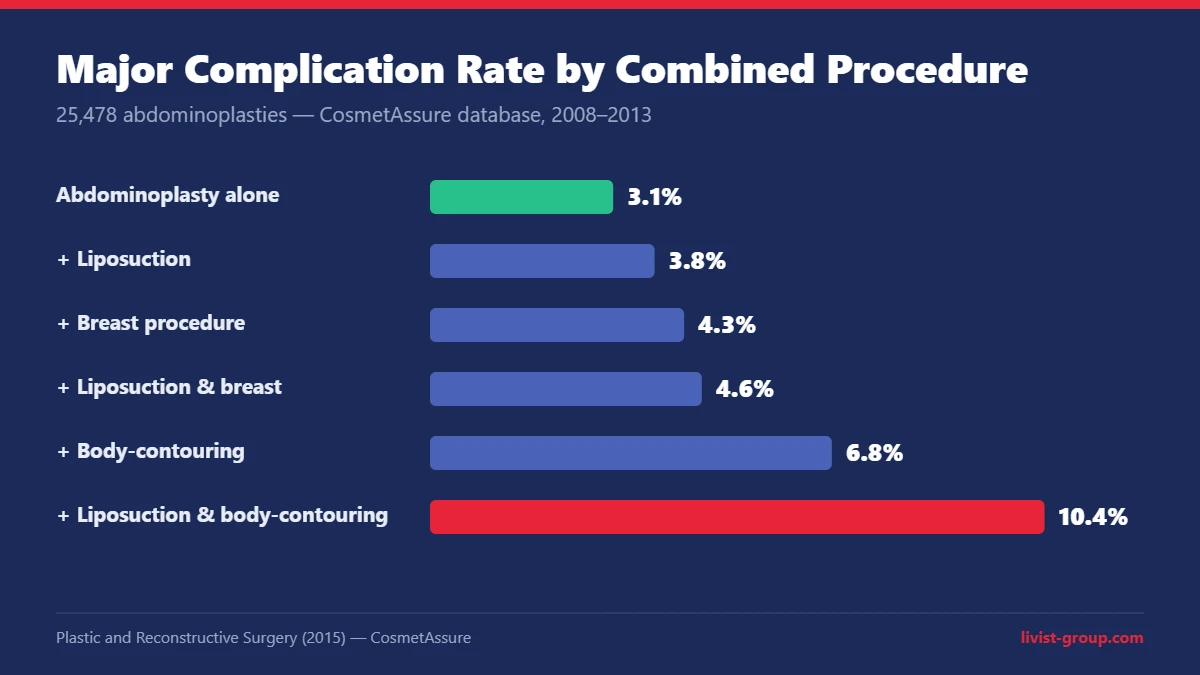
Major complication rates rise from 3.1% for abdominoplasty alone to 10.4% when combined with liposuction and body contouring — CosmetAssure analysis, Plastic and Reconstructive Surgery (2015).
Read the last row again. Going from one procedure to three in a single session more than triples the major complication rate. That is precisely what some packages sell as an "all-in-one" or "mommy makeover."
The same analysis identified independent risk factors: male sex (relative risk 1.8), age 55 or older (1.4), BMI of 30 or above (1.3), and multiple procedures (1.5).
The practical translation: if a third procedure is offered, ask the surgeon — not the coordinator — what it adds against what it adds to your risk, in your case.
Where tummy tuck and liposuction complications actually are
| Measure | Rate |
|---|---|
| Major complications — abdominoplasty | 4.0% |
| Major complications — other aesthetic procedures | 1.4% |
| Major complications — liposuction alone | 0.7% |
| Of abdominoplasty complications: haematoma | 31.5% |
| Of abdominoplasty complications: infection | 27.2% |
| Of abdominoplasty complications: venous thromboembolism | 20.2% |
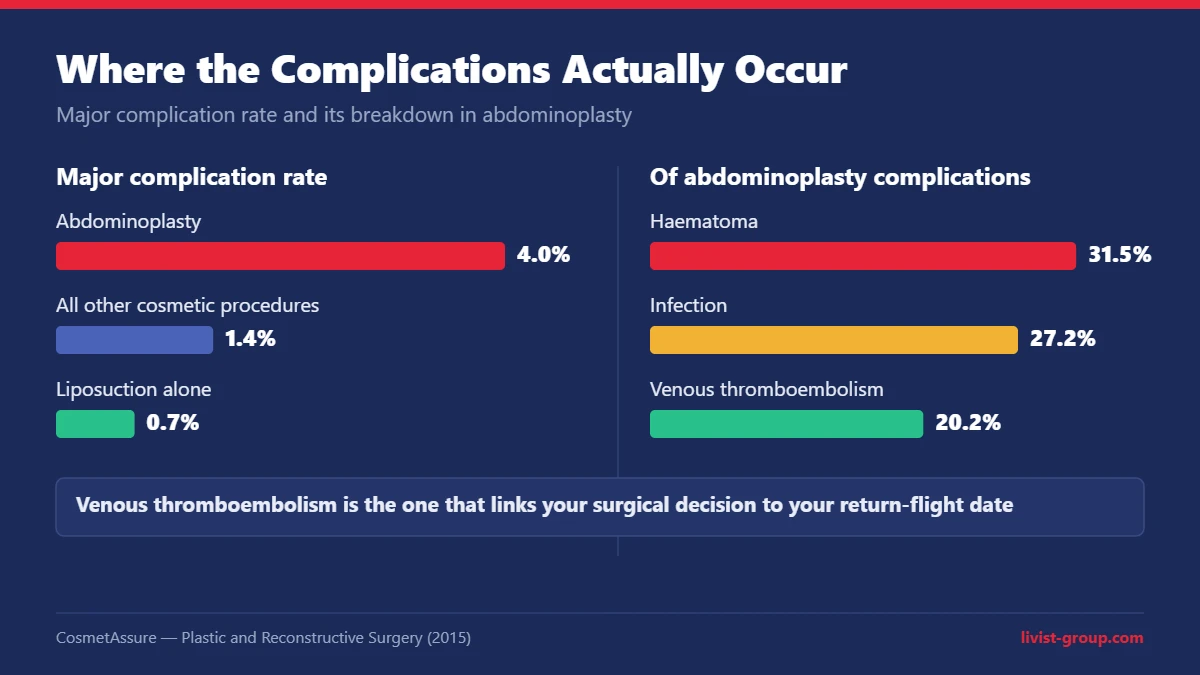
Abdominoplasty carries roughly three times the major complication rate of other cosmetic procedures; liposuction alone is among the lowest.
A tummy tuck therefore carries roughly three times the major complication rate of other aesthetic procedures, while liposuction alone is among the safest. The most consequential line is the last one: venous thromboembolism at 20.2%. It is the single item that connects your surgical decision to your return flight — which is the next section.
How painful are liposuction and a tummy tuck, and what do the first days feel like?
The NHS describes what you will feel rather than how much. After liposuction it lists bruising, swelling, numbness, scars and fluid leaking from the incision sites as common, and puts numbness at 6 to 8 weeks. After a tummy tuck it lists numbness or pain and tummy cramps among the possible complications.
⚠️ We publish no pain score. No official source rates the pain of these procedures numerically, and every "7 out of 10" online is one person's impression rather than a clinical statement. What you can plan around is the list above: prescribed pain relief in the first days, numbness measured in weeks, and swelling measured in months.
The one thing that genuinely reduces it is the same decision that reduces risk — fewer procedures in one session.
Tummy tuck compression garment: how long to wear it
Plan on wearing a compression garment for about six weeks after a tummy tuck, per the NHS; after liposuction the NHS says the corset or bandages "should be worn constantly for several weeks after the operation". Search results show many surgeons asking for six to eight weeks, so the exact period is your surgeon's written instruction, not the package's.
Before you fly home, ask for a spare garment: you will be wearing it on the flight.
Tummy tuck and liposuction recovery timeline, from an official source
These ranges are the NHS's.
| Item | Tummy tuck | Liposuction |
|---|---|---|
| Operating time | 2 to 5 hours | — |
| Hospital stay | A few nights | — |
| Compression garment | 6 weeks | — |
| Off work and exercise | 4 to 6 weeks | — |
| Full recovery | About 6 weeks | — |
| Stitches out | — | About a week |
| Numbness | — | 6 to 8 weeks |
| Gentle exercise | — | 3 to 4 weeks |
| Strenuous activity | — | Avoid for 10 to 12 weeks |
| Swelling settles | — | Up to 6 months |
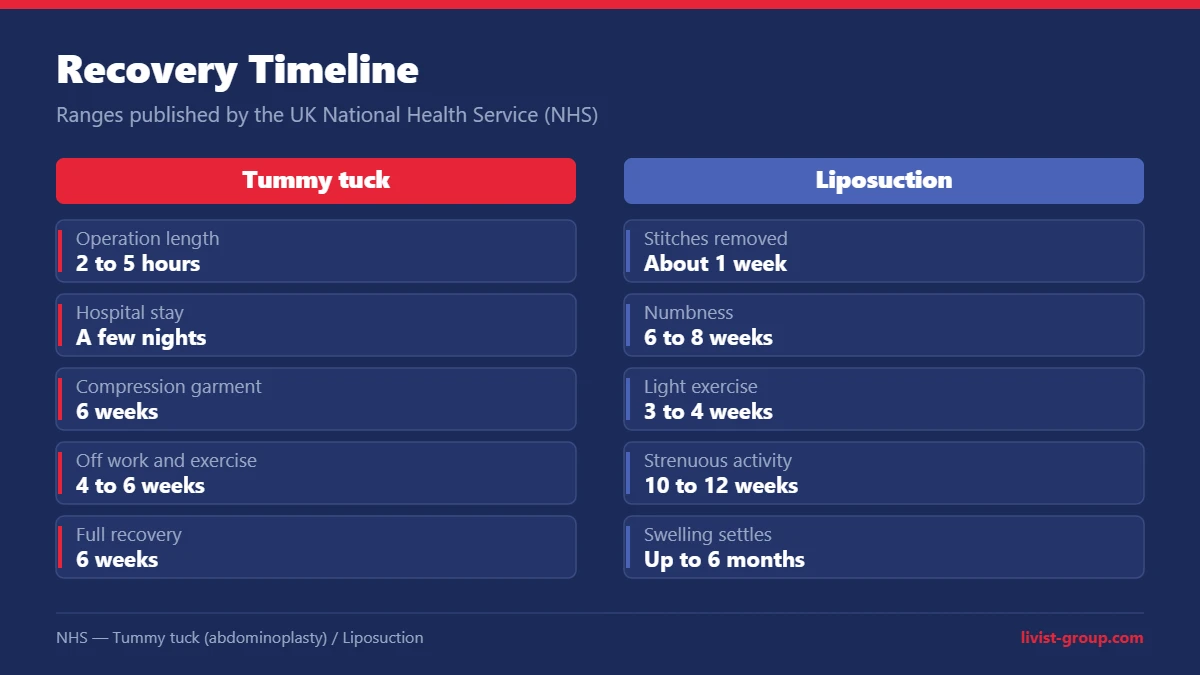
Recovery ranges as published by the UK National Health Service for both procedures.
Three things follow from that table and from no sales page:
One. The compression garment is not a week. The NHS specifies six weeks of a corset or tummy-control garment after an abdominoplasty, and says the liposuction garment is "worn constantly for several weeks."
Two. Swelling after liposuction can take up to 6 months to settle, and the NHS notes results "are not always noticeable until the swelling has gone down." Judging your outcome at week three is judging swelling, not a result — which explains a great deal of the regret written in forums.
Three. The two decisive numbers — about six weeks to full recovery, four to six weeks off work — belong in your leave calendar before they belong in your travel calendar.
When you can fly after a tummy tuck or liposuction
This is the most important line in the article for anyone travelling for surgery.
The NHS recommends not flying for 5 to 7 days after procedures such as breast surgery and liposuction, and 7 to 10 days after facial cosmetic procedures or tummy tucks. Its stated reason: "Air travel and major surgery increase your risk of a blood clot, which can be life threatening."
Now connect that to the table above: venous thromboembolism accounts for 20.2% of major abdominoplasty complications. A return ticket booked a day or two early is not a saving; it stacks a risk factor on top of the third most common complication on the list.
The operating rule: do not book the return flight until the surgeon has written a fly-from date into your treatment plan. Any package that fixes your length of stay before anyone has examined you is fixing it for operational reasons, not clinical ones.
In which situations is liposuction performed?
Liposuction is performed to remove stubborn fat from specific areas such as the tummy, hips, thighs and bottom — not to lose weight. The NHS states it "is not a treatment for obesity, and it will not remove cellulite or stretch marks", and that it "works best in people who are not overweight and in areas where the skin is firm and elastic". Where the skin is loose, a tummy tuck is what removes it — which is why the two are so often booked together.
What happens 10 years after liposuction?
No official source publishes a ten-year outcome study, so we publish no ten-year figure. What is documented is the nearer horizon, and it answers most of what the question is really asking.
Swelling can take up to 6 months to settle, and the NHS notes results "are not always noticeable until the swelling has gone down" — so the shape you judge at three weeks is not the shape you keep. Numbness typically resolves over 6 to 8 weeks. And the durable point: the NHS states liposuction is not a treatment for obesity, which means remaining fat cells can still enlarge with weight gain, in the treated area and elsewhere. A tummy tuck removes skin and repairs muscle; it does not prevent new fat.
The honest ten-year answer is therefore behavioural rather than surgical: what happens in ten years depends far more on weight stability than on the technique used.
Is Turkey the right country for liposuction — or the wrong question?
Two of the most-asked questions here are country comparisons. Neither has an official answer, and any list claiming one is commercial — so below is what each question is actually asking, answered on its own terms, then measured against Turkey.
Is Turkey or Mexico better for liposuction and plastic surgery?
The search intent behind this is almost always cost and distance: Mexico is the near-shore option for North American patients, Turkey the near-shore option for European, Gulf and North African patients. No health authority in either country publishes a comparative safety ranking, and no independent body ranks the two. What is comparable is regulatory transparency, and it is checkable rather than arguable. Turkey operates a named licensing instrument for medical tourism — the International Health Tourism and Tourist Health Regulation of 26 April 2025 — under which every facility and every intermediary must hold an authorisation certificate, hospitals must be accredited by TÜSKA, and the Ministry of Health publishes the lists of who holds one (last updated 20 August 2026). Mexico regulates hospitals through COFEPRIS and its facilities may hold international accreditation, but there is no equivalent public register built specifically for the international patient. The practical difference is therefore not “which country is better” but “in which country can I verify my specific facility before I pay”. On that single measure Turkey is verifiable by name, and that is the only comparison this article will make.
What is the best country to get a tummy tuck?
There is no such country, and the framing is the problem. An abdominoplasty carries a major complication rate of roughly 4.0% wherever it is performed — three times that of other cosmetic procedures — and that number is driven by how many procedures are combined in one session, not by the flag over the building. Combining a tummy tuck with liposuction and a body-contouring procedure raises it to 10.4%, in Turkey exactly as anywhere else. The UK Foreign Office puts the same point plainly for any destination: discuss the plan with your own doctor first, and do your own research, because private companies have a financial interest in booking your treatment. The right question is not which country, but which provider — and whether the four checks below are answerable in writing.
What actually varies is not the country but the provider, and it is checkable in four places:
- Does the facility hold a valid national authorisation? Turkey happens to publish these lists openly, which makes the check possible — the next section shows how.
- Is the named surgeon qualified in your specific operation, written into the treatment plan?
- How many procedures are being combined, and why? That single answer moves your risk from 3.1% to 10.4%.
- Who manages complications after you fly home? The NHS is explicit that a UK surgeon is responsible for follow-up, while clinics abroad may not offer the equivalent.
A country that publishes its authorisation lists lets you settle the first. The other three are on you to get in writing, and they are the same three wherever you go.
Verifying a Turkish liposuction or tummy tuck facility before you pay
Turkey regulates health tourism through a dedicated instrument: the International Health Tourism and Tourist Health Regulation, published in the Official Gazette on 26 April 2025, issue 32882. What matters to you as a patient:
1. Authorisation is mandatory. Article 5(1) requires health facilities and intermediary institutions to hold an authorisation certificate (yetki belgesi) in order to operate in international health tourism. The Ministry of Health issues it for facilities; USHAŞ issues it for intermediaries. It is non-transferable (Article 5(5)), and every branch needs its own (Article 5(4)).
2. Accreditation is mandatory for hospitals. Article 6(1)(b) requires hospitals, medical centres, medical laboratories and dialysis centres to be accredited by TÜSKA, the Turkish Institute for Healthcare Quality and Accreditation; other facilities must hold a Ministry-issued certificate.
3. Intermediaries have limits. Article 6(2)(a) requires accommodation, transport and transfer services to be delivered through licensed travel agencies under Law 1618. Article 6(2)(b) requires the intermediary to provide 24/7 call handling in at least two foreign languages.
4. You are entitled to a named responsible staff member. Article 7 requires an international health tourism unit within the facility, at least one member of staff with certified foreign-language ability, and a named responsible staff member assigned to each international patient and recorded on the official portal.
5. Authorisation can be suspended and revoked. Under Article 9, USHAŞ evaluates facilities and intermediaries at least once a year; authorisation is suspended for three months for partial insufficiency and six months for insufficiency, and revoked if a second control evaluation still fails.
6. After emergency care, an unauthorised facility cannot continue treating you. Article 10(1) states that continuing health services following an emergency cannot be provided at a facility without an authorisation certificate.
How to check: the Ministry of Health's General Directorate of Health Services, Health Tourism Department, publishes separate official lists of authorised hospitals, medical centres, private practices and other health facilities, plus a list of authorised intermediary institutions. The lists were last updated 20 August 2026. Ask for the facility's officially registered name, then look for that name on the list — a badge on a website is not a check.
Tummy tuck complication insurance in Turkey: what the law says
You will read on many sites that complication insurance is mandatory in Turkey. That needs precision.
The provision requiring facilities to hold complication insurance for surgical and interventional procedures performed in an operating-theatre setting — Article 6(1)(c) — has had its execution suspended by a decision of the 10th Chamber of the Turkish Council of State (Danıştay) dated 25 December 2025. The phrase "complications and" within Article 6(3), which sets out post-treatment liability, has likewise been suspended.
What this means for you: do not assume complication cover exists because a regulation mentions it. Ask for the policy itself, in writing, as part of the quote, and read what it covers, for how long, and who pays for revision surgery if it is needed. The difference between a provision in force and one whose execution is suspended is the difference between an entitlement and a marketing promise.
Before you move to the next step: the official list of authorised facilities and intermediaries is the first reference; after it, the best hospitals and clinics in Türkiye helps you see what separates one facility from another, and cosmetic surgery in Türkiye if you are comparing procedures or destinations. The work-up that precedes surgery is set out in the pre-travel health check.
Eight things to verify before booking liposuction in Turkey
- The surgeon's name and specialty written into the treatment plan, not the advert.
- The facility on the Ministry of Health's authorised lists — and the intermediary on its own list.
- TÜSKA accreditation if it is a hospital or medical centre.
- Two pre-operative consultations — the NHS recommendation, with a cooling-off period that is normally two weeks in UK practice. One exchange of messages is not a consultation.
- The combination decision, written and justified — how many procedures, why, and what it does to your risk.
- A fly-from date in the treatment plan, with the return flight booked after it, not before.
- Named aftercare — who follows you up once home, through which channel, and who pays for any revision.
- A medical report in a language your own doctor reads, detailing what was done and what was used.
Liposuction and tummy tuck cost in Turkey: the official floor first
This page does not sell on price, but hiding the number does not protect you — knowing where the number officially starts does. Body-contouring surgery is priced by name in the Public Health Services Price Tariff (EK-2) issued by the Turkish Ministry of Health, under "correction of body contours". Article 12(a) of the implementing provisions (EK-1) makes that tariff a binding floor, not a guide price, for an international patient — in both the public and the private sector:
| Procedure | Tariff code | Turkish lira | US dollars | Pounds sterling |
|---|---|---|---|---|
| Tummy tuck with liposuction, same session | S101710 | 44,850 | 917 | 692 |
| Mini abdominoplasty | S101700 | 36,300 | 742 | 560 |
| Liposuction — one area | S101740 | 42,675 | 872 | 658 |
| Liposuction — two areas | S101750 | 42,675 | 872 | 658 |
| Liposuction — extensive | S101760 | 51,225 | 1,047 | 790 |
| Laser / Vaser liposuction | S101770 | 72,600 | 1,484 | 1,120 |
| Each additional area | S101741 | 21,300 | 435 | 328 |
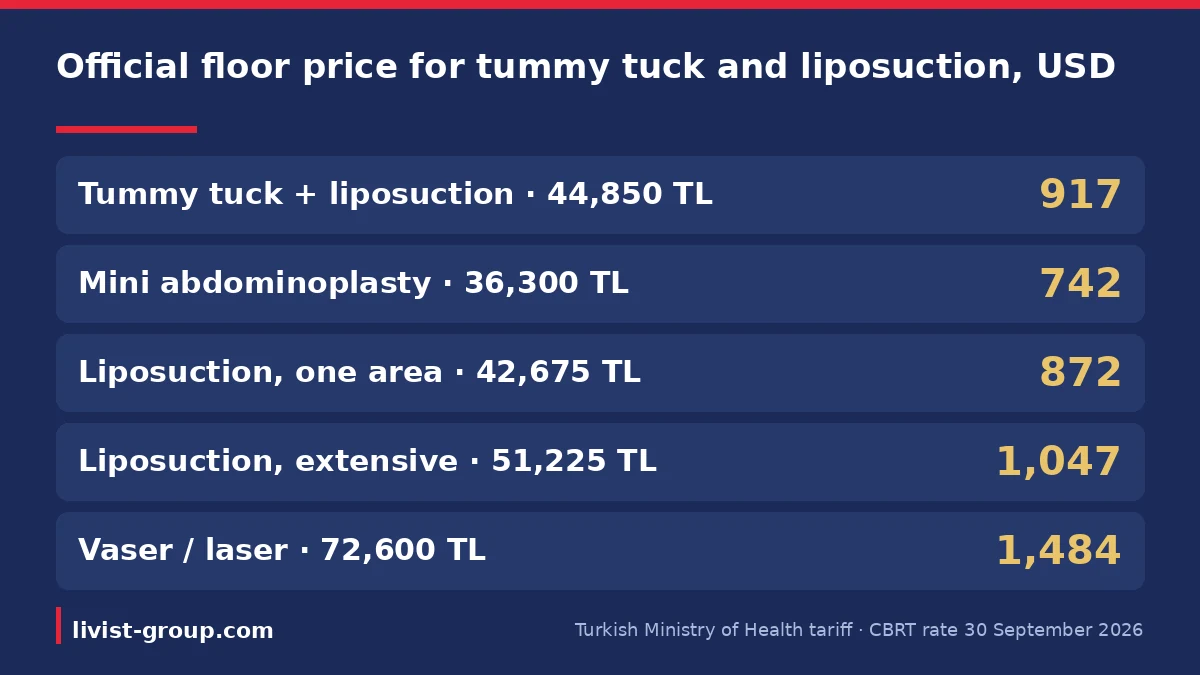
The official price floor from the Turkish Ministry of Health EK-2 annex, converted at CBRT bulletin 2026/165 of 3 September 2026.
Two limits that must be read with the table — leaving them out would be misleading:
- The tariff states in terms that these prices exclude consumables. The compression garment and disposables are billed separately. So any "all-inclusive" quote deserves the question: inclusive of what, exactly?
- The tariff line covers the operation, not the trip. Hotel, transfers, interpreting and follow-up after you fly home are separate items that this figure does not contain.
Conversion: the Turkish central bank's official buying rate, bulletin 2026/165 dated 3 September 2026 (USD 48.2238 · GBP 64.9761). Article g.4 of the tariff provisions requires the invoice to be issued in lira, with collection in a foreign currency at the lira equivalent using the central bank's rate on the day of collection — not a rate the facility picks.
Liposuction and tummy tuck market prices — from search results, dated
For comparison only, and to protect you from sticker shock rather than as a reference: the ranges search results show for these procedures in Türkiye, read live on 4 September 2026:
| As presented in the market | Circulating range |
|---|---|
| Tummy tuck with liposuction (combined package) | $3,800 – $6,800 |
| Full tummy tuck without liposuction | $3,000 – $4,500 |
| Mini tummy tuck | $2,500 – $3,500 |
| Abdomen and flanks liposuction (360°) | $2,880 – $3,660 |
| Vaser liposuction, per area | $3,000 – $3,500 |
We do not name the parties who published those ranges and we do not adopt them — they are commercial package prices whose contents differ fundamentally, and the search results themselves attribute the spread to technique, the extent of laxity, surgeon experience and hospital accreditation.
The useful comparison between the two tables is not "which is cheaper" but this: does the quote you were given name the procedure code, the number of areas and the technique? Because "liposuction" in a quote can mean S101740 or S101770, and the gap between them in the official tariff alone is about seventy per cent.
Tummy tuck and liposuction video: watching without being sold it
A warning before any link: do not assess your own operation from a video. What is available here is either a clinic's marketing video — which shows the best case, not the median one, and is made by the party selling you the operation — or a live surgical recording, which is graphic and carries no decision value for a non-specialist.
The middle ground is an anatomical animation from a neutral medical-illustration studio that does not sell surgery: Tummy Tuck — 3D Animation · Viz Medical — ninety seconds on what is removed, what is tightened and where the scar sits.
The clinical reference stays with the official bodies, not the video: every figure on this page comes from the NHS and the peer-reviewed analysis listed under sources, not from any recording.
VASER liposuction: what actually differs?
VASER is a brand name for breaking up fat with ultrasound before it is suctioned out. The NHS describes that step as breaking up the fat cells using "high-frequency vibrations, a weak laser pulse or a high-pressure water jet" — meaning VASER is one of three ways of doing the same step inside the same operation, not a different procedure.
That is what the price gap reflects. The Turkish tariff gives laser/VASER liposuction its own line, S101770, at 72,600 lira — about 42% above extensive liposuction (S101760) in the table above.
⚠️ What no official source claims: neither the NHS nor the tariff publishes any clinical superiority for VASER in the final result. If VASER is offered at a premium, ask why it suits your case — not what the technology is called.
Why Livist Group for liposuction and a tummy tuck
We do not sell on price, and we do not publish a number whose source you cannot open yourself. What we add to a medical file is the part that is hard to do from abroad: confirming that the facility and the intermediary actually appear on the official lists, getting the surgeon's name and specialty written into the treatment plan, and setting the length of stay and flight date after the surgeon's opinion rather than before it.
One group covers the medical file, the stay, transfers and follow-up — so you are not passed between three parties when a complication appears.
[Conversion card] Title: "Have your treatment plan reviewed before you book" · Body: "Send us the quote you were given and we will return it with the verifiable items it is missing." · Button: "Medical consultation" → https://livistmedical.com
Liposuction and tummy tuck in Turkey in summary
If you are weighing liposuction and tummy tuck in Turkey, here is what official sources actually support: combining the two raises the major complication rate from 3.1% to 3.8%, and up to 10.4% with a third body-contouring procedure; the compression garment is six weeks; four to six weeks away from work; swelling can take up to six months to settle; and you should not fly for seven to ten days after a tummy tuck. What no official source supports — a pain score, a kilogram figure, a mortality rate, a ten-year outcome — we have not invented. Ask for each of these in writing in your treatment plan; what is written has someone answerable for it.
Liposuctioned fat can also be used for fat-transfer breast augmentation; prices and recovery are in breast augmentation Turkey.
For men, chest liposuction is one treatment for pseudo-gynecomastia; techniques and prices are in gynecomastia surgery Turkey.
Plan liposuction and a tummy tuck in Turkey with Livist Group
We coordinate an assessment with a contracted, health-tourism-licensed institution, and you receive a written quote stating which procedures are combined, the hospital stay and the garment period, set against the official floor, before any payment.
Liposuction and tummy tuck: frequently asked questions
Answers to the most common questions about this topic

Hair Transplant Turkey: What Decides Your Result — and How to Check a Clinic’s Licence
A neutral 2026 guide with official sources: how the procedure works, who actually performs it, and how to verify your clinic and agency on Turkey’s public Ministry of Health licence lists before you pay.
Gynecomastia Surgery Turkey 2026: Cost, Types, Recovery
Gynecomastia surgery Turkey cost runs $2,000 to $4,100, the official floor is 21,960 lira for both sides, plus causes, non-surgical options and recovery.

Breast Augmentation Turkey 2026: Cost, Recovery and Risks
Breast augmentation Turkey cost runs $2,800 to $5,500, the official floor is 50,000 lira before implants, plus recovery, garment time and implant lifespan.