FUE vs DHI Hair Transplant 2026: The Honest Comparison — and Why the Question Itself Is Wrong
A comparison table with actual numbers, why every source quotes a different success rate, four claims that do not survive scrutiny, and the one question that predicts your result.

FUE and DHI are not competing techniques. FUE describes how follicles are extracted from the donor area; DHI describes how they are implanted, using a Choi pen that opens the channel and places the graft in one motion. Every DHI procedure uses FUE extraction. What matters is who performs it, how many grafts your donor area can give, and what the price excludes.
| Indicator | Value |
|---|---|
| What FUE describes | The extraction stage |
| What DHI describes | The implantation stage |
| Session length difference | DHI about a third longer |
| Graft-ceiling spread in sources | 1,500 → 5,000+ |
| Published success-rate spread | 80% → 95% |
| Advertised price spread | About eightfold |
Educational content reviewed by the Livist team. It does not replace an individual medical consultation. Clinical figures below are presented as the range circulating in market sources, with the origin of each stated — not as a single agreed standard, because no such standard exists. That absence is itself one of the most useful things on this page.
Welcome — let's fix the question first
If you arrived here after an hour of clinic websites, you probably carry one impression: that you must choose between two techniques, one newer and pricier, one older and cheaper. That impression is worth discarding — not because it oversells, but because it is technically incorrect.
A hair transplant has three stages: extracting follicular units from the donor area, opening sites in the recipient area, and implanting. FUE names the first stage. DHI names the second and third merged into one. Which means every DHI procedure is, at the extraction stage, an FUE procedure.
FUE describes how the graft comes out. DHI describes how it goes in. Choosing "between" them is like being asked to choose between driving a car and parking it.
So what actually differs?
We read the live English results for this query in July 2026. Two things stood out: the highest-voted community answer and one first-page result both say plainly that these are not competing methods — while five clinic pages answer the question as though it were a genuine either/or. And across the entire first page, not one price appears.
| Point of comparison | FUE with pre-made channels | DHI with Choi pen |
|---|---|---|
| What the term describes | Extraction | Implantation (extraction is still FUE) |
| Site creation | Separate step, steel or sapphire blade | No separate step — the pen opens and implants |
| Time grafts spend outside the body | Longer | Shorter — the clearest genuine advantage of DHI |
| Shaving | Usually a full shave | Allows partial shaving in selected cases |
| Session length | Shorter | Roughly a third longer — the pen is loaded graft by graft |
| Grafts per session | Wider margin | Practically narrower, because implantation is slower |
| Best suited to | Large areas, advanced pattern loss | Limited areas, hairline density, beard and eyebrow work |
| Price in Turkey | Usually lower | Higher — a premium that is as much positioning as it is cost |
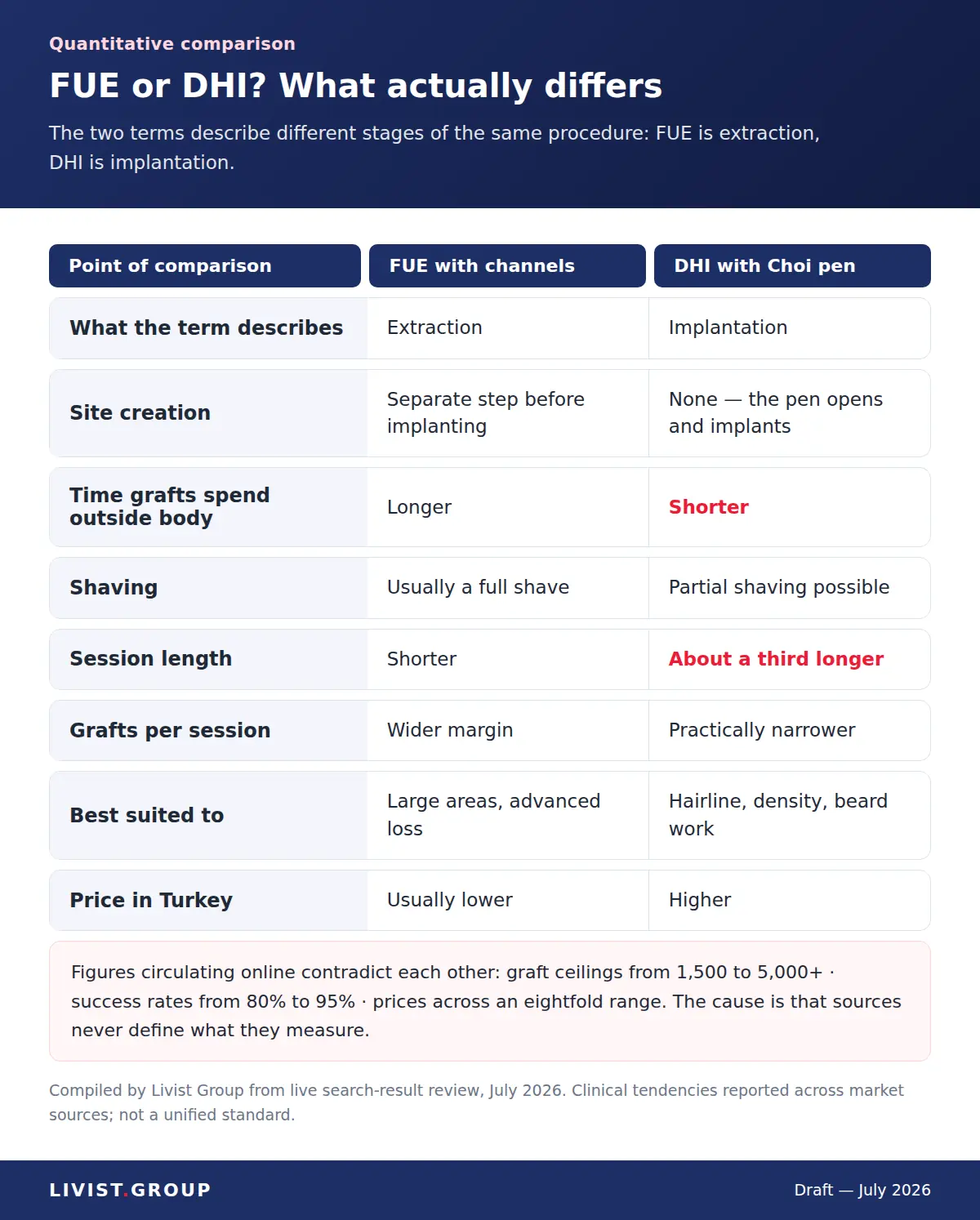
FUE vs DHI comparison table — compiled by Livist Group
Durations and graft counts above are clinical tendencies reported across market sources, not standards. They shift with the team and the condition of your donor area. Ask your clinic for its own figures, in writing.
Why every source gives you a different number
We ran each common question as its own live search and read the answers Google itself surfaces. The spread is remarkable:
- Graft ceiling: answers range from 1,500 to 5,000+ — a 3.3× spread. One source contradicts itself inside a single sentence.
- Success rate: 80% to 95%, a fifteen-point gap, with one page claiming "close to 100%".
- Session length: the organic consensus is that DHI takes longer; several answer boxes imply the opposite.
- Scarring: the same operators say "no scars" in one language and "microscopic scars" in another.
None of this is random. There are three explanations, and knowing them makes you immune to the next brochure you read.
1. A session ceiling is not a lifetime ceiling
When one source says 3,000 grafts and another says 5,000, they are usually measuring different things: what can be implanted in one session versus what your donor area can yield across your whole life. Both can be true. Neither is set by the technique.
The ceiling on what can be transplanted is not set by the technique you choose. It is set by the donor area you were born with. No pen creates a new follicle.
2. "Success" is quoted without a definition
A success rate can mean graft survival at twelve months, final achieved density, or patient satisfaction on a questionnaire. Three definitions, three different numbers from the same operation. When a page does not say which it means, the figure cannot be compared to anything.
A success rate with no definition of success is not a clinical figure. It is a marketing claim wearing a white coat.
3. Prices compare packages, not procedures
Quotes swing wildly because they bundle differently: flat fee versus per-graft, hotel included or not, medication included or not, follow-up sessions included or not. We break the line items down in Hair Transplant Cost in Turkey 2026.
The question that predicts your result
If you may ask a clinic only one question before paying, do not spend it on the technique. Spend it here:
In many high-volume centres the procedure is divided between the physician and a trained team. Task division is normal and widespread. What varies enormously between centres is how much is delegated, and to whom — and that variation shows up in your result a year later, not in the technique printed on the invoice. A clinic where the surgeon designs the hairline, sets graft angles and supervises each stage is not the same product as one where the surgeon appears for the photographs.
The technique name goes in the advertisement. The name of the person holding the instrument shows up in the mirror twelve months later.
The question is entirely legitimate, and serious clinics answer it without discomfort. Deflecting it into a discussion of equipment brands is itself an answer.
Four claims that do not survive scrutiny
| The claim | What holds up |
|---|---|
| "DHI leaves no scars" | Every extraction leaves marks in the donor area, however small, and they are generally hidden once hair grows. Note that several operators publish "no scars" in one language and "microscopic scars" in another — the contradiction is editorial, not medical. |
| "Success rate close to 100%" | An undefined, unreferenced claim. No clinical body endorses an absolute figure like this. |
| "People with diabetes cannot have a hair transplant" | A dangerous generalisation we found published on a first-page clinic site. Chronic conditions call for individual medical assessment and stabilisation before any elective procedure — not a blanket prohibition announced on a marketing page. That call belongs to your treating physician. |
| "Sapphire is a rival technique to DHI" | "Sapphire" describes the blade material used to open channels within an FUE workflow. It is not a third pathway, and it is not comparable to DHI because it describes a different stage. |
Choosing, practically
The rule: let the diagnosis choose, not the advertisement. That said, these are the tendencies clinicians describe:
- Large area, advanced loss: FUE with channel creation, because more ground is covered per session.
- Frontal hairline or densification among existing hair: DHI, because pen implantation disturbs surrounding hair less.
- Beard and eyebrow work: DHI is common, for angle precision in small areas.
- You cannot accept a full shave: DHI allows partial-shave options in selected cases — confirm before booking, as not every case qualifies.
- Budget is the binding constraint: ask for the per-graft price rather than the package price, so you compare like with like.
Seven questions to ask before you pay
- How many grafts do you estimate for my case, and on what basis was that number reached?
- Who performs each stage, by name and role?
- Is the price per graft or flat, and precisely what does it include?
- What does it not include — medication, extra sessions, PRP, accommodation, transfers?
- What is your policy if a proportion of grafts does not grow, and is it written into the contract?
- How is follow-up handled once I am home, and who is my named contact?
- May I see cases similar to mine at twelve months — not at one month?
The last three matter most, because they cover what happens after you fly home — the part offers routinely leave vague. If you are planning recovery time around your trip, the month-by-month climate guide is worth a look: direct sun on a healing scalp is a real constraint, not a detail.
Why Livist
We do not own a clinic and we are not selling you a technique. Our role is to put an honest comparison in front of you: a written graft estimate, an itemised price, a clear answer on who performs the procedure, and a follow-up plan for after you fly home. If your case is not suitable for a transplant right now, we will tell you that too.
Get a free case assessment and an itemised price comparison — Livist MedicalFrequently asked questions
Answers to the most common questions about this topic

Hair Transplant Turkey: What Decides Your Result — and How to Check a Clinic’s Licence
A neutral 2026 guide with official sources: how the procedure works, who actually performs it, and how to verify your clinic and agency on Turkey’s public Ministry of Health licence lists before you pay.

Medical Visa Turkey 2026: Rules, Documents and Permits
The medical visa turkey guide from official sources: who is already exempt, why the e-Visa will not cover treatment, and the treatment permit.

Lasik in Turkey 2026: The Official Price Floor Per Technique
Lasik in turkey priced against the Turkish Health Ministry's binding floor for each technique, so you can spot the quote that sits below the legal minimum.