Is Hair Transplant Haram? Hanafi, Ibn Baz, IslamQA & Ramadan Rulings
Is hair transplant haram? No: restoring your own hair is permitted by the Fiqh Academy, Ibn Baz and Hanafi scholars, and it doesn't break the Ramadan fast.

Is hair transplant haram? No. Moving your own follicles to restore hair you lost is permissible (halal) as treatment, according to the International Islamic Fiqh Academy (Resolution 173, 2007), Ibn Baz and Jordan's General Iftaa Department. Hair transplant during Ramadan: a daytime hair transplant does not break the fast (IslamQA 610876, February 2026); tablets or drink taken in daylight do. Hanafi view: permissible as a restorative measure that does not change Allah's creation, provided it causes no harm (SeekersGuidance, 2012). Hairline and beard: lowering the natural hairline or thickening a naturally sparse beard for looks is not permitted (Fatwa Centre 108478; IslamQA 182542). Cost in Turkey: the legal floor price is 30 Turkish lira per graft (Ministry of Health tariff, code S101260). With Livist Group: we help Muslim patients plan a hair transplant in Turkey, including timing around Ramadan. For a ruling on your own case, ask your country's Iftaa department.
| Item | Detail |
|---|---|
| The Academy's resolution | International Islamic Fiqh Academy Resolution 173 (2007) permits necessary and needed cosmetic surgery and names "hair transplant for women suffering from hair loss". |
| The principle | Restoring what was lost in its own place (treatment) versus adding what was never there for the sake of beauty. |
| Where texts agree | Moving a person's own follicles to their own bald area: permitted in the resolutions and fatwas quoted in full on this page. |
| Where texts differ | Artificial hair that does not grow — some researchers treat it as the prohibited joining of hair. |
| Purity rulings | If the transplant covers part of the skin it invalidates ghusl; if follicles sit in the pores without covering skin, wudu and ghusl are unaffected (Jordanian Iftaa Department). |
| Who to ask | Your own country's Iftaa department, or a scholar you trust. We do not issue rulings on this page. |
| Eyebrows and beard | Permitted to treat loss from illness, injury or burns, not to thicken what is naturally sparse (IslamQA 182542). |
| Fasting | A daytime Ramadan transplant does not affect the fast (IslamQA 610876, February 2026). |
| Hanafi school | "A restorative measure… It is therefore permissible" (SeekersGuidance, Hanafi Fiqh). |
Is hair transplant haram? No. In the published fatwas, moving your own follicles to restore hair you lost is permissible (halal): the International Islamic Fiqh Academy (Resolution 173, 2007), Ibn Baz and the Hanafi scholars at SeekersGuidance all permit it as treatment. A hair transplant during Ramadan does not break the fast (IslamQA 610876, 2026). The texts restrict lowering the natural hairline for looks and differ on artificial hair.
Hair transplant ruling by case: what each source states
| Case | What the published text states | Source |
|---|---|---|
| Your own follicles moved to your own bald area | Permissible | Jordan Iftaa Dept. fatwa 3584 (2020); IIFA Resolution 173 (2007) |
| Transplant for medical treatment | Permissible; not for frivolity or mere adornment | Ibn Baz fatwa 6396 |
| Hanafi school | Permissible as a restorative measure, if it causes no harm | SeekersGuidance, Shaykh Faraz A. Khan (2012) |
| Disfiguring bald forehead | Permissible as treatment of a defect | IslamQA 208629 (2013) |
| Beard lost to illness, accident or burns | Permissible | IslamQA 182542 (2024) |
| Naturally sparse beard, for looks | Not permissible | IslamQA 182542 (2024) |
| Daytime transplant in Ramadan | Does not affect the fast | IslamQA 610876 (2026) |
| Grafts covering part of the skin | Ghusl not valid until water reaches the skin | Jordan Iftaa Dept. fatwa 3584 |
| Grafts not covering the skin | Wudu and ghusl valid | Jordan Iftaa Dept. fatwa 3584 |
Note: this page reports published texts; it is not a fatwa. Livist Group is not an Iftaa body, does not issue Sharia rulings, and does not provide medical services directly. For your own case, refer to your country's Iftaa department or a scholar you trust.
Hair transplant ruling: on this page
- Is hair transplant haram? What the councils actually published
- Hair transplant ruling: restoring what was lost, not adding what was never there
- Hair transplant in Islamic Fiqh Academy resolutions 173 and 26
- Is hair transplant haram according to Ibn Baz? The text verbatim
- Hair transplant ruling by Ibn Uthaymeen, verbatim
- Why a hair transplant is not the prohibited joining of hair
- Is hairline transplant haram? Where the line falls
- Is hair transplant haram for women
- Is hair transplant haram for men
- Is beard transplant haram?
- Is eyebrow transplant haram?
- Is hair transplant haram in islam hanafi
- Artificial hair transplant implants: where the disagreement actually is
- Hair from another person: a separate question
- Wudu and ghusl after a hair transplant
- Hair transplant during Ramadan: does it break the fast?
- Who is not a good candidate for a hair transplant?
- Is hair transplant halal or allowed in Islam: the conditions in one list
- Is hair transplant safe
- Is hair transplant painful
- Is hair transplant harmful
- Is hair transplant successful? The results timeline
- Hair transplant cost in Turkey: the official floor price
- Hair transplant ruling in summary
- Sources for the hair transplant ruling
- Plan your hair transplant in Turkey with Livist Group
Is hair transplant haram? What the councils actually published
People ask is hair transplant haram before they book, not after, and the question deserves a reported answer rather than an invented one. Here is what the published texts quoted in full on this page actually say:
| The question | What the published texts state |
|---|---|
| Moving a person's own follicles to their own bald area | Permitted in the Islamic Fiqh Academy resolutions, the Jordanian Iftaa Department fatwa, the Fatwa Centre fatwas, and the answers of Ibn Baz and Ibn Uthaymeen |
| Planting hair outside its natural growth line for beauty | Falls under what is prohibited, per the Fatwa Centre fatwa |
| Artificial hair that does not grow | Disputed — see the section below |
| Follicles taken from another person | A separate question with more than one position — see the section below |
| Effect on wudu and ghusl | Detailed published text from the Jordanian Iftaa Department — see the purity section |
And that is where our role ends. Livist Group is a coordination and services company, not an Iftaa body. What we provide is the texts as published, with their links, the point of agreement and the point of difference, without preferring one over another. Applying any of it to your own case — which may be alopecia, a burn scar, or hereditary baldness, and jurists distinguish between these — belongs to your country's Iftaa department or a scholar you trust.
Hair transplant ruling: restoring what was lost, not adding what was never there
Every published text on this page, whichever body issued it, turns on one distinction.
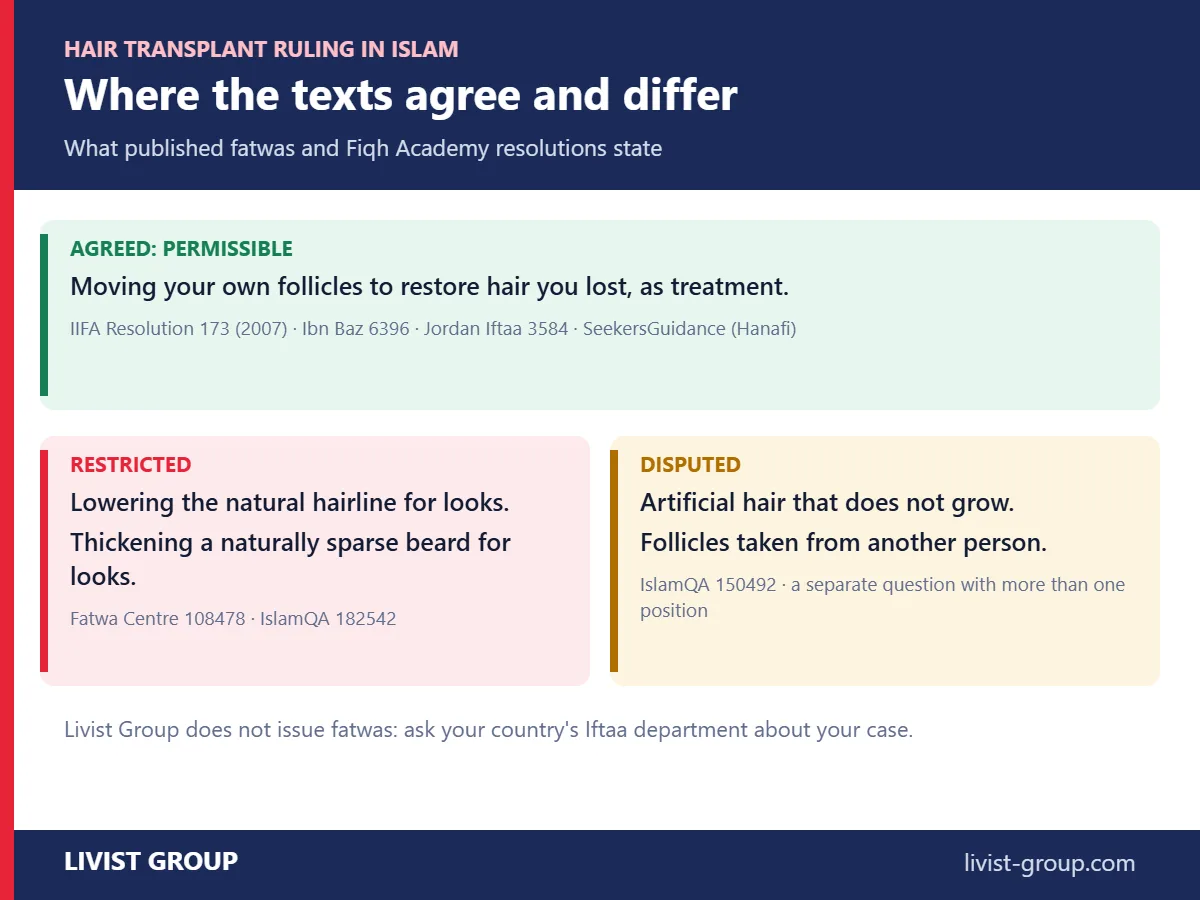
Where the published texts agree and where they differ — read from the texts themselves, not from summaries of them.
First: restoring what was lost — returning something to the state in which the human being was created. This is classified as treatment, not adornment.
Second: adding to creation for the sake of beauty — the category the prohibition attaches to.
The Jordanian Iftaa Department adds the usuli rule the whole question rests on: all things are, in principle, lawful as long as there is no prohibition by a Sharia text or maxim, and there is neither harming nor reciprocating harm. Its fatwa states that a hair transplant "doesn't change Allah's creation; rather, it is treatment to restore what Allah had created".
Why this matters practically: it is not an abstraction but a filter that sorts the medical procedures themselves. Moving your own hair to a place you lost it falls on the first side. Adding artificial fibre that never grows, or planting below a hairline that was never there, is what raises the question — which is exactly what the following sections work through.
Hair transplant in Islamic Fiqh Academy resolutions 173 and 26
The International Islamic Fiqh Academy, which operates under the Organisation of Islamic Cooperation, is a collective ijtihad body whose members come from many countries. Its resolutions are the widest reference available on a contemporary question.
Resolution 173 (2007): hair transplant among permitted cosmetic surgery
Issued at the 18th session in Malaysia, 24–29 Jumada al-Akhirah 1428 AH / 9–14 July 2007. On what is permitted:
"It is permissible to do cosmetic surgery, which is daruriyyah (necessities) and hajiyyah (comforts, as being complementary or secondary to necessities), such as removing an urgent defect due to a burn, an accident, a disease and the like. For example, skin grafts and hair transplant for women suffering from hair loss." — Islamic Fiqh Academy Resolution No. 173/2007, as quoted in the English text of the Jordanian Iftaa Department fatwa
For the clinical and price side of the procedures the resolution names, see our guide to cosmetic surgery costs in Turkey.
Resolution 26 (1988): a hair transplant moves tissue within the same body
"It is permissible to move an organ from one place to another in the same body so long as the benefit expected from this procedure outweighs the harm resulting from it. This is also provided that the aim is to bring back a missing organ or remove a defect causing physical or psychological harm." — Islamic Fiqh Academy Resolution No. 26/1988, as quoted by the Jordanian Iftaa Department
Why both resolutions? Because a hair transplant carries two descriptions at once: it is cosmetic surgery (so 173 applies), and it is moving tissue from one place to another within the same body (so 26 applies). That combination is why the bodies that permitted it cite the two together rather than either alone.
Is hair transplant haram according to Ibn Baz? The text verbatim
Sheikh Abd al-Aziz Ibn Baz was asked on his official website about "modern surgery for hair transplantation". The published answer, in translation:
"If it is for medical treatment, it comes under this; if it is for treatment — not for frivolity, adornment, or imitating the enemies of Allah — then it is treatment." — Official website of Sheikh Ibn Baz, fatwa no. 6396, from his lessons on Bulugh al-Maram, Book of Marriage
Reading the text: the ruling turns on intention, not on the procedure. The operative distinction is "treatment" against "frivolity, adornment or imitation" — the same criterion as the previous section in different words.
Hair transplant ruling by Ibn Uthaymeen, verbatim
Sheikh Muhammad ibn Salih al-Uthaymeen was asked about transplanting hair for someone with baldness by taking hair from the back of the head and planting it in the affected area. His published answer:
"Yes, it is permissible, because this is restoring what Allah created and removing a defect. It is not adornment or adding to what Allah created, so it does not fall under changing the creation of Allah; rather it is restoring what was lost and removing a defect. And the story of the three men, one of whom was bald and said he wished Allah would return his hair to him, so the angel wiped him and Allah returned his hair and gave him beautiful hair, is well known." — Quoted from Fatawa Ulama al-Balad al-Haram, p. 1185, as reproduced in Islam Question & Answer fatwa 150492 and Fatwa Centre fatwa 226981. The hadith referred to is narrated by al-Bukhari (3277) and Muslim (2964)
Reading the text: the answer describes the procedure precisely — hair taken from the back of the head and planted in the affected area — which is the clinical description of extraction from a donor area into a recipient area. The ruling therefore rests on an understanding of what the operation does, not on its name.
Why a hair transplant is not the prohibited joining of hair
This is the first objection anyone raises: is this not the wasl (joining of hair) that the hadith prohibits?
Fatwa Centre fatwa 3568 answers directly:
"There is no objection in Sharia to transplanting the hair of the head, and this is not the prohibited joining mentioned in the agreed-upon hadith... nor does it come under changing the creation of Allah, since it is restoring what Allah created, and it is permitted treatment, because it is growing hair in its own place." — Fatwa Centre, fatwa no. 3568
The decisive phrase is "in its own place". Joining adds hair to hair; a transplant grows hair in the place it originally grew.
Fatwa Centre fatwa 226981 adds a second proof and a classical commentary:
- The hadith of Arfajah ibn As'ad, whose nose was injured so he took a nose of silver which then decayed, and the Prophet صلى الله عليه وسلم instructed him to take one of gold. Narrated by Abu Dawud, graded hasan by al-Albani.
- Al-Nawawi's commentary on the hadith cursing "those who file their teeth for beauty, altering the creation of Allah": he notes that the wording means they do so seeking beauty, "and in this is an indication that what is forbidden is what is done seeking beauty; but if she needed it for treatment, or for a defect in the tooth and the like, then there is no harm."
The qualifier in the hadith, on this reading, is "for beauty" — not alteration as such.
Is hairline transplant haram? Where the line falls
This is the most precise question in the whole subject, and it has an explicit text. The Fatwa Centre was asked about a woman transplanting hair in the forehead area:
"What is intended as adornment and beauty by altering creation, by planting hair out of its place without a disfiguring harm, is prohibited, because it carries the meaning of the prohibited joining... However, as for planting hair in the forehead area: if it is at the front of the head because hair has gone or fallen out, there is no objection, because it is treatment, with no alteration of creation. But if it is below the front of the head and the natural line where hair grows, that is prohibited mutilation and the alteration forbidden in Sharia." — Fatwa Centre, fatwa no. 108478
What that means in practice: the boundary is not "the front of the head" as a region, but the natural hairline:
| The case | What the fatwa states |
|---|---|
| Planting inside the natural hairline to replace hair that fell out | Treatment; no objection |
| Lowering the hairline below where hair naturally grew, for the look | Prohibited |
IslamQA answer 208629 permits a transplant where a bald forehead is disfiguring, as treatment of a defect, while Fatwa Centre fatwa 108478 prohibits lowering the hairline below its natural line for looks.
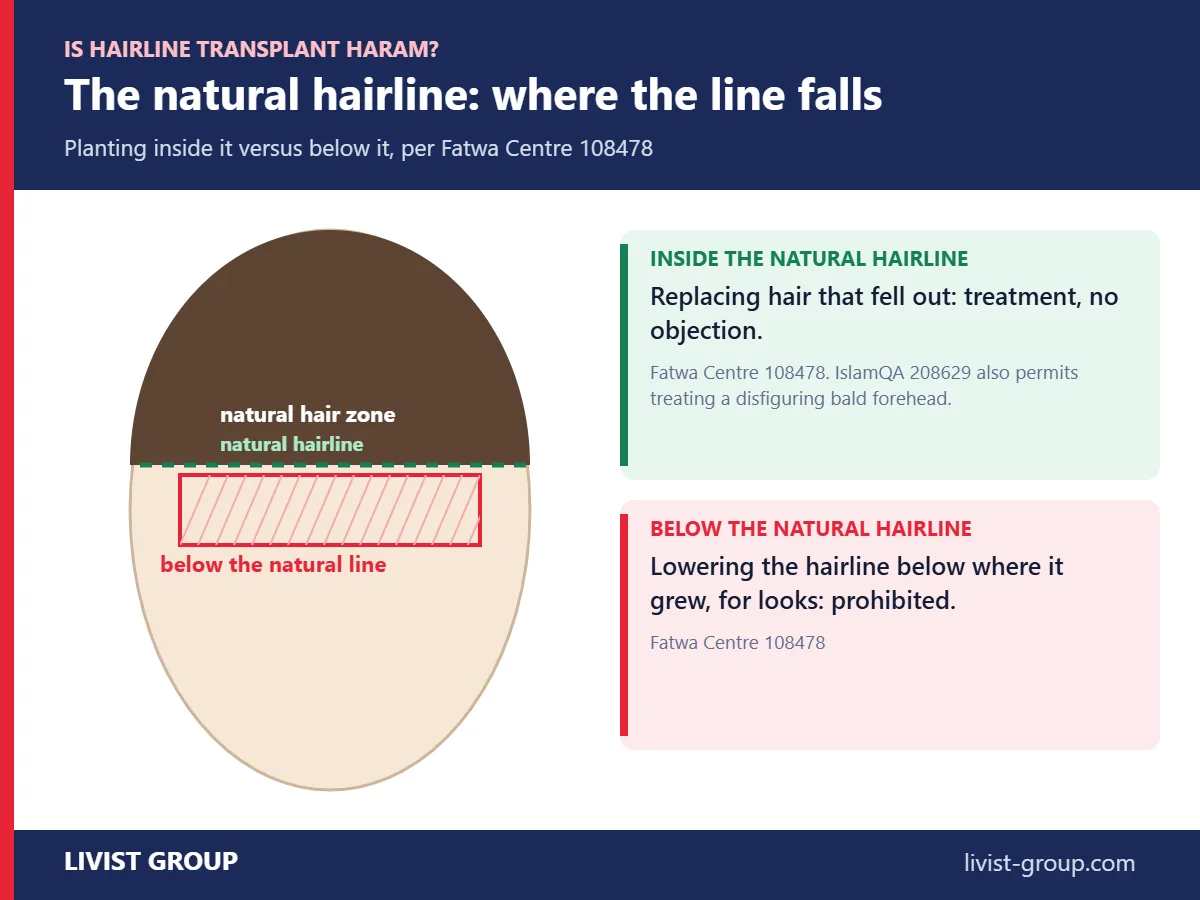
The natural hairline: planting inside it and planting below it are not treated as one question in the published texts.
That turns one practical question in the surgical consultation into a question that is both medical and religious: where exactly will the recipient area be drawn? Ask it explicitly, and ask to see it marked before the operation, not after.
Is hair transplant haram for women
This is the case the Academy's resolution names outright. Note the wording of Resolution 173: "hair transplant for women suffering from hair loss". The woman's case is not an exception someone had to argue for; it is the example written into the resolution itself.
The same conditions set out on this page apply:
- The purpose is replacing what fell out, not adding outside its place.
- The transplant stays within the natural hairline, per the fatwa in the previous section.
- No harm results that exceeds the harm already present.
One practical point specific to women: hair loss in women is often a symptom of an underlying condition — a thyroid disorder, iron deficiency, a post-partum hormonal change. Diagnosis before surgery is therefore not a formality, and it may make the operation unnecessary. Ask which tests will be run before you ask how many grafts are planned.
Is hair transplant haram for men
This is the case Ibn Uthaymeen's answer describes literally: "transplanting hair for someone with baldness by taking hair from the back of the head and planting it in the affected area" — that is androgenetic baldness, the most common pattern in men.
Three practical differences from the women's case:
- The donor area is usually wider, at the back and sides of the head — the very area the text itself describes.
- Loss is gradual and continuing, so the question "what happens to the remaining native hair in a few years?" bears more heavily, and it changes the final appearance.
- The frontal hairline is where the temptation to lower it below its natural line is strongest — which is precisely what falls under the hairline text.
For the medical rather than the religious detail, our guide to hair transplants in Turkey explains the procedure and how to verify a facility, and FUE versus DHI explains the two techniques.
Is beard transplant haram?
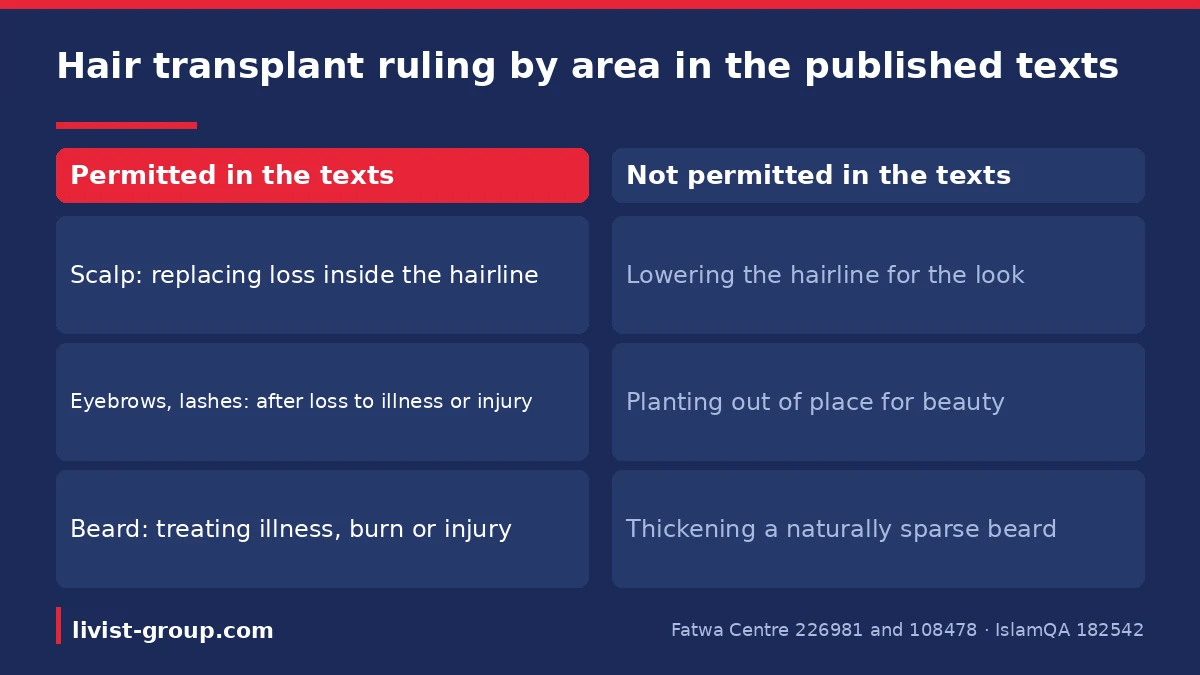
A beard transplant is permissible only as treatment in IslamQA answer 182542: "It is not permissible to do hair transplants for the beard unless that is for the purpose of treating a problem and removing a defect."
| The case | What answer 182542 states |
|---|---|
| Beard hair lost to illness, an accident or burns | Permissible, as treatment and removing a defect |
| A beard that is naturally sparse, transplanted to look fuller | Not permissible: adding to creation, not restoring what was lost |
For someone who cannot grow a beard and asks about alternatives, IslamQA answer 253482 permits hair-growth oils and medication, "on condition that there is no harm".
Is eyebrow transplant haram?
Eyebrow and eyelash transplants follow the same rule as the scalp in the published texts: permitted to restore what fell out, not to plant hair outside its place for beauty. Fatwa Centre fatwa 226981 is titled for the head, eyebrows and eyelashes together and rests on Resolution 173's wording, "hair transplant... in cases of hair loss"; fatwa 108478 is the text on planting out of place.
Is hair transplant haram in islam hanafi
SeekersGuidance (Shaykh Faraz A. Khan, 23 March 2012) rules hair transplantation "permissible" as a restorative measure that is not changing Allah's creation, provided it causes no harm.
This is one of the most searched variants of the question, and it deserves an honest answer rather than a confident one.
This page does not issue rulings; it reports the published answer above. What can be said accurately:
- The Islamic Fiqh Academy resolutions quoted above are the product of a collective body whose members are drawn from across the schools of law, which is why they are the widest reference available on a contemporary question.
- The Jordanian Iftaa Department answers within its own methodology and publishes that methodology on its site.
- The Fatwa Centre and Islam Question & Answer fatwas quoted here likewise answer from their own frames of reference.
If you specifically want a ruling within the Hanafi school, the correct step is not to weigh website answers against each other but to put your case to a Darul Ifta that answers within that school, and to describe your own situation — hereditary loss, illness, scarring — because the texts on this page distinguish between them.
Artificial hair transplant implants: where the disagreement actually is
Everything above sits in an area of broad agreement. Artificial hair is where the published texts diverge, and setting that out honestly serves the reader better than hiding it.
Islam Question & Answer fatwa 150492 presents both positions:
"If a natural hair transplant is not possible... there is no objection to implanting artificial hair on condition that it is made of a pure material, and that no harm results from it exceeding the harm already present. Some researchers have held artificial hair implantation to be prohibited, reasoning that it resembles the prohibited joining, because artificial hair remains as it is and does not grow, and that some of the reasons for the prohibition are realised in it, such as deception and altering the creation of Allah."
Why is that disagreement coherent? Because the reason that took natural transplantation out of the category of joining — "growing hair in its own place", in the text quoted above — is not realised in artificial hair: it does not sprout and does not grow; it stays as it is. Those who looked to the reason attached it to joining; those who looked to need and the absence of an alternative permitted it under the two conditions.
And our position? We have none. The material is set out above in its own words and the weighing belongs to scholars. But the medical point deserves stating alongside it: artificial fibre is an entirely different procedure from moving your own follicles, it carries its own complication profile, and it is not what clinics normally mean when they say "hair transplant". Ask plainly: will what is implanted be follicles from my own head, or fibre? The question is religious and clinical at the same time.
Hair from another person: a separate question
A third question, often confused with the first, with its own texts.
The Jordanian Iftaa Department framed its permission with the words "it is permissible for a person to do hair transplant using his or her own hair", relying on Resolution 26, which concerns moving an organ within the same body.
Islam Question & Answer fatwa 131313 took a different position: "What appears to be the case is that there is no difference between taking hair follicles from the person himself and taking them from someone else."
So the question is under discussion between the two bodies, and we present it as such.
A necessary medical note alongside the fiqh: transferring follicles between two people is not standard practice in hair transplant clinics, and it faces the immune rejection problem that any tissue transfer between two people faces. If it is ever offered to you, the first question is clinical before it is religious.
Wudu and ghusl after a hair transplant
A daily practical question you will not find on clinic pages, and it has an explicit text from the Jordanian Iftaa Department:
"If the hair transplant covers a portion of the skin then this renders ghusl invalid because the water must reach all parts of the body. However, if the hair follicles don't cover any portion of the skin, then this doesn't render the ghusl or wudu invalid." — Iftaa' Department, the Hashemite Kingdom of Jordan, fatwa no. 3584
The same fatwa adds, on a related question, that wiping over a wig does not suffice in wudu, since it is not considered part of the head, by analogy with the turban, citing al-Nawawi's Rawdat at-Talibeen (1:60).
In practice: standard extraction techniques set the follicle into the pores of the skin without laying an impermeable layer over it, so the second case in the text is the usual one. As for the first days after surgery, when there are crusts, dressings and strict instructions to keep water off, that is a temporary circumstance rather than a permanent description of a transplant, and it is put to scholars as such.
Hair transplant during Ramadan: does it break the fast?
A hair transplant during Ramadan does not break the fast, according to IslamQA answer 610876 (19 February 2026), which notes the procedure needs no general anaesthesia or oral medication. Tablets or drink taken in daylight are a separate matter that affects the fast.
- Local anaesthetic: it is given by injection, and Islamic Fiqh Academy Resolution 93 (10th session, Jeddah, 1997) lists "subcutaneous, intramuscular, or intravenous injections" among what does not invalidate the fast, excluding nutritive fluids.
- Through the skin: the same resolution lists "anything penetrating the body through the skin, like creams, ointments or cutaneous patches".
- The exception: a nutritive drip, or oral medication the surgeon requires during daylight, puts you in the position of a patient who breaks the fast and makes it up later.
The practical point matters more than the fiqh one: the first days after surgery come with medication on a schedule, so ask the surgeon for it before booking a date that falls in Ramadan.
Hair transplant during Ramadan: recovery, medication and timing
Most people searching for a hair transplant during Ramadan are asking a practical question, not only a fiqh one: does fasting fit the recovery days? What a medical source says:
- Back to work: days 3 to 5 after surgery, and exercise after 3 weeks (Cleveland Clinic, medically reviewed 2021).
- Medication: antibiotics, pain relief and scalp sprays come on a schedule set by the surgeon, so check whether it can sit between iftar and suhoor before you book.
- Timing: a date just before or after Ramadan lets you take medication and fluids freely in daylight during the first days, an option worth asking about.
- Results do not depend on the month: transplanted hair shedding after surgery is normal, and full results can take up to a year.
Who is not a good candidate for a hair transplant?
Not everyone with hair loss is a hair transplant candidate. In "Is Every Patient of Hair Loss a Candidate for Hair Transplant?" (True RH, Indian J Plast Surg 2021;54(4):435-440), absolute contraindications are few, but eight conditions are listed that make patients not appropriate candidates:
"While there are few absolute contraindications to hair restoration surgery, there are several relative contraindications."
Indian J Plast Surg 2021;54(4):435–440- Diffuse unpatterned alopecia: thinning reaches the back and sides, so there is no safe donor area.
- Scarring (cicatricial) alopecia.
- Unstable hair loss that is still progressing fast.
- Insufficient hair loss that does not yet justify surgery.
- Very young patients: the final pattern is not yet clear.
- Unrealistic expectations.
- Psychological disorders such as body dysmorphic disorder and trichotillomania.
- Medically unfit patients.
Cleveland Clinic adds that good candidates are in good health, have realistic expectations and still have areas of thick hair on the scalp. The decision is the surgeon's after an examination, and no result is guaranteed.
Is hair transplant halal or allowed in Islam: the conditions in one list
Gathering the conditions scattered through the texts above into one place, without adding to them:
- The purpose is treatment, replacing what was lost — not adornment, frivolity, or imitation (Ibn Baz).
- It restores rather than adds — moving your own hair to the place it grew (Ibn Uthaymeen, Fatwa Centre 3568).
- It stays within the natural hairline and does not lower it for effect (Fatwa Centre 108478).
- The expected benefit outweighs the resulting harm (Fiqh Academy Resolution 26).
- There is no harming and no reciprocating harm (Jordanian Iftaa Department).
- No deception — the wig conditions in the same fatwa turn on this, and it is one of the reasons cited by those who restricted artificial hair.
Anything beyond this list — artificial fibre, another person's follicles, a school-specific ruling — has its own section above, and its own scholars to ask.
Is hair transplant safe
A clinical question rather than a religious one, but it appears on the same results page and deserves an answer rather than a promise.
The NHS lists a tight, achy and swollen scalp for a few days, temporary scabbing and small scars as common after a hair transplant, with a small risk of bleeding, infection, or the grafts not taking.
A hair transplant is surgery, and it carries what surgery carries: infection at the wound, bleeding, a reaction to local anaesthetic. Added to that are the risks specific to it: scarring in the donor area, loss of a proportion of the transferred follicles, and uneven distribution.
Which is why licensing is not an administrative detail. The facility should appear on the Turkish Ministry of Health's list of facilities authorised for international health tourism — a list updated on 20 August 2026. And there is a second date to know: under the International Health Tourism Regulation published in the Turkish Official Gazette (26 April 2025, no. 32882) and the Health Tourism Department's announcement of 13 May 2026, facilities must complete TÜSKA accreditation by 31 December 2026, and those that do not may not admit international patients after that.
Verification detail is in our guides to hair transplants in Turkey and choosing hospitals and clinics.
Is hair transplant painful
The procedure is done under local anaesthetic, so what people are usually asking about is not the operation itself but what follows: swelling, tightness across the scalp, tenderness in the donor area, and sleeping in a particular position for some days.
We publish no pain-scale figure, because no official source publishes one and pain is an experience that differs between people. What can be said honestly: ask the surgeon, before the operation, for the post-operative pain plan by name and dose. That is a question that is either answered clearly or it is not — and how it is answered tells you something on its own.
Is hair transplant harmful
Distinct from the safety question, this one is usually asking about lasting effects rather than immediate risk.
Is hair transplant good or bad: the honest framing
The phrase bundles two different questions: is the procedure effective for the condition you actually have, and is it worth what it costs and risks in your case. Neither is answerable by a page. What a page can give you is the complications the NHS lists above, the official floor price below, and the questions to put to a surgeon — and those three are what turn "good or bad" into a decision you can make.
Three things can be said without inventing figures:
- The donor area is finite. Follicles moved from it do not regrow there. That is why the number of grafts is a decision about a limited resource, not a package upgrade.
- Native hair keeps behaving as it did. If the cause is hereditary, the hair around the transplanted area continues to thin, and the appearance changes over years even when the transplant itself does not.
- A second procedure is a real possibility and belongs in the plan and the budget from the start, not as a surprise.
None of these makes the procedure harmful in itself. All three are questions to put to the surgeon before the consent form, not after.
Is hair transplant successful? The results timeline
Whether a hair transplant is successful is judged months after the operation, not on the day. The NHS sets out the usual sequence:
| When | What the NHS says |
|---|---|
| First 2 weeks | Be very careful with the transplanted hair |
| Time off work | 1 to 2 weeks may be needed |
| After a few weeks | The transplanted hair often falls out, then later grows back |
| After about 4 months | New hair usually starts to appear |
| After 10 to 18 months | The full result should be seen |
The NHS also notes a small risk that the transplant will not take, so the result cannot be promised before the operation. How grafts are extracted and placed differs between techniques; our comparison of FUE vs DHI hair transplant explains the difference.
Hair transplant cost in Turkey: the official floor price
We end the religious question with a checkable practical one, because it is what matters most to a reader who has settled the ruling and still faces a clinical and financial decision.
Türkiye's Ministry of Health publishes a Health Services Price Tariff (EK-2), in force since 23 February 2026, with an explicit line item for hair transplantation:
| Item | Code | Official price | Billing unit |
|---|---|---|---|
| Hair transplant | S101260 | 30 Turkish lira | per follicle |
| Eyebrow transplant | S101270 | 32,025 TL | per session |
| Eyelash transplant | S101280 | 42,675 TL | per session |
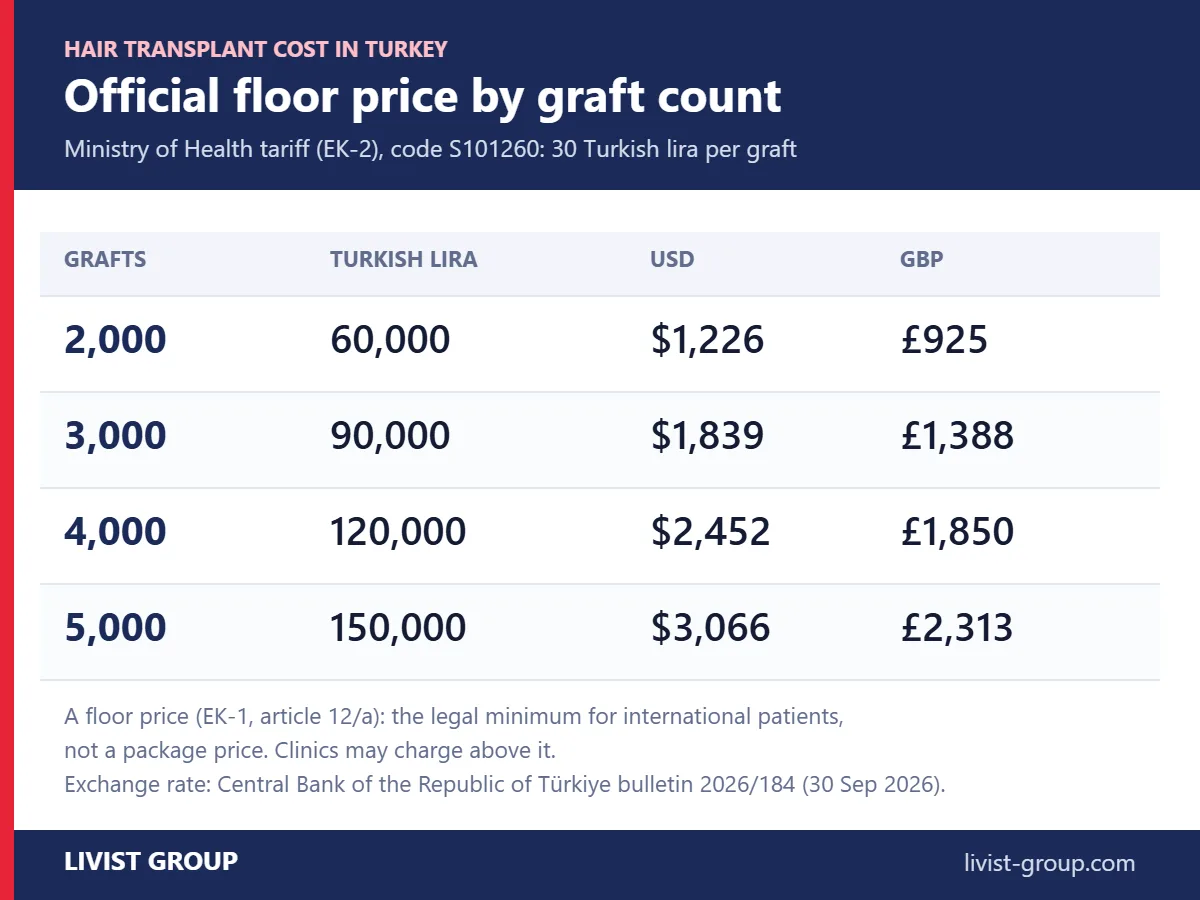
The official floor cost of hair transplantation in Turkey by graft count, from the Turkish Ministry of Health tariff.
The rules governing the tariff (EK-1, article 12(a), as amended 16 February 2026) make these prices the floor price (TABAN) for international patients, at public and private providers alike.
Hair transplant cost by graft count in USD and GBP
Converted at the Central Bank of the Republic of Türkiye buying rate, bulletin 2026/184 dated 30 September 2026.
| Grafts | Turkish lira | USD | GBP |
|---|---|---|---|
| 2,000 | 60,000 | 1,226 | 925 |
| 3,000 | 90,000 | 1,839 | 1,388 |
| 4,000 | 120,000 | 2,452 | 1,850 |
| 5,000 | 150,000 | 3,066 | 2,313 |
How to use the table: not as an expected price, but as a line to hold an offer against. Ask for the graft count first and the price second — without that number no offer can be measured against anything — then compare what you were quoted with the matching row above.
For the full breakdown of cost components see our guide to hair transplant costs in Turkey, and for what packages include, what a medical package in Turkey covers.
Where Livist Group sits: a coordination and services company, not a health facility and not an Iftaa body. We do not perform procedures and we do not issue rulings; work is carried out with contracted health institutions holding health tourism authorisation.
Hair transplant ruling in summary
The question is hair transplant haram has, in the published texts, a point of agreement and a point of difference:
- Agreement: moving a person's own follicles into an area where their hair fell out — permitted by Islamic Fiqh Academy Resolution 173 (2007), which names "hair transplant for women suffering from hair loss", by the Jordanian Iftaa Department, by the Fatwa Centre, and in the answers of Ibn Baz and Ibn Uthaymeen.
- The principle: restoring what was lost in its own place, not adding outside it for beauty. Its practical form: the natural hairline is the boundary.
- Difference: artificial hair that does not grow, and follicles from another person. The texts differ and are presented here without preference.
- Purity: if the transplant covers part of the skin it affects ghusl; otherwise it does not.
Closing note: this page reports; it does not issue fatwa. Livist Group is not an Iftaa body and does not provide medical services directly. For your own case — which may or may not be therapeutic, and may differ from the cases described — refer to your country's Iftaa department or a scholar you trust, and for the clinical side to a doctor who examines you.
Sources for the hair transplant ruling
Last reviewed: 26 October 2026 by Sara Murat.
- Iftaa' Department, the Hashemite Kingdom of Jordan, fatwa no. 3584: "Ruling on Men having Hair Transplant and Wearing Wig" — the texts of Resolutions 173 and 26, and the wudu and ghusl rulings. (Available in Arabic and English.)
- Fatwa Centre, fatwa no. 226981 — the evidences, al-Nawawi's commentary, and the text of Ibn Uthaymeen.
- Fatwa Centre, fatwa no. 3568 — "growing hair in its own place".
- Fatwa Centre, fatwa no. 108478 — the natural hairline boundary.
- Official website of Sheikh Ibn Baz, fatwa no. 6396.
- Islam Question & Answer, fatwa no. 150492 — the two positions on artificial hair, and the details of the Academy's 18th session.
- Islam Question & Answer, fatwa no. 131313 — follicles taken from another person.
- International Islamic Fiqh Academy — Resolution 173 (18th session, Malaysia, 9–14 July 2007) and Resolution 26 (1988), quoted verbatim via sources 1 and 6.
- Turkish Ministry of Health — Health Services Price Tariff (EK-2), in force from 23 February 2026: item S101260.
- Turkish Ministry of Health — Price Tariff Principles (EK-1), article 12(a): floor-price status.
- Health Tourism Department, Turkish Ministry of Health — announcements of 13 May 2026 (TÜSKA deadline) and 20 August 2026 (updated lists of authorised facilities).
- Central Bank of the Republic of Türkiye — exchange rate bulletin 2026/184 dated 30 September 2026.
- Islam Question & Answer, answer no. 182542 (2024) — beard transplant: treating loss versus thickening a naturally sparse beard.
- Islam Question & Answer, answer no. 208629 (2013, Arabic) — transplant for a disfiguring bald forehead.
- Islam Question & Answer, answer no. 253482 — hair-growth oils and medication.
- Islam Question & Answer, answer no. 610876 (19 February 2026, Arabic) — hair transplant during a Ramadan day.
- SeekersGuidance (Hanafi Fiqh), Shaykh Faraz A. Khan, "Is Hair Transplantation Allowed", 23 March 2012.
- Fatwa Centre, fatwa no. 25463.
- International Islamic Fiqh Academy — Resolution 93 (10/1), Jeddah 1997: what does not invalidate the fast.
- NHS, "Hair transplant" — side effects, risks and the results timeline.
- True RH, "Is Every Patient of Hair Loss a Candidate for Hair Transplant? Deciding Surgical Candidacy in Pattern Hair Loss", Indian J Plast Surg 2021;54(4):435-440, doi:10.1055/s-0041-1739247.
Plan your hair transplant in Turkey with Livist Group
Once the religious question is settled with a scholar you trust, the next step is clinical: we coordinate a consultation with a contracted health institution on the Turkish Ministry of Health's international health tourism list, and you receive a written plan with the graft count and the marked recipient area before any payment.
Hair transplant ruling: frequently asked questions
Answers to the most common questions about this topic

Hair Transplant Turkey 2026: Cost, Clinics, Risks & Recovery
Hair transplant Turkey: $2,000–5,000 per search results. What decides the result, how to check a clinic licence, and the honest recovery timeline.

BBL Turkey 2026: Cost, All-Inclusive Packages, Safety and Recovery
How much a BBL in Turkey costs in 2026, what all-inclusive packages cover, the official minimum price, BAAPS safety rules, recovery time and how to check a surgeon.
Knee Replacement Turkey 2026: Cost, Total vs Partial, Recovery
Knee replacement in Turkey costs in 2026 for one or both knees, partial and robotic surgery, what packages include, the official minimum fee, NHS recovery timeline and risks.