Medical Tourism in Turkey 2026: Costs, Safety & How to Choose a Clinic
You have read the price list and you have read the horror stories, and neither tells you what you actually need to know. This guide separates the country from the people selling you access to it — because that distinction is the whole decision.

Medical tourism in Turkey means travelling abroad for treatment at internationally accredited Turkish hospitals for 50–80% less than private care in Europe or the United States. Turkey has dozens of JCI-accredited hospitals and treats more than a million international patients a year. The country is not the risk — unlicensed intermediaries are.
| Indicator | Value |
|---|---|
| Saving vs Europe and the US | 50–80% |
| JCI-accredited hospitals | Dozens — one of the largest clusters worldwide |
| International patients per year | More than 1 million |
| Most common procedures | Hair transplant, dental / Hollywood smile, cosmetic, bariatric |
| Medical treatment visa | Usually up to 90 days, extendable to 180 |
Reviewed by the Livist medical team. Figures are 2026 market estimates and vary by case and clinic. This guide is information, not medical advice.
Is medical tourism in Turkey safe?
The two versions of Turkey you have been reading about
Search this topic in English and you get pushed into one of two camps immediately.
The first is the sales page: a clinic or an agency with a glossy package price, a before-and-after gallery, and a WhatsApp number. The second is the warning: a surgeon in London or Baltimore explaining why you should stay home, a news story about a procedure that went wrong, a comment thread about Turkey teeth.
Both are arguing about the wrong thing. They are arguing about a country. The country is not the variable — Turkey contains world-class accredited hospitals and it also contains people who will sell you a surgery they are not qualified to perform. Both statements are true at the same time, and which one you experience is decided by a choice you make months before you board a plane: who you book through.
That is the honest frame here. We are not going to tell you Turkey is safe, nor that it is dangerous. We are going to tell you which parts of the decision carry the risk, so you can put your attention there instead of on the price.
What you actually save
The savings are real and they are the reason you are here: 50–80% less than equivalent private treatment in the UK, the US, or Western Europe. For a self-payer, that is not a discount, it is the difference between having the procedure and not having it.
Two things drive the gap, and neither is a shortcut. Turkish costs — salaries, facilities, currency — are structurally lower than Western ones. And the volume is enormous: a surgeon performing a procedure hundreds of times a year operates at a scale most Western private practices never reach, and that repetition is itself a quality input. Turkey did not become the destination by cutting corners. It became the destination by doing more of the same operation than anyone else, cheaper.
What the saving does not buy you is a shorter recovery, a guaranteed result, or someone to fix it at home if it goes wrong. Price the trip against private care abroad, not against a free public system — and price aftercare into it, which we will come back to.
What people fly to Turkey for
Hair transplants
The best-known procedure by a distance, using FUE and DHI techniques. Full breakdown in our guide to hair transplant costs in Turkey 2026.
Dental work and the Hollywood smile
Implants, crowns, and full smile makeovers at a fraction of Western dental pricing. This is also the category with the loudest cautionary tales in the English-speaking press, which makes clinic selection matter more here, not less.
Cosmetic surgery
Rhinoplasty, liposuction, and body contouring.
Bariatric surgery
Sleeve gastrectomy and bypass procedures, usually sold as a package including the hospital stay.
Full check-ups
One or two-day comprehensive screening programmes — worth knowing about if you want a baseline before or after treatment.
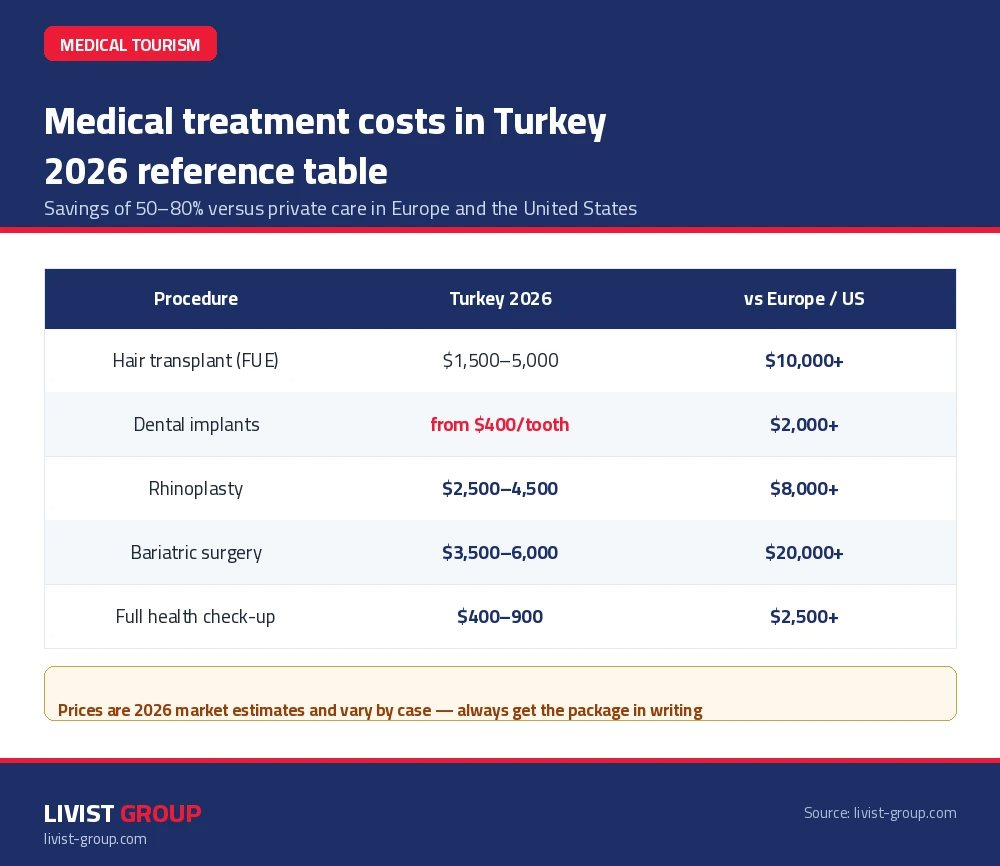
Medical treatment costs in Turkey 2026
Estimates for reputable clinics, usually including a basic package. Your quote will move with your case, the number of sessions, and the technique used.
| Procedure | Estimated 2026 price range | Notes |
|---|---|---|
| Hair transplant (FUE/DHI) | $1,500–4,000 | By graft count and technique |
| Hollywood smile | $1,500–4,000 | By number of teeth and material |
| Dental implant (per tooth) | $300–700 | Plus crown and components |
| Rhinoplasty | $2,500–4,500 | Surgical / non-surgical |
| Bariatric surgery (sleeve) | $3,000–5,000 | Package including stay |
| Full check-up | $300–900 | By programme |
Read these as ranges, not price tags. A quote that sits far below the bottom of a range is not a bargain you found — it is a signal that something in the package has been removed, and you will find out which part later.
JCI accreditation, and what to ask about it
JCI (Joint Commission International) is the global gold standard for hospital quality and patient safety, and Turkey holds dozens of JCI accreditations — one of the largest concentrations anywhere.
The catch is that accreditation belongs to a facility, not to whoever emailed you. An agency can truthfully say "we work with JCI-accredited hospitals" while booking your operation with a surgeon who merely rents theatre time there. So push past the badge. Is the facility accredited? Who is the responsible surgeon, and what is their speciality? How many cases like yours do they do? If the answer to any of those is a brochure rather than a name, you have learned what you needed to learn.
How to read a clinic in five minutes
This is the section that decides your outcome. A trustworthy provider does all of the following:
- Names the responsible surgeon before you pay a deposit, in writing.
- Documents the package in writing — everything included, and everything excluded.
- Works with accredited facilities (JCI or Ministry of Health registered), not with rooms you cannot verify.
- Does not compete on being the cheapest. A very low price is a red flag, not a win: it usually means technicians instead of a surgeon, hidden fees, or no follow-up.
- Provides follow-up after you fly home, with a named point of responsibility if something goes wrong.
If a provider will not name your surgeon or put the package in writing, you have your answer. Walk away — the cheapest surgery you will ever buy is the one you did not.
Notice that not one of these tests is about Turkey. Every one is about the intermediary. This is the whole argument of the guide in list form: you are not choosing a country, you are choosing who is accountable to you.
What must be in the package — in writing
A complete medical package covers the procedure itself, the consultation and pre-operative tests, medication and aftercare kit, hotel accommodation, airport and clinic transfers, and an interpreter with you throughout. Ask for the inclusions and the exclusions in a document, not a chat message.
Then read the exclusions first. Inclusions are marketing; exclusions are the contract. A package that lists ten things it includes and stays silent on what happens if you need a second night in hospital has told you something important about itself.
The medical visa and the shape of the trip
Many nationalities enter Turkey on a tourist or e-visa. Turkey also issues a treatment visa, typically valid for up to 90 days and extendable to 180 depending on your case — which matters if your procedure needs a recovery window rather than a long weekend. A typical journey runs:
- Initial consultation — send reports and photos, receive a treatment plan and a cost estimate.
- Confirm the package in writing (procedure + accommodation + transfers + interpreter).
- Arrange the visa, flights, and appointment date.
- Arrive, treat, and recover locally before flying.
- Remote follow-up once you are home.
Step five is the one people skip when they book on price, and it is the one that matters most from a thousand miles away.
Build recovery into the trip
Plan a gentle convalescence rather than a sightseeing marathon: our Turkey travel guide is useful for pacing the non-medical days. Check travel insurance for Turkey carefully — elective procedures are typically excluded, so arrange complications cover deliberately rather than assuming it. And if you are considering a longer stay, our Turkish residence permit guide covers that route.
Why Livist Medical
Livist coordinates your treatment, stay, and care under one roof. We work only with licensed surgeons and accredited facilities, on a written, transparent plan — with more than 8 years of experience and 60,000 clients across our six divisions.
Frequently asked questions
Answers to the most common questions about this topic
Hair Transplant Turkey: What Decides Your Result — and How to Check a Clinic’s Licence
A neutral 2026 guide with official sources: how the procedure works, who actually performs it, and how to verify your clinic and agency on Turkey’s public Ministry of Health licence lists before you pay.
Gynecomastia Surgery Turkey 2026: Cost, Types, Recovery
Gynecomastia surgery Turkey cost runs $2,000 to $4,100, the official floor is 21,960 lira for both sides, plus causes, non-surgical options and recovery.

Breast Augmentation Turkey 2026: Cost, Recovery and Risks
Breast augmentation Turkey cost runs $2,800 to $5,500, the official floor is 50,000 lira before implants, plus recovery, garment time and implant lifespan.