
Real Estate Investment in Turkey for Foreigners 2026: Numbers, Steps & Risks
A neutral 2026 guide to buying property in Turkey as a foreigner: ownership rules, the $400,000 citizenship threshold, tapu tax, real yields in hard currency, and how to avoid fraud.

Foreigners can own property in Turkey freely outside military and security zones, with gross rental yields typically between 4% and 8%. Citizenship through real estate requires $400,000, a three-year no-sale lock registered in the tapu, an SPK-licensed valuation, and a documented bank transfer. Measure every return in hard currency.
| Indicator | Value |
|---|---|
| Citizenship threshold (real estate) | $400,000 + 3-year no-sale lock |
| Property-based residence permit | From ~$200,000 (rule in force since 16 Oct 2023) |
| Tapu (title deed) tax | ~4% of registered value (2026 estimate) |
| Typical gross rental yield | ~4%–8%, by district and property type |
| Ownership limits for foreigners | No military/security zones · 30 hectares max · 10% cap per district |
Reviewed by the Livist Real Estate team. Official thresholds and ownership limits follow the Turkish government investment portal (invest.gov.tr); tax and cost figures are 2026 estimates and change — verify before you sign. This is information, not investment advice.
Is Turkish property actually a good investment in 2026?
The mistake international buyers make first
Most English-language guides to Turkish property are written by firms that sell Turkish property, or by citizenship-by-investment brokers who earn a commission on the passport. That shapes what they tell you. The yield gets quoted gross. The lira gets a footnote. The citizenship threshold gets described as an opportunity rather than a lock-up.
Here is the reframe that matters. There are two entirely separate questions in front of you, and merging them is expensive:
- Is this a good asset? Answered in dollars, euros, or pounds — whatever currency your wealth actually lives in.
- Do I want the passport? Answered by your mobility needs, your family, and your tolerance for holding an asset you cannot sell for three years.
A property can be an excellent route to citizenship and a mediocre investment at the same time, or the reverse. Buyers who conflate the two pay a citizenship premium on an asset they only wanted for yield — or accept a weak yield on an asset they only wanted for the passport, without ever pricing that trade.
Can foreigners buy property in Turkey? The rules that actually bind
Yes — nationals of most countries can own property in Turkey in their own name. The constraints are narrower than the internet suggests, but they are real:
- No ownership inside military or security zones. This is checked during the transfer, and it kills deals late if nobody looked early.
- A maximum of 30 hectares per individual across the country.
- Foreign ownership cannot exceed 10% of the total area of any given district. In neighbourhoods popular with international buyers, this cap is the binding constraint — not your budget.
- Some nationalities are restricted or barred entirely. Check your own passport before you spend time on a shortlist.
The 10% district cap deserves a moment. It means the availability of a property to you is not a function of price or willingness to pay — a district that has hit its ceiling is closed to foreign buyers regardless. Confirm eligibility for the specific parcel, not the city, before any deposit changes hands.
Turkish citizenship by property 2026: $400,000 and the three-year lock
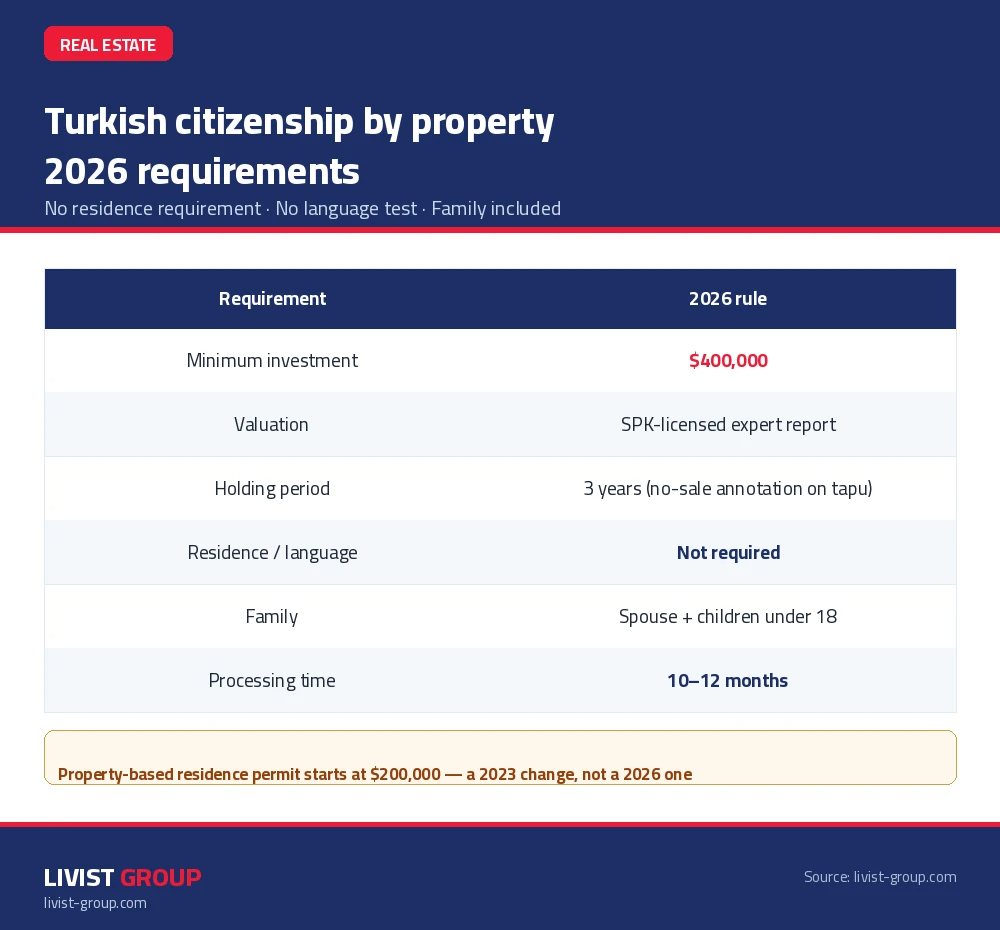
Read those conditions as a package, because each one has teeth. The valuation report is the one that surprises people: the qualifying figure is the value the SPK-licensed expert certifies, not the price on your contract. If a seller has priced the unit at $400,000 and it appraises below that, you do not have a citizenship file — you have a property. Get the valuation before the commitment, not after.
The three-year no-sale undertaking is registered against the title itself. It is not a gentleman's agreement; it is an encumbrance on your tapu. For three years, your capital is illiquid by law. If your investment thesis depends on being able to exit in year two, the citizenship route is not compatible with it, and no amount of structuring changes that.
The documented-bank-transfer rule is the quiet one. Cash does not merely complicate the file — it fails to establish the qualifying investment at all. Every dollar must be traceable through the banking system.
The full path, the paperwork, and the mistakes that stall files are covered in our guide to Turkish citizenship through real estate in 2026.
The residence route is not the citizenship route
A smaller purchase — from around $200,000 under the framework in force since 16 October 2023 — may qualify you for a property-based residence permit. This is not a 2026 development, whatever a recently updated page tells you; it has been the rule for years, and pages still quoting far lower thresholds are simply out of date.
More importantly: a residence permit does not lead to citizenship automatically. These are two separate tracks with separate thresholds and separate logic. Buying at $200,000 and assuming a passport follows is one of the most common and most expensive misreadings of the Turkish system. If citizenship is your objective, the number is $400,000 — there is no partial credit.
If residence is the actual goal, our Turkish residence permit guide sets out the process and the current conditions.
What it costs beyond the sticker price
Budget for the transaction, not just the asset. Estimates for 2026:
| Item | Estimated 2026 cost | Note |
|---|---|---|
| Tapu (title deed) tax | ~4% of registered value | Paid at transfer of ownership |
| Valuation report (Ekspertiz) | ~$150–300 | Mandatory |
| DASK earthquake insurance | From ~$20/year | Mandatory |
| Administrative fee (Döner Sermaye) | ~$130 | For foreign buyers |
| Annual property tax | Small percentage of value | Varies by municipality |
The 4% tapu tax is the line that moves your maths. It is levied on the registered value, and on a $400,000 citizenship purchase it is roughly $16,000 — a full year of gross rental yield on many units, paid on day one. Any model that ignores acquisition costs overstates your return by a wide margin.
How to buy: the sequence
- Select the property and verify ownership and that it is free of mortgages or liens.
- Obtain a tax number and open a Turkish bank account.
- Commission the mandatory valuation report (Ekspertiz).
- Sign the contract and document payment by bank transfer.
- Transfer the tapu (title deed) at the Land Registry Directorate.
- Arrange DASK earthquake insurance and connect utilities.
Steps two and three are the ones buyers try to compress under seller pressure. Resist. The valuation especially: it is cheap, it is mandatory anyway, and it is the only independent read on price you will get in the whole process.
Red tapu, blue tapu, and verifying ownership
The red tapu generally covers built property and residential land; the blue tapu covers agricultural land. Always confirm the tapu type matches the property you believe you are buying, and confirm the identity of the registered owner, before any payment. A blue tapu on land you were told was a development plot is a very different asset from the one in the brochure.
Yield, and the ready-versus-off-plan trade
Gross rental yields typically land between 4% and 8%, varying by district and property type, and net returns can improve with capital growth. Preferences differ by objective — fast citizenship, rental income, or appreciation — and we cover districts in detail in our Istanbul investment-areas cluster, alongside alternatives such as Antalya and Bursa.
Completed property produces income immediately and carries lower risk. Off-plan can offer a lower entry price and capital gain in exchange for genuine delivery risk. For an international buyer, one factor outweighs that choice: measure the return in hard currency and account for lira volatility. A yield that looks strong in lira can be flat or negative once converted, and a multi-year off-plan build exposes you to currency movement for the entire construction period without any rental income to offset it.
How to avoid property fraud
- Never rely on a single seller-supplied source — commission an independent valuation.
- Verify the tapu and the owner's identity through official channels.
- Document every payment by bank transfer. Avoid cash.
- Be sceptical of below-market pricing and of guaranteed or inflated yield promises.
The golden rule: verify ownership and value officially before any deposit — and never pay in cash.
Why Livist
We give neutral advice that starts from your objective, not from a unit we are trying to move: independent valuation, legal oversight of the tapu process, and your property decision connected to residence and the rest of your file under one group.
Frequently asked questions
Answers to the most common questions about this topic

Where to Live in Istanbul 2026: Neighbourhoods for Expats
Where to live in Istanbul comes down to two questions: which neighbourhood suits you, and which one will register your residence address at all.

Property Tax in Turkey 2026: Rates, Dates and Exemptions
Property tax in Turkey from Law 1319: the annual rates, the metropolitan doubling, the two instalments and compulsory earthquake cover.
Turkish Citizenship by Investment 2026: All Seven Routes, and Who Attests Each Amount
The full official list from the Investment Office — thresholds, three-year lock-ins and the ministry or regulator that must certify each one — plus how to check a title deed yourself before anyone’s paperwork.